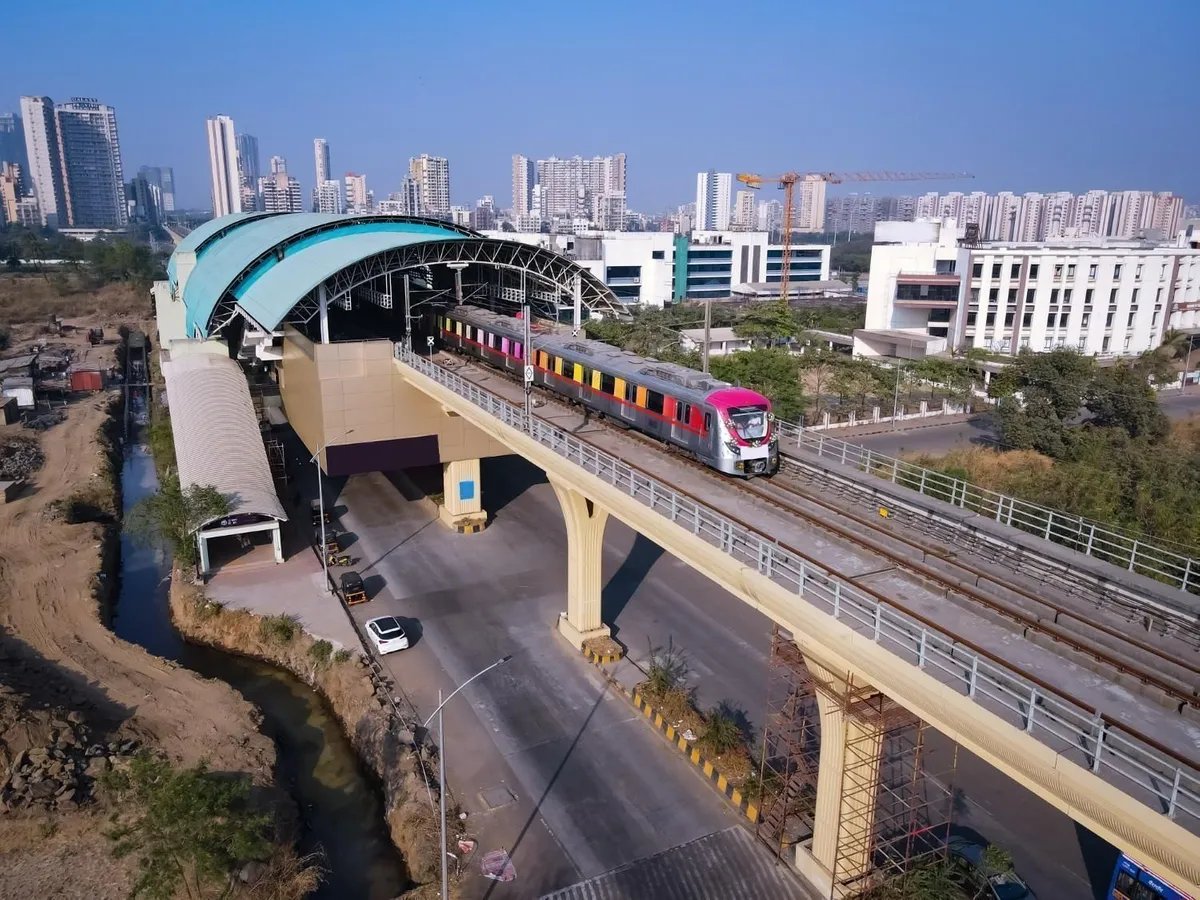
Mumbai’s expanding metro infrastructure has achieved another construction breakthrough with the successful placement of a key structural span over one of the busiest suburban rail corridors in the western suburbs. The development marks an important step forward for Mumbai Metro Line 6, a corridor expected to strengthen east–west connectivity across the city. The latest engineering milestone involved installing a steel span across active railway tracks between Jogeshwari and Ram Mandir, a stretch characterised by high-frequency train operations and limited working space. Executing such work required precise coordination with railway authorities, as construction activity had to be confined to short overnight windows to avoid disruption to daily commuter services.
Before the span could be launched, engineers constructed a supporting pier within a narrow zone between parallel railway lines—an operation considered technically challenging due to continuous train movement and stringent safety requirements. Infrastructure specialists note that such interventions demand advanced planning, including vibration control, structural stability, and strict adherence to railway safety norms. The progress on Mumbai Metro Line 6 reflects the broader complexities of building urban transit systems in densely populated environments. Unlike greenfield projects, metro construction in established cities often involves navigating existing infrastructure networks, including railways, utilities, and road systems, without interrupting essential services. Urban mobility experts highlight that corridors such as Mumbai Metro Line 6 are critical for balancing transport demand across the metropolitan region.
By connecting key residential and commercial zones, the line is expected to reduce dependence on overcrowded suburban rail and road networks. Improved east–west links are particularly significant in Mumbai, where most existing transport infrastructure is oriented along a north–south axis. From an environmental perspective, expanding metro capacity is seen as a step towards reducing vehicular emissions and improving air quality. Public transport systems that offer reliable and efficient alternatives can help shift commuter behaviour away from private vehicles, contributing to long-term sustainability goals. However, experts caution that infrastructure expansion must be accompanied by integrated planning. Seamless interchange facilities, last-mile connectivity, and pedestrian-friendly access will be essential to maximise the benefits of Mumbai Metro Line 6. Without these elements, the full potential of the corridor in reducing congestion and travel time may not be realised. The successful execution of this complex span installation also reflects evolving construction practices in urban India, where prefabrication, heavy-lift engineering, and coordinated project management are becoming increasingly common. These methods can help accelerate timelines while maintaining safety standards in constrained environments.
As Mumbai Metro Line 6 progresses through its construction phases, the focus will remain on maintaining momentum while managing the challenges of working within an active urban landscape. The project’s completion is expected to play a significant role in shaping the city’s future mobility framework, offering a more balanced and efficient transport network.