


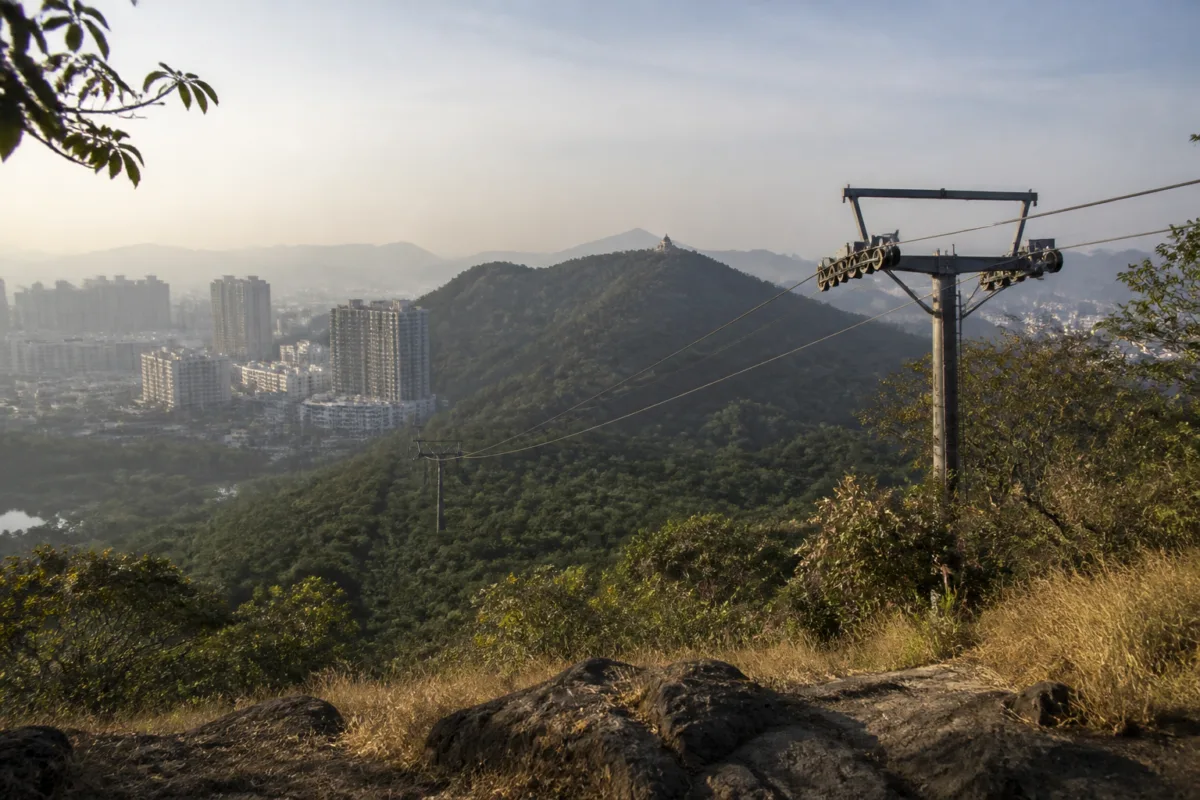
Mumbai’s proposed first ropeway has moved into the consultancy stage, with the Public Works Department inviting bids to prepare an architectural design for a route connecting Mulund’s foothills to Taramati Mata Temple inside Sanjay Gandhi National Park (SGNP). The project will proceed only after its alignment, design, environmental implications and statutory approvals are assessed.
The tender scope includes identifying possible alignments and station locations, assessing land requirements, benchmarking international ropeway systems and carrying out engineering investigations. These will include topographical, geotechnical, geodetic, hydrographic and reconnaissance surveys, according to officials cited in the report.
The proposed ropeway is intended to connect Mulund to the temple located within the boundaries of SGNP. Mulund BJP MLA Mihir Kotecha, who had earlier demanded the project, said the tender was not for a commercial ropeway between Mulund and Borivli. He said it was exclusively for a route within Mulund, linking the foothills to Taramati Mata Temple.
Kotecha said the proposal had been part of his campaign commitments during the 2024 elections and was aimed at promoting tourism. He also proposed an observatory from which visitors could access the temple and view SGNP and Tulsi Lake. According to him, the ropeway could contribute to tourism in Mulund and across Mumbai.
The project faces a significant regulatory hurdle because the proposed destination is inside a notified national park. Officials said construction inside a national park is legally prohibited unless it is explicitly intended for wildlife management and improvement and receives the highest levels of statutory clearance. National parks have the highest tier of environmental protection, with strict restrictions on human intervention.
Kotecha said the project would proceed only after the detailed design was completed and all required clearances were obtained from the Centre’s forest and environment departments. The consultant appointed through the tender will be expected to assess the project’s social, environmental, forest and wildlife impacts as part of the design process.
Green activist Zoru Bathena questioned the need for a ropeway from Mulund into SGNP, while acknowledging that ropeways can be less invasive than roads or walkways in forest areas. He said the project would require clearances from the forest and environment departments and should not proceed without them.
The consultancy is also expected to produce a detailed ropeway alignment and system design, identify the origin and destination stations, estimate the project cost and examine the engineering and environmental conditions along the route. The tender therefore represents an initial planning step rather than approval for construction or confirmation of a final alignment.
The next major milestones will be the appointment of the consultant, completion of the surveys and design studies, and consideration of the required forest and environment clearances before any construction decision is taken.

