


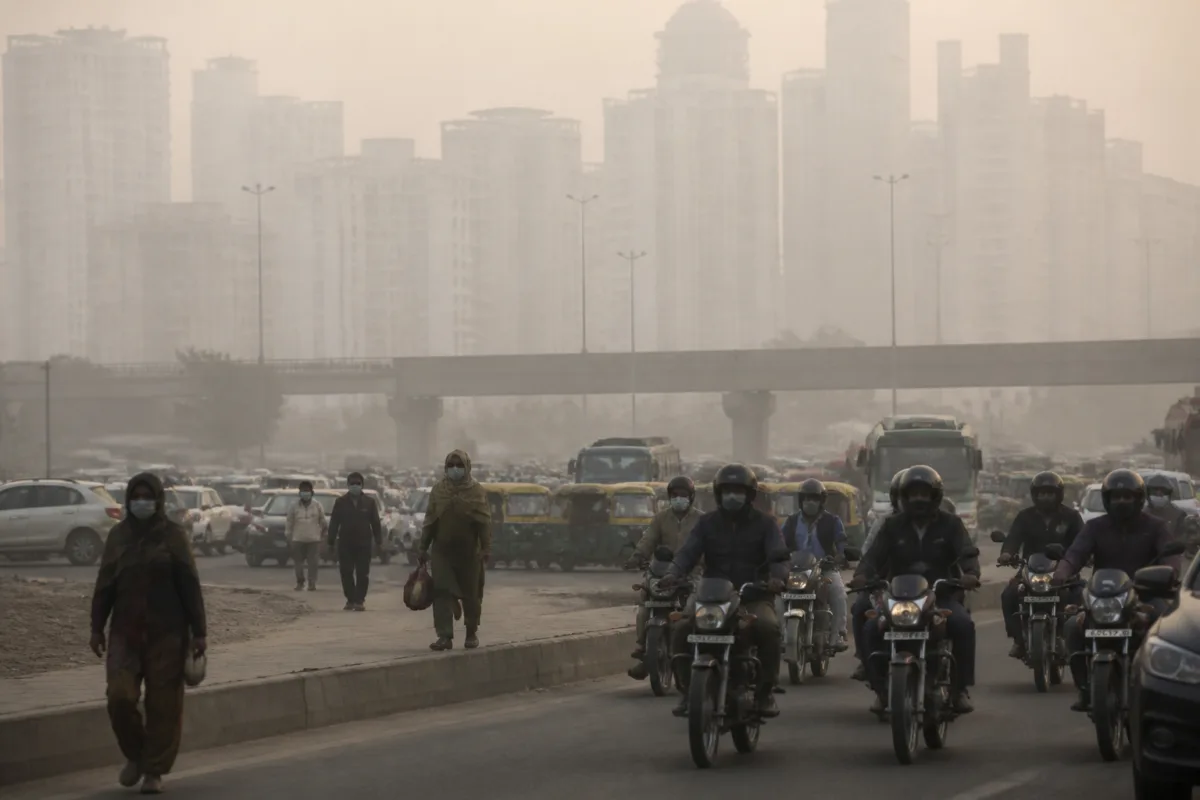
Delhi’s air quality deteriorated further on Thursday, with the AQI crossing 300 in the national capital as the India Meteorological Department ruled out immediate rainfall that could provide temporary relief from pollution. The worsening conditions have affected residents across several areas, with children, older people and those with existing health conditions facing heightened exposure to polluted air.
According to a report by Jagran, Delhi’s air quality has continued to decline since Diwali. The report said the AQI had crossed 300, while the reading had exceeded 400 on Wednesday. Areas reporting high readings included Burari at 355 and Jhilmil at 373. Sonia Vihar recorded 293, Mandir Marg 225 and Knowledge Park 197, indicating that pollution levels remained uneven but elevated across the wider Delhi-National Capital Region.
The deterioration has been linked in the report to the lingering impact of firecracker emissions after Diwali, along with weather conditions that are not currently expected to disperse pollutants. The absence of rain is significant because rainfall can help remove suspended pollutants from the air, although the report did not provide a forecast for when conditions might improve.
The reported air quality is creating difficulties for residents who already have respiratory or other health problems. Children and older people have been identified as particularly vulnerable, with health experts advising additional precautions while pollution levels remain high. The conditions are also discouraging some residents from spending time outdoors.
Against this backdrop, the Delhi government and researchers from the Indian Institute of Technology, Kanpur, are considering whether cloud seeding could produce artificial rainfall. The proposal is being examined as a possible short-term intervention, but the meteorological conditions may not support an effective operation.
Dr Mahapatra, cited in the report, said clouds would be present and the sky would remain partly cloudy, but the expected cloud layers would mainly be at middle and higher altitudes. He said these would not be convective clouds, which are generally required for a successful cloud-seeding operation. In his assessment, the resulting rainfall could therefore be limited.
Cloud seeding depends on the structure of clouds, the moisture they contain and the broader atmospheric conditions. The comments indicate that the presence of clouds alone may not be enough to generate meaningful rainfall over Delhi. Any operation would consequently depend on whether suitable clouds develop and whether the atmospheric conditions allow the intervention to produce the intended result.
For now, the immediate forecast offers no rain-based relief. Delhi’s next improvement in air quality will therefore depend on changes in weather and pollution conditions, while authorities and researchers continue to assess whether cloud seeding is technically feasible.

