


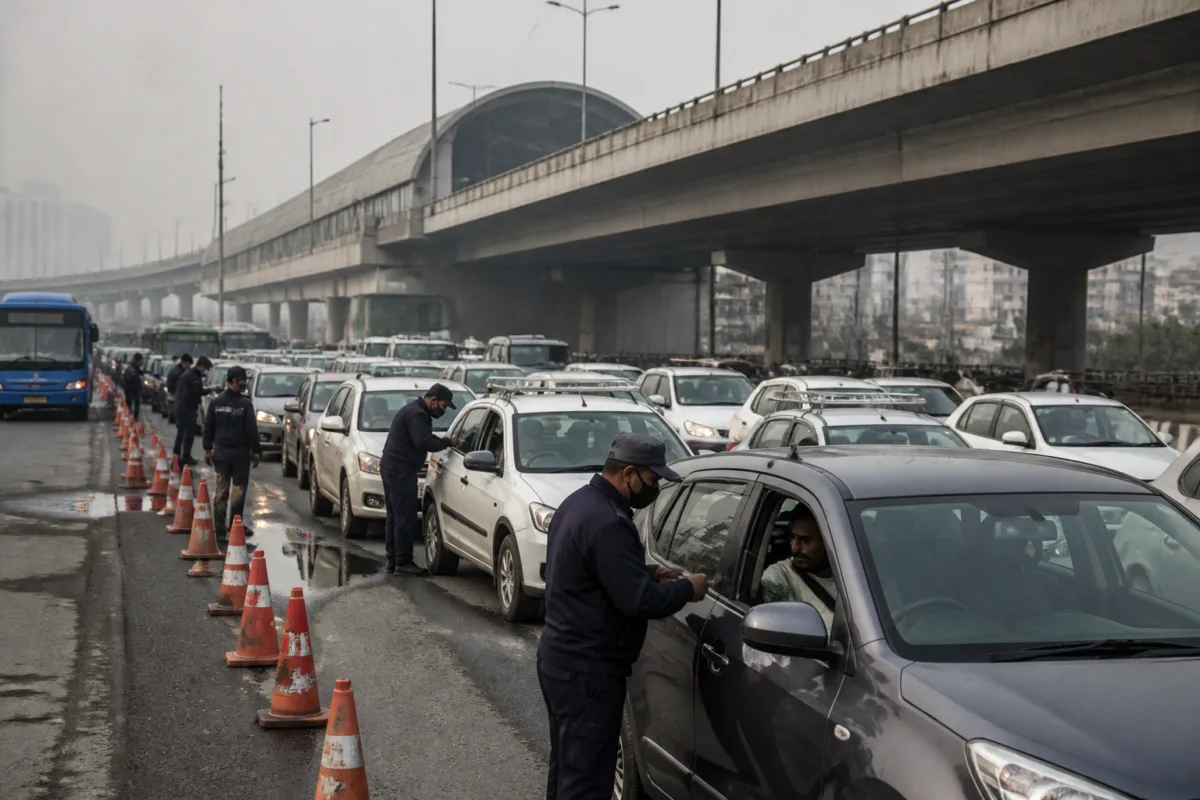
Delhi’s air-pollution restrictions are imposing a second, less visible cost on commuters: the price of reaching work. Accounts from residents travelling between Noida, Ghaziabad and Delhi show how restrictions on vehicles that do not meet BS-VI emission norms are pushing households towards app-based cabs, longer metro journeys, temporary accommodation near workplaces and, in some cases, working from home. The result is not simply a change in transport mode, but a redistribution of the cost of pollution control from vehicle owners and regulators to commuters, families and small transport operators.
The experience of Brajesh Sharma illustrates the scale of that shift. Sharma travels from Sector 78 in Noida to Asiad Village in Delhi and had carpooled with two colleagues for years. Their daily petrol expense was around Rs 550 per person. Because their vehicle does not meet BS-VI emission norms, the group has had to turn to app-based services, increasing the combined daily commuting cost to about Rs 1,200. Over 24 working days, the monthly expense has risen from Rs 13,200 to Rs 28,800, an additional Rs 15,600.
That calculation makes the urban consequence of the restrictions unusually clear. A pollution-control measure that is designed around vehicle eligibility is being experienced by households as a recurring mobility charge. Sharma said the increase was a substantial burden for middle-class salaried employees and suggested regulated carpooling arrangements or exemptions for verified office commuters. His account also points to the problem of treating private vehicles as isolated sources of emissions when, for many cross-border commuters, they are part of an informal shared transport system created because public transport does not complete the journey.
The metro is available across parts of the region, but the reported experiences show that network access and practical accessibility are not the same thing. Poor last-mile connectivity, work schedules and the physical demands of commuting limit its usefulness for some passengers. Asfaq Khan, who oversees train operations at New Delhi Railway Station, travels 32km one way from Sector 78 in Noida. His earlier car journey cost around Rs 350, but the BS-IV vehicle he uses is affected by the restrictions. Private cabs now cost about Rs 700 one way, while availability and peak-hour congestion make the journey more difficult.
Khan sometimes uses the metro, depending on his schedule and physical energy, but does not consider it consistently practical for his responsibilities. His account is important because it complicates the assumption that workers can shift to public transport whenever restrictions are imposed. Employees responsible for keeping railway operations running still need a reliable and time-compatible way to reach their workplace. Khan argued that pollution control should be accompanied by dependable public transport and practical arrangements for essential-service personnel, while traffic teams should focus on managing congestion and facilitating movement rather than only issuing challans.
The costs extend beyond daily fares. One Ghaziabad resident working in Vasant Kunj has rented a one-bedroom flat near the workplace to avoid a 76km daily round trip. Checks and congestion had made the journey increasingly difficult. The temporary arrangement costs around Rs 30,000 extra each month and keeps the commuter away from the family for most working days. Housing, in this case, has become a response to a transport restriction. The commuter is effectively paying twice: once for accommodation near the job and again through the social cost of spending weekdays away from home.
Another commuter has chosen to work from home to avoid the restrictions. Returning to the office would require around Rs 530 a day for a cab, compared with an estimated monthly fuel bill of Rs 4,500 when using a personal vehicle. The commuter has never used the metro for the journey and considers driving more convenient. The reported problem is not only the fare difference. Some drivers have refused to travel to Delhi, and repeated bookings have consumed time, making the return to office less predictable.
For Jitendra Kumar, a Noida-Delhi commute that earlier took about one hour and 15 minutes now takes between two and two-and-a-half hours. His expenses have nearly doubled. He attributed the delays to queues at the DND toll plaza, where vehicles registered outside Delhi are being checked. According to his account, vehicles often wait with their engines running during the checks, creating a direct tension between the enforcement process and the pollution objective behind the restrictions.
This is a central administrative question raised by the commuting experiences: how should restrictions be enforced at the edges of a metropolitan region whose labour market, housing market and transport network cross state boundaries? A Noida resident working in Delhi may be governed by restrictions in one jurisdiction while beginning the journey in another. Vehicles registered outside Delhi can become the focus of checks even though the commuters using them may have no practical alternative for completing the trip. The reported queues at DND show how enforcement can become a source of delay and additional emissions if traffic flow is not managed alongside vehicle screening.
The metro-road combination offers a partial solution, but it can also raise the cost and duration of the journey. Alok, whose work involves meetings with government officials across Delhi, previously spent Rs 11,000-12,000 a month on petrol. He now spends Rs 800-1,000 a day on commuting. He takes the metro to central Delhi and uses cabs for local travel, or sometimes takes a cab for the full journey when his schedule requires it. The metro journey takes about an hour, excluding the additional travel needed for meetings. The substitution therefore involves more than moving from road to rail; it adds transfers, local trips and scheduling constraints.
The pressure is also visible among transport businesses. Bus contractor Anil Dixit has six buses operating on Delhi routes sitting idle. Each bus generates around Rs 14,000 a day, placing potential daily receipts of Rs 84,000 at stake. The vehicles represent capital that remains tied up while the buses cannot operate. Dixit said recurring restrictions make it difficult to recover losses during periods when buses are off the road and that prolonged downtime is affecting the viability of the business.
That account shows why the impact of GRAP restrictions cannot be measured only through the number of vehicles removed from roads or the immediate compliance rate. A vehicle restriction affects a chain of linked actors: commuters who need to travel, employers who depend on punctual attendance, app-based transport providers, bus contractors and households that may need to rearrange where they live during the working week. The reported costs are uneven. A salaried commuter may absorb a higher cab bill, while a small bus operator faces idle assets and lost daily revenue.
The restrictions are also influencing vehicle-replacement decisions. Vineet, 56, who has recently dealt with heart problems, said even simple outings had become difficult because he could not use his car while pollution levels were high. He is considering the practical consequences of needing personal transport despite the vehicle being in working condition. The pollution-control objective may therefore create pressure to buy a newer car before the older vehicle has reached the end of its useful life. That raises a separate urban question about how environmental rules can reduce emissions without encouraging premature replacement or making mobility unaffordable for people with health and access needs.
The evidence in the reported experiences does not establish whether the restrictions have achieved a measurable improvement in air quality, nor does it quantify the total number of commuters or vehicles affected. It does, however, establish the range of adjustments being made at household and business level: carpooling has been replaced by app-based travel, private vehicles by expensive cabs, office attendance by remote work, long commutes by rented accommodation and bus operations by parked vehicles. The figures supplied by commuters also demonstrate that these are not marginal inconveniences. They involve additional monthly expenses of Rs 15,600, Rs 30,000 and nearly double daily commuting costs, alongside journeys that have become up to an hour and 15 minutes longer.
The larger issue is the sequencing of urban policy. Restricting older or non-compliant vehicles is an enforcement decision, but making the restriction workable is a transport-planning responsibility. The reported dependence on cabs and the difficulties with last-mile connectivity suggest that the effectiveness of a vehicle rule depends partly on whether public transport can absorb displaced trips. The experiences from Noida, Ghaziabad and Delhi also show that a metropolitan commuting system cannot be planned city by city when jobs, homes, railway stations and government offices are distributed across the National Capital Region.
The source accounts leave several implementation questions open: how long the restrictions will continue, how essential-service workers are to be accommodated, whether regulated carpooling will be introduced, and how checks at entry points can be conducted without creating engine-running queues. They also show what deserves monitoring beyond pollution readings: household travel expenditure, access to work, small-operator losses, public-transport capacity and the unintended housing burden created when workers move closer to their offices. Until those costs are measured alongside emissions, the public experience of GRAP will remain defined not only by cleaner-air enforcement but by the price and difficulty of moving through the city.

