


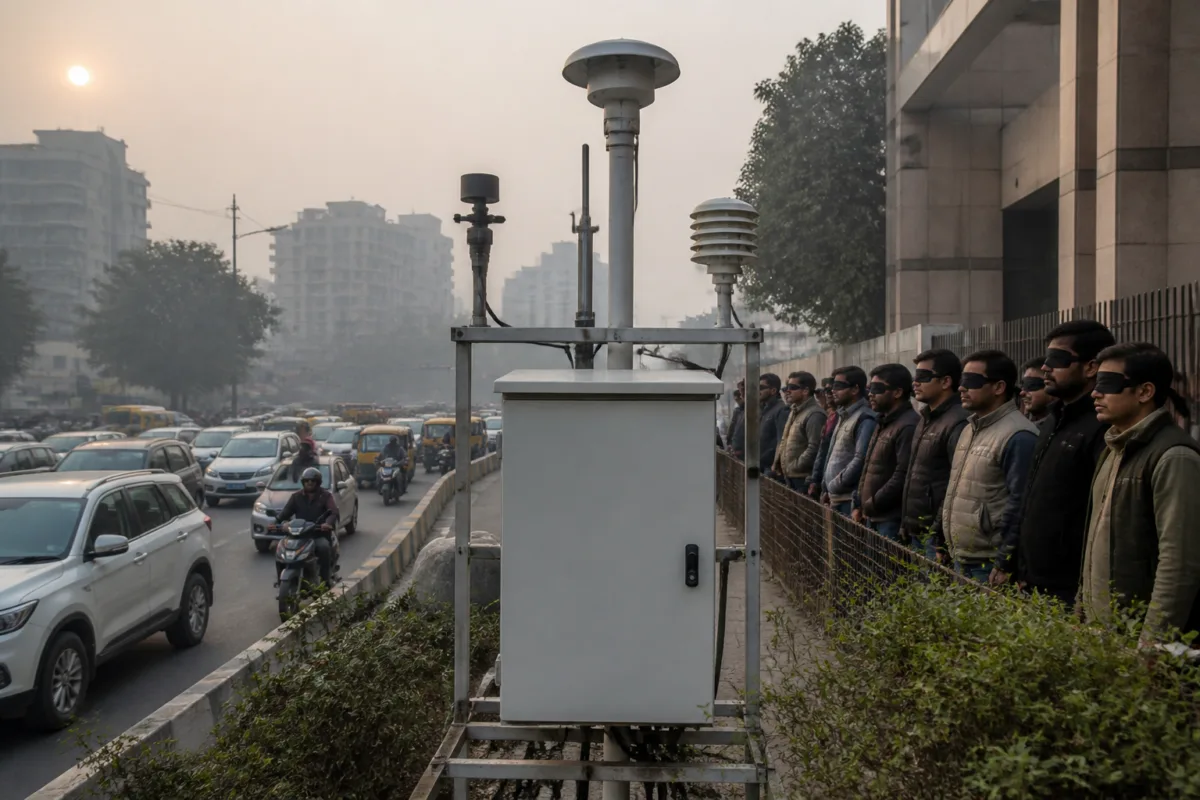
Aam Aadmi Party Delhi president Saurabh Bhardwaj and party workers reached the Commission for Air Quality Management office on November 11 wearing black blindfolds, accusing the commission of failing to act on complaints about alleged manipulation of Delhi’s air-quality data.
According to a report by Live Hindustan – NCR, the AAP leaders said they had approached the Commission for Air Quality Management, or CAQM, after allegedly receiving no response to written complaints submitted about air-quality monitoring stations. The demonstration focused on what the party described as a lack of transparency in the recording and reporting of Delhi’s Air Quality Index.
Bhardwaj alleged that the Delhi government had stopped collecting AQI data from monitoring stations on Diwali night, preventing the public from assessing the pollution caused by firecrackers. He also alleged that water was being sprayed over monitoring stations in pollution hotspots, including Jahangirpuri, affecting the readings. The report said Bhardwaj claimed that the party had submitted a video related to the allegation.
The allegations were not independently verified in the supplied report. The report also did not include a response from the Delhi government or CAQM addressing the claims.
Bhardwaj said the issue had previously been taken up with the Supreme Court, which, according to his statement, had directed CAQM to file a status report. He described CAQM as the authority responsible for clean air and questioned why the commission had not acted on the complaints submitted by the party.
The AAP leader further alleged that new AQI monitoring stations were being installed in green areas in a way that lowered the calculated pollution level. He called this an attempt to mislead residents and said a written complaint had been sent to the CAQM chairperson around 10 days earlier. According to Bhardwaj, the party had not received a response and was also not given an appointment after sending a second letter requesting a meeting.
The protest also raised questions about access to the commission. Bhardwaj said the office gate was closed when the delegation arrived, that the leaders were not allowed to meet officials and that police were sent to detain them. The report did not provide details of any detention or record an official police response.
Air-quality monitoring stations are central to how residents, regulators and courts assess pollution levels and decide whether restrictions or emergency measures are necessary. Any interruption in data collection or dispute over station placement can therefore affect public understanding of pollution conditions and the credibility of decisions based on the readings.
The immediate issue remains whether CAQM or the Delhi government will respond to the complaints and provide documentary clarification on the operation of AQI stations during Diwali, the alleged water spraying near monitoring equipment and the placement of newer stations. No such response was included in the report.

