


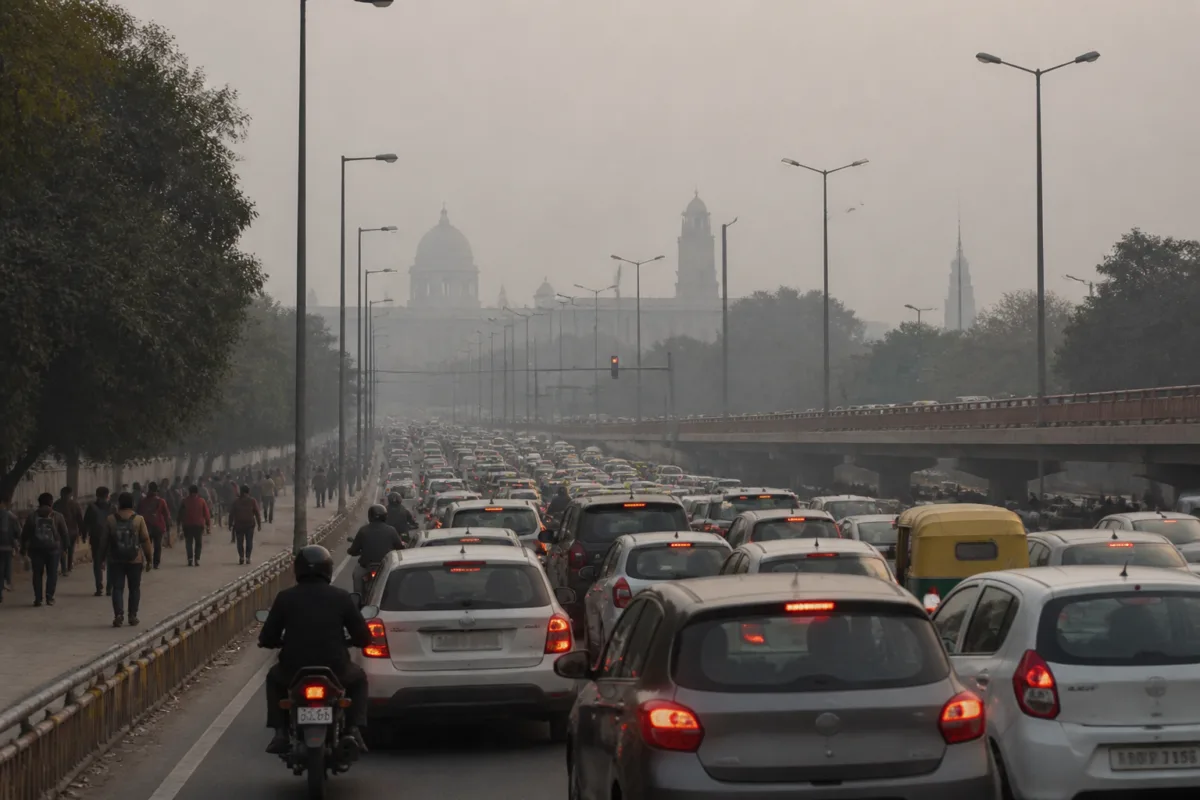
Delhi air pollution has worsened before the peak winter season despite restrictions under the Graded Response Action Plan, according to a Centre for Science and Environment analysis cited by Jagran. The evidence presented in the report shifts attention from crop-residue burning alone to a more persistent urban problem: vehicle emissions, traffic congestion and pollution generated within the National Capital Region.
The finding matters because Delhi’s clean-air response continues to rely heavily on measures activated when air quality deteriorates. These include restrictions on vehicle movement and construction activity. But the CSE analysis, as reported by Jagran, suggests that such measures are not sufficiently reducing the pollution load already present in the city before seasonal triggers such as stubble burning and fireworks take effect.
The data points to a high baseline of pollution rather than a problem created only by a short winter episode. The average PM2.5 concentration before Diwali was reported at 236 micrograms per cubic metre in 2026, compared with 120 in 2025 and 179 in 2024. That represents a 97 per cent increase over the previous year and a 32 per cent increase over 2024. The source report says pollution had already been higher than in earlier years before Diwali, with a brief decline around the end of September following rainfall.
This distinction between baseline pollution and episodic spikes is central to understanding the limits of GRAP. Emergency restrictions can respond to worsening air quality, but they do not by themselves remove the emissions produced every day by urban travel, congestion and other internal sources. If the air is already heavily polluted when winter conditions begin, additional external sources can push the city into a more severe episode more quickly.
The CSE analysis cited in the report also challenges the idea that crop-residue burning was the dominant explanation for Delhi’s worst air-quality day. On November 6, when Delhi’s air quality index reached 382, the contribution from stubble-burning smoke was estimated at around 8 per cent. The report attributes the larger share of pollution to vehicle emissions and other internal sources within the city and its surrounding urban region.
That does not mean agricultural fires or fireworks are irrelevant. The reported analysis says that these sources can cause sudden increases in pollution. Its larger point is that Delhi enters the winter season with an elevated level of pollution from sources that remain active throughout the year. Treating seasonal sources as the primary explanation can therefore obscure the emissions that urban authorities have more direct responsibility to manage.
Vehicle emissions become especially significant in the way they interact with congestion. The report describes heavy traffic during the morning and evening peaks, along with stable night-time air that allows nitrogen dioxide levels to remain high until midnight. This connects air pollution to the daily functioning of Delhi’s transport system: long queues, repeated acceleration and braking, idling vehicles and extended travel times all increase the period during which people and vehicles remain exposed to polluted air.
The transport burden is also visible in the reported Travel Time Index. Even after restrictions were imposed, commuters spent between 13 and 31 per cent more time on the road during peak hours than under normal conditions. The figure does not establish that GRAP caused the additional travel time, but it does show that the restrictions did not eliminate congestion during the period examined. A policy that limits selected categories of vehicles without reducing total traffic demand can leave the underlying mobility problem intact.
This is the institutional challenge at the heart of Delhi’s pollution response. GRAP is designed as a graded emergency mechanism, with measures becoming stricter as air quality worsens. Its logic is reactive: authorities impose restrictions after pollution reaches specified conditions. The CSE findings reported by Jagran raise a different question about governance—whether the city and the wider NCR are doing enough between emergency episodes to reduce the emissions that make those episodes more dangerous.
A restriction on vehicles below the BS-VI emissions standard illustrates the difficulty. Such a rule may remove some polluting vehicles from the road, but its impact depends on enforcement, the composition of the vehicle fleet, the availability of public transport and the ability of residents to shift trips. If commuters still need to travel at the same times and over the same distances, traffic can remain heavy even when a specific vehicle category is restricted.
The report’s evidence therefore links air-quality management to public transport and urban mobility, rather than treating them as separate policy areas. The CSE analysis calls for reducing the total number of vehicles on roads, strengthening public transport and applying stringent measures across the NCR throughout the year. These points are attributed to CSE’s research and advocacy executive director Anumita Roychowdhury, who said that relief would remain difficult unless such a strategy was adopted.
The regional dimension is important because Delhi’s air does not stop at municipal or state boundaries. The source report refers to pollution from Delhi and neighbouring states, as well as the need for action across the NCR. This means that measures applied only within the capital can have limited effect when emissions, traffic flows and atmospheric conditions operate across a wider metropolitan system.
The reported numbers also show why a short-term enforcement cycle may be inadequate. Before Diwali, average PM2.5 was already recorded at 236 micrograms per cubic metre in 2026. That level was nearly twice the reported 2025 average for the comparable period. The comparison does not by itself identify the cause of every change, but it indicates that the city began the festival period with a substantially heavier pollution burden than in the two preceding years listed in the analysis.
The source report says rainfall at the end of September produced only a slight reduction in pollution. Rain can temporarily remove some pollutants from the air, but the reported subsequent increase underlines the difference between temporary atmospheric relief and a lasting reduction in emissions. Once traffic, stagnant air and other sources resumed their influence, the underlying pollution problem remained.
For residents, this means that air pollution is experienced not only as an emergency alert or a restriction on construction and vehicle use. It is also embedded in routine journeys, roadside exposure and the time spent in congested traffic. The reported persistence of nitrogen dioxide into the night adds another dimension, indicating that exposure is not confined to daytime peak hours.
The evidence does not prove that GRAP has no value. Emergency measures may still be necessary when pollution reaches severe levels. Nor does the reported analysis quantify the precise contribution of every internal source across the entire season. What it does show is that restrictions activated during pollution episodes have not prevented a higher pre-Diwali pollution baseline in 2026, and that traffic conditions remained difficult even after vehicle-related restrictions were applied.
The larger urban question is whether Delhi’s clean-air framework is sufficiently connected to the way the city moves and grows. A response centred on episodic restrictions can interrupt activity without changing the conditions that produce repeated congestion and emissions. The CSE findings cited by Jagran suggest that air-quality policy will remain under pressure unless year-round action, public transport capacity and coordination across the NCR are treated as part of the same governance problem.
The immediate facts are clear: Delhi recorded a reported AQI of 382 on November 6; stubble-burning smoke contributed about 8 per cent on that day according to the cited analysis; average pre-Diwali PM2.5 reached 236 micrograms per cubic metre in 2026; and peak-hour travel times remained 13 to 31 per cent above normal despite restrictions. What remains to be established through fuller official and primary-source data is the precise contribution of each internal source and the measured effect of individual GRAP interventions. Those are the figures authorities will need to track if emergency restrictions are to become part of a more effective year-round clean-air strategy.

