


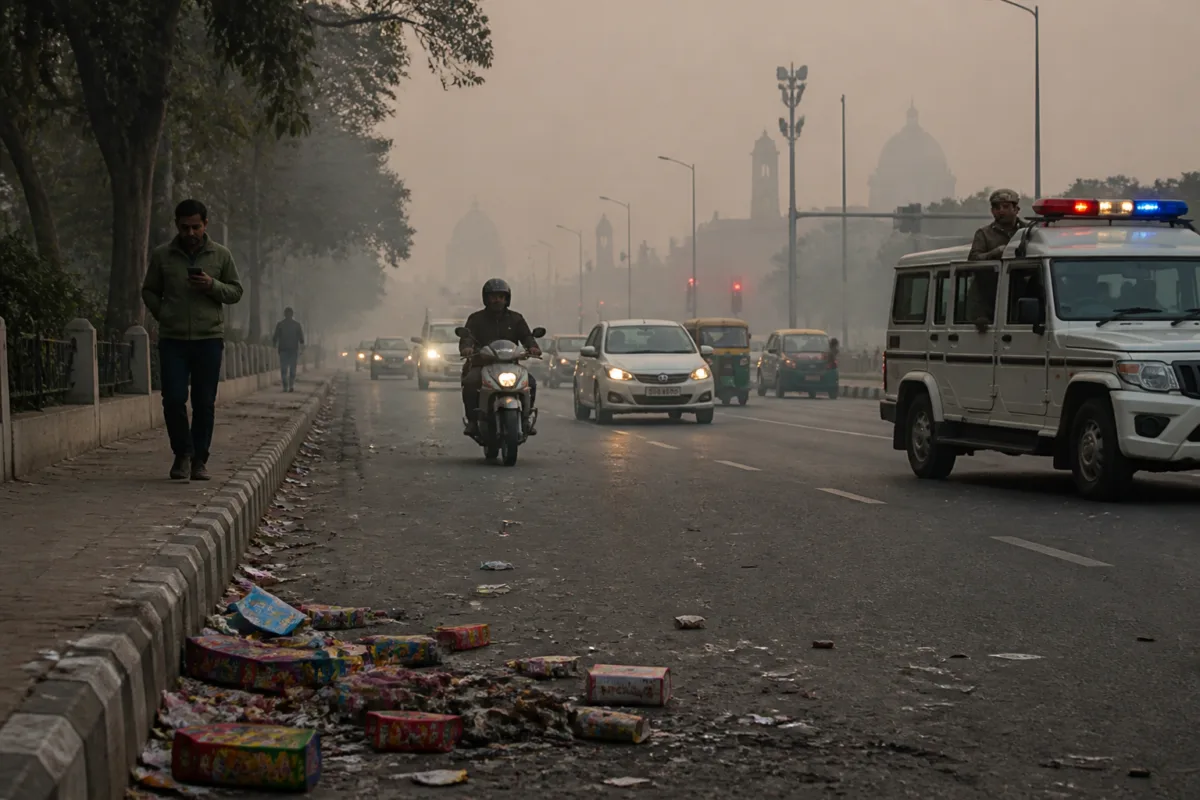
Delhi Police has warned residents against bursting firecrackers after the permitted window ended, as the capital’s air quality deteriorated to the ‘very poor’ category and official analysis attributed a substantial share of pollution to fireworks on two days around Diwali.
In a post on X, Delhi Police said permission to burst firecrackers in the national capital was available only during specified hours on November 7 and 8. That period has now ended, and bursting firecrackers is prohibited, the police said. Violations will invite legal action, while residents were asked to follow the restrictions as responsible citizens.
The renewed enforcement warning comes after heavy fireworks across Delhi during Diwali. According to data attributed to the Indian Institute of Tropical Meteorology (IITM), firecrackers accounted for 71.1% of Delhi’s pollution on Monday and 29.8% on Tuesday. The report did not specify the wider measurement methodology or the duration used for calculating the contribution, but presented fireworks as the largest identified contributor on those two days.
Vehicle emissions accounted for 6.9% of Delhi’s pollution on Monday, according to the same IITM data cited in the report. The figures underline the short-term impact of fireworks during a period when winter weather can also affect the dispersion of pollutants over the city.
Delhi’s air quality worsened on Wednesday, with the 24-hour average Air Quality Index reaching 303 in the morning. This falls in the Central Pollution Control Board’s ‘very poor’ category. On Tuesday, the city’s 24-hour average AQI had recorded 299, placing it in the ‘poor’ category after a temporary improvement.
The deterioration has occurred alongside a broader seasonal rise in fine particulate pollution across Delhi-NCR. An analysis by the Centre for Science and Environment said the average PM2.5 concentration during the week before Diwali reached 236 micrograms per cubic metre, the highest level for that period in three years. The figure was 32% higher than the 179 micrograms per cubic metre recorded in 2024, according to the analysis cited in the report.
The pollution mix is not limited to fireworks. The Central Pollution Control Board has also identified stubble-burning incidents in neighbouring states as one of the contributors to Delhi’s air pollution. The relative contribution of different sources can change with weather, wind conditions, traffic, agricultural burning and the timing of emissions.
For residents, the immediate administrative position is clear: the permitted firecracker-use period has ended, and Delhi Police says further bursting of firecrackers will be treated as a violation. The police’s latest warning places enforcement alongside the city’s continuing response to deteriorating air quality. No further details on the number of cases or penalties imposed were provided in the report.

