


Delhi’s Yamuna cruise service has added a new tourism option, but its early experience also exposes a basic urban-planning problem: a river cruise cannot become a major attraction through the vessel alone. Without a developed riverfront, recognisable landmarks, convenient access and a clear relationship with the city’s heritage, the service risks becoming a short boat ride rather than a full riverfront destination.
The cruise currently operates from a station near the Yamuna barrage towards Sonia Vihar. According to a report by Jagran – New Delhi, the journey lasts about 30 minutes and costs ₹500 per passenger. Visitors must also pay an additional ₹50 entry fee to access the premises. Several tourists have questioned the combined cost, particularly because the separate entry charge is collected even after the cruise ticket has been purchased.
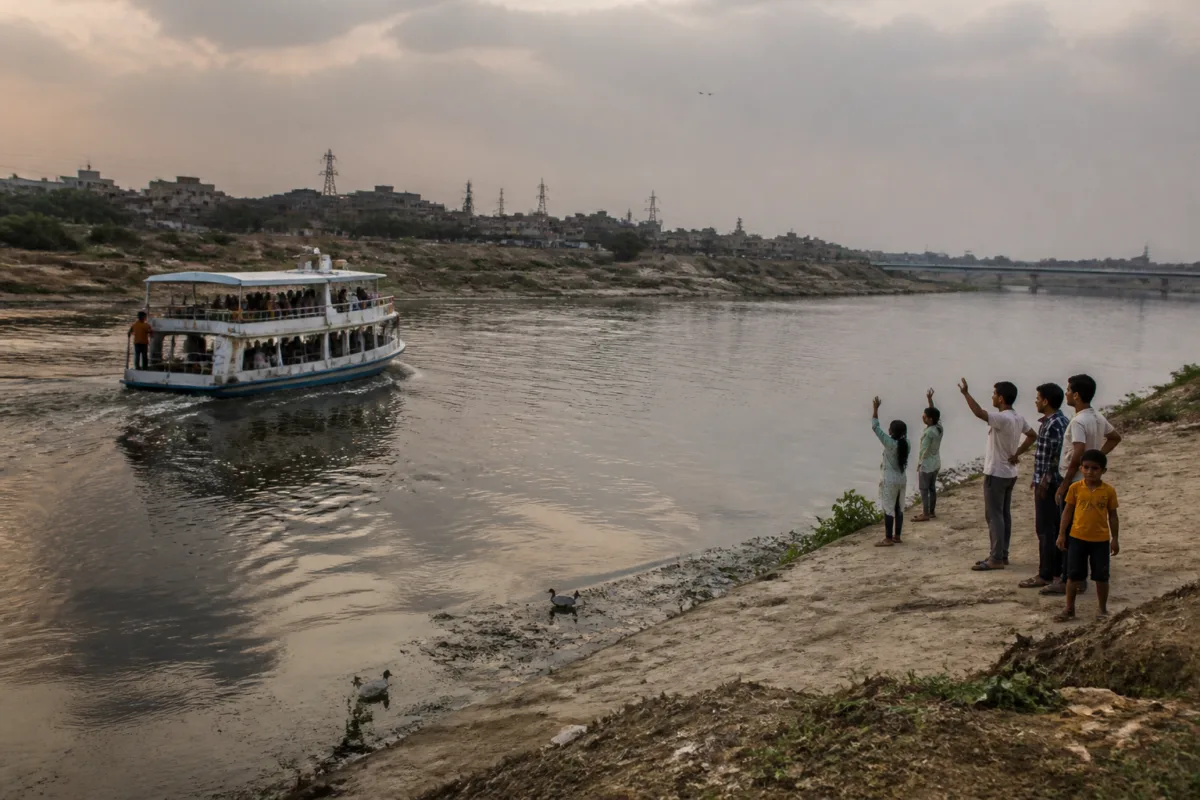
The pricing issue is not only a question of what passengers can afford. It also affects the value proposition of the service. A ticket is easier to justify when the experience connects passengers to a sequence of visible attractions, public spaces or cultural sites. In the present setting, the cruise route reportedly offers few major sights along either bank. Passengers travelling towards Sonia Vihar see people standing along the river and waving at the vessel, while birds on parts of the opposite bank provide some visual interest. These moments may be pleasant, but they do not yet constitute a structured tourism experience.
That distinction matters because successful urban river cruises generally depend on more than navigable water. Their appeal is created by the relationship between the river and the city around it. The banks need to offer something to see, understand or access. This may include historic structures, religious sites, public promenades, landscaped spaces, cultural activity or distinctive bridges. Where those elements are absent, the cruise becomes dependent almost entirely on the novelty of being on the water.
The comparison with Varanasi and Kolkata, cited in the report, illustrates this difference. In Varanasi, the Ganga cruise is linked to the city’s historic and religious ghats. The reported journey covers 84 ghats over approximately 90 minutes, while evening packages include views of the Ganga Aarti at Dashashwamedh Ghat and illuminated lamps along the river. The attraction is therefore not simply the boat; it is the visual and cultural continuity of the riverfront.
Kolkata’s Hooghly cruises similarly draw value from a connected landscape of urban landmarks. The route includes the Howrah Bridge, also known as Rabindra Setu, Vidyasagar Setu, Prinsep Ghat, Millennium Park and older riverfront ghats. Some longer routes also offer views of Belur Math and the Dakshineswar Kali Temple. These landmarks give passengers a recognisable sequence and help convert the river into a way of reading the city.
Delhi’s Yamuna route currently lacks an equivalent concentration of developed attractions, according to the report. This is not merely a tourism-sector limitation. It reflects the condition of the river edge as an urban space. A river can be physically present within a metropolitan region without functioning as a public-facing civic landscape. The absence of accessible, maintained and visually coherent edges means that a city may launch water transport or tourism services without having built the surrounding public realm required to support them.
The proposed solution discussed in the report is the development of a Yamuna riverfront, alongside efforts to make the river cleaner and maintain its flow. The riverfront has been discussed in relation to the Sabarmati Riverfront model. However, the report indicates that work on the project is not expected to begin immediately. This creates a sequencing challenge: the cruise service is already operating, while the larger riverfront system that could give it lasting value remains at an earlier stage.
That sequencing also raises questions about institutional coordination. A cruise operation requires decisions on fares, entry arrangements, passenger facilities, safety, access and daily management. A riverfront project involves a much wider set of responsibilities, including river management, land use, public-space design, sanitation, ecological conditions, mobility connections and the treatment of existing activities along the banks. If these functions are planned separately, the passenger experience can remain fragmented even when the individual components are operational.
The additional ₹50 entry charge is a small but visible example of this fragmentation. The report does not establish whether the fee is collected by the same authority or operator responsible for the cruise ticket, nor does it explain how the charges are allocated. But from the visitor’s perspective, the distinction between entering the cruise premises and boarding the cruise may not be clear. A unified ticket or an explicitly integrated fee structure would require administrative coordination, while the current arrangement leaves passengers questioning what they are paying for.
The ₹500 fare also needs to be understood alongside the duration and content of the journey. A 30-minute ride is not automatically poor value, but its acceptability depends on the quality of the route, the services included and the sights available. The report records demands from tourists for a lower cruise ticket and exemption from the separate entry fee. It does not provide passenger numbers, operating costs, occupancy levels or revenue figures, so the financial performance of the service cannot be assessed from the available evidence.
The same limitation applies to the environmental and public-space dimensions. The report notes that the river must become cleaner and more continuous in its flow and that development of the riverfront is being considered. It does not provide water-quality measurements, ecological assessments or details of the proposed design. As a result, it is not possible to conclude whether the current cruise operation has improved public engagement with the Yamuna, or whether the future riverfront plan will balance tourism with ecological and public-access objectives.
What the available evidence does show is a mismatch between a new attraction and its setting. The service provides access to the river, but the surrounding banks do not yet offer a comparable narrative of Delhi. The route’s most immediate visual interaction is with people watching from the banks, while birds offer occasional interest. In contrast, the examples from Varanasi and Kolkata show how a river journey becomes stronger when it is embedded in a dense network of recognised places.
This makes the Yamuna cruise a useful test of how Delhi approaches riverfront development. The central question is not simply whether the city can operate a boat service. It is whether the river can be integrated into the city’s public life without reducing the riverfront to a commercial backdrop. That requires clarity about what visitors are being invited to experience, how residents will access the banks, what environmental conditions will be protected and which public agencies will be responsible for delivery.
The immediate issues identified in the report are therefore practical: the ₹500 fare, the additional ₹50 entry fee, the 30-minute duration and the limited number of visible attractions. The larger issue is institutional and spatial. A cruise can be launched quickly, but a meaningful riverfront depends on coordinated work across water management, public infrastructure, heritage, mobility and tourism. Delhi’s proposed riverfront development remains the longer-term intervention that could address this gap, although the report indicates that implementation is still some distance away.
For now, the evidence confirms that the Yamuna cruise has created a new way to approach the river, but not yet a complete riverfront experience. The next developments to monitor are the treatment of the entry and cruise charges, the progress of riverfront planning, and whether future work creates accessible and distinctive public spaces along the route while addressing the Yamuna’s cleanliness and flow.

