


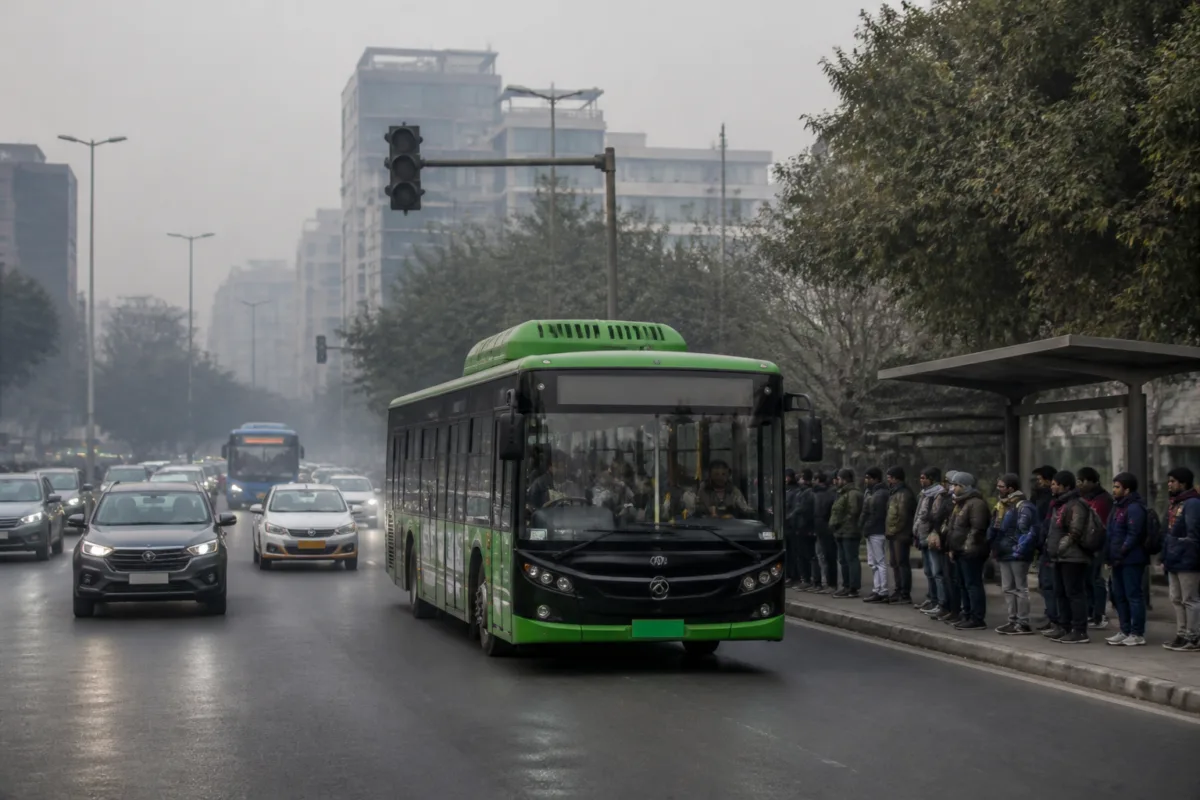
A proposed Delhi free bus service from November to January has put the city’s winter pollution strategy back on the question of public transport capacity. The suggestion, reported by Jagran, combines zero-fare bus travel for everyone with a larger electric-bus fleet, discounts on metro tickets and temporary parking facilities at Delhi’s borders. It also carries an estimated cost of about Rs 200 crore, but the supplied report does not indicate that the Delhi government has accepted or notified the proposal.
That distinction matters because the proposal is not simply about removing bus fares. It assumes that commuters will leave private vehicles at home if public transport is frequent, available across important destinations and supported by convenient interchange facilities. The suggestion therefore brings together three separate urban systems: the road network, the public transport fleet and the administrative coordination required between Delhi and its neighbouring districts.
The proposal was attributed to Ramvir Singh Bidhuri, BJP MP from South Delhi, who said the city would need 14,000 electric buses to cover important locations and residential areas. The report said Delhi’s bus fleet currently has about 6,988 buses, including 1,750 CNG buses, while the Delhi government has set a target of taking the electric-bus fleet to around 14,000 by 2028-29. The figures indicate the scale of expansion being discussed, although the report does not provide a route-wise deployment plan, procurement schedule or operating model for the proposed free service.
The central urban challenge is not only the price of a bus ticket. It is whether the network offers a sufficiently reliable alternative to private vehicles during the months when pollution episodes become a recurring public concern. A fare-free service can reduce the direct cost of a trip, but it cannot by itself solve gaps in route coverage, long waiting times, overcrowding, poor interchange or the absence of parking and last-mile connections at the city’s edges.
The Association of Environmental Professionals, cited in the report, linked Delhi’s winter pollution to a combination of low wind speeds, falling temperatures and limited atmospheric mixing. The association’s general secretary, Dr Shalini Gupta, said vehicle emissions and traffic pressure play an important role in Delhi’s air pollution and that reducing private-vehicle use between November and January could help lower emissions and unnecessary congestion. These claims are presented as expert observations in the source report; the supplied material does not quantify the share of pollution that a free-bus scheme would remove.
This is where the proposal moves beyond a seasonal subsidy. It treats mobility behaviour as part of the pollution response. The proposed three-month period corresponds to the winter season identified in the report as particularly vulnerable to the accumulation of pollutants. But a temporary incentive would need to be matched by temporary operating capacity. If additional passengers are directed towards buses without enough vehicles, drivers, depots and road space, the policy could shift demand onto an already pressured system without creating a dependable substitute for private travel.
The reported fleet figures also expose a capacity question. The proposal calls for the number of electric buses to be increased substantially, while the government target cited in the report is for an electric-bus fleet of about 14,000 by 2028-29. The report does not clarify whether that target refers to buses owned directly by the government, buses operated under contracts, or the total fleet available to passengers. It also does not state how many buses would be required specifically for the November-January free-service period or how many additional trips the existing network could absorb.
The estimated Rs 200 crore burden is similarly important but incomplete as a policy measure. The report describes the amount as an impact on government revenue and suggests that it could be met from other heads. It does not identify the source of funding, the expected number of additional passenger journeys, the cost of extra operations or the revenue loss by mode and route. Without those details, the figure establishes the broad fiscal scale of the suggestion but not its full budgetary requirement.
Making buses free for everyone would also create a design choice between universal access and targeted relief. The suggestion, as reported, is for all commuters to travel free during the three-month period. That approach is administratively straightforward because it avoids eligibility checks, but the supplied report does not examine whether universal free travel would attract existing public-transport users who already pay fares or primarily shift people from private vehicles. The environmental effect would depend on the latter change, not merely on the number of free journeys.
The proposal’s border-parking element recognises that Delhi’s transport system does not stop at its administrative boundary. The report identifies large numbers of private vehicles entering Delhi from Gurugram, Faridabad, Ghaziabad and Noida. It suggests temporary parking facilities at the borders, followed by sufficient electric-bus availability for onward travel. This would require coordination across Delhi and the neighbouring jurisdictions, as well as decisions on land, traffic management, security, pricing and connections to metro or bus routes. No specific border sites, agencies or implementation arrangements are identified in the supplied material.
That cross-border dimension is significant because a policy implemented only inside Delhi would not fully address commuter travel generated in the wider National Capital Region. A person driving from a neighbouring district would need a practical point at which to leave the vehicle, a predictable onward service and a journey time that compares reasonably with continuing by car. The report proposes the parking-and-bus model but does not provide evidence on land availability, expected demand or the number of buses required at each entry point.
The suggestion to provide discounts on metro tickets during the same period adds another layer to the proposed response. Buses and the metro could serve different parts of the city, and an integrated seasonal measure could give commuters more than one alternative to private vehicles. Yet the report does not state the proposed discount level, whether the Delhi Metro Rail Corporation has been consulted or how the cost would be shared. It also does not explain whether discounted metro travel would be linked to parking facilities or bus transfers.
The governance question is therefore as important as the fare question. A free bus service would involve the department responsible for transport, bus operating agencies, electric-bus suppliers and operators, traffic authorities, municipal bodies and, for border facilities, neighbouring state and city administrations. The source report identifies the proposal and its broad components but does not establish which institution would lead the programme or whether a formal inter-agency plan exists.
The proposal also arrives against a background of measures that have not eliminated the city’s winter mobility and pollution pressures. The report refers to restrictions on BS-IV vehicles at borders, repeated water sprinkling on road dust and efforts to limit vehicles. It also points to continuing problems from the number of private vehicles, dust and traffic jams associated with incomplete construction. These references show that the suggested bus intervention would sit alongside existing pollution-control actions rather than replace them.
For the public, the practical test would be whether a free journey is also a usable journey. A bus must arrive with sufficient frequency, stop close enough to the origin and destination, and connect with other modes. The supplied report provides no service-level commitments on frequency, route additions, passenger capacity or operating hours. It consequently supports the case for examining public transport as a pollution-control tool, but not a conclusion that the proposed scheme would achieve a specific reduction in emissions.
The evidence currently confirms three things. First, a publicly reported proposal seeks free bus travel across Delhi from November to January, alongside more electric buses, metro discounts and border parking. Second, the proposal is linked to the city’s winter pollution and traffic conditions. Third, its implementation would require substantial fleet expansion, funding and coordination beyond Delhi’s municipal limits. What remains unestablished is whether the government will adopt it, how the Rs 200 crore estimate was calculated and what operational capacity would be available.
The next meaningful developments would be an official response, a formal cost assessment, details of the proposed bus and parking network, and clarification of how the plan would connect with the stated 2028-29 electric-bus target. Until then, the proposal is best understood as a public-transport intervention suggested for Delhi’s winter pollution season, not as an announced free-bus policy.

