


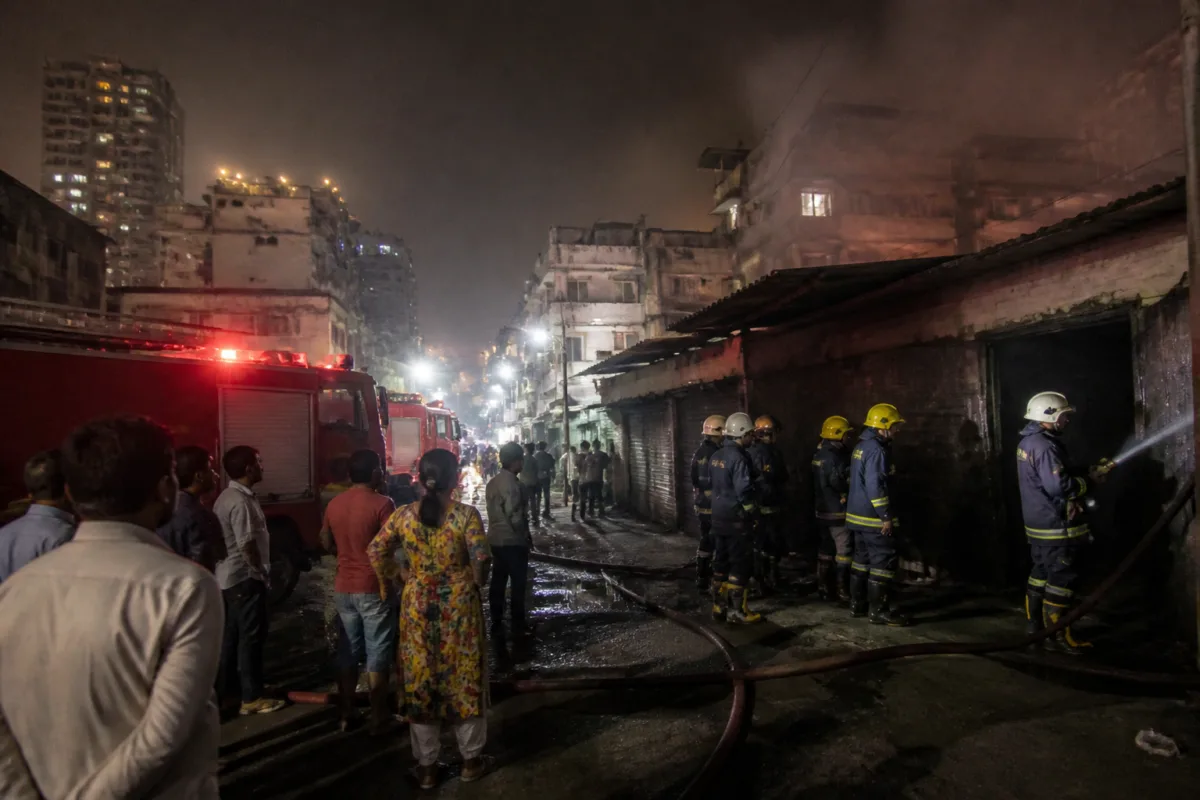
Mumbai’s firecracker fires during the Diwali period have exposed a safety problem that extends beyond individual accidents: the city’s dense neighbourhoods, informal settlements, commercial premises and adjoining municipal jurisdictions can turn fireworks into a city-wide emergency-response challenge. Between November 6 and November 10, the Mumbai fire brigade attended 333 fire calls triggered by fireworks, while police recorded 200 fire-related accidents caused by crackers. The police figure was sharply higher than the 80 incidents recorded in 2024 and 113 in 2025.
The numbers sit alongside several fatal and potentially preventable incidents. In Malad, 16-year-old Shahnawaz Niyaz Khan died after a rocket allegedly fell on a firecracker shop where he had entered with three friends. The friends escaped, but Khan was trapped inside. In another incident at Pratiksha Nagar in Sion, six labourers’ huts caught fire after multiple explosions, reportedly involving LPG cylinders. A fireman was injured while responding. In Andheri Lokhandwala, a firecracker blaze in the Runwal Elegante housing society killed lift operator Dhanpat Mahto.
Together, these incidents show how quickly fireworks-related risks can move across different urban settings. The Malad incident involved a commercial firecracker shop. The Sion blaze affected workers’ hutments, where the presence of LPG cylinders increased the danger. The Andheri incident occurred in a residential society. The common factor identified by Mumbai’s fire authorities was not a single building type but the ignition of fires by firecrackers and the need to prevent flames from spreading.
Chief fire officer Ravindra Ambulgekar said both the Malwani and Pratiksha Nagar blazes were triggered by firecrackers. He said the fire brigade’s response in each case focused on ensuring that the fire did not spread. That statement points to the central operational task during a dense urban fire: containment can be as important as extinguishing the original flame, particularly where buildings, temporary structures, stored fuel or neighbouring premises are closely packed.
The reported incidents also underline the difficulty of separating a fire’s immediate trigger from the conditions that determine its consequences. In Malad, residents told the newspaper that the rocket allegedly landed on the shop from outside, causing a series of explosions. Congress MLA Aslam Shaikh said the shopkeeper did not know the teenager was still inside, rolled down the shutter and fled the site. The account, as reported, describes a rapidly changing emergency in which a fire, a locked premises and incomplete information combined to trap a person inside.
That sequence matters because fire safety is not only about preventing ignition. It also involves access, visibility, evacuation, supervision and the ability of people at the scene to understand who may still be inside. The supplied report does not establish whether the shop complied with licensing, storage or safety requirements, nor does it identify the precise cause of the rocket’s fall. It does, however, record a fatal outcome in a premises where people were present when the explosions began.
The Sion incident presents a different urban vulnerability. Local BJP corporator Shilpa Keluskar said six huts caught fire and that multiple explosions took place as LPG cylinders blasted. One fireman was injured. In a settlement of labourers’ hutments, the combination of temporary structures, closely spaced dwellings and cooking-gas cylinders can create conditions in which a local fire becomes a fast-moving emergency. The report does not provide details of the settlement’s layout, the number of residents evacuated or the extent of property damage, but the incident demonstrates the exposure of low-income communities to seasonal fire risks.
The figures from neighbouring urban bodies indicate that the problem was not confined to Mumbai’s municipal limits. In Vasai-Virar and Mira-Bhayandar, 48 fires were reported on November 9 and 10, most of them at garbage dumps. Mira-Bhayandar Municipal Corporation chief fire officer Prakash Borade said most were minor, were quickly doused and caused no casualties. Navi Mumbai Municipal Corporation reported 28 fires on November 9 and 10, taking the Diwali mishap toll there to 90, according to a disaster-management official.
These figures cannot be treated as a single standardised regional dataset without more information. The report does not explain whether each civic body counted incidents using the same definition, whether repeat calls were removed, or whether the figures include only firecracker-triggered fires or all fires reported during the period. Mumbai’s 333 fire calls and the police’s 200 recorded accidents are also different measures collected by different institutions. Even so, the scale and geographic spread show that fire services across the Mumbai Metropolitan Region faced an unusually concentrated seasonal workload.
The comparison with earlier years is clearer within the police figures supplied in the report. Recorded cracker-related fire accidents rose from 80 in 2024 to 113 in 2025 and 200 during the period covered in the latest report. The time windows and counting methods for the earlier figures are not specified, so the comparison should be read cautiously. The increase nevertheless provides an important signal: firecracker-related incidents are not being described as isolated annual mishaps but as a growing operational concern in the available police data.
The burden on emergency services becomes more complicated when municipal boundaries are involved. The report says Mumbai fire brigade vehicles were deployed to Thane on November 8 to assist firefighting at a high-rise society housing relatives of Deputy Chief Minister Eknath Shinde. The deployment triggered a political controversy after opposition leader Kishori Pednekar criticised the move. Amey Ghole, the Shiv Sena (Shinde) group leader in the Brihanmumbai Municipal Corporation, defended it on the grounds that saving lives during emergencies should take precedence over municipal boundaries.
The dispute raises an institutional question without resolving it: how should fire resources be shared across neighbouring jurisdictions during simultaneous emergencies? The report does not state how many vehicles were deployed, for how long, whether Mumbai faced a shortage during that period, or what formal mutual-aid protocol governed the decision. It does show that cross-boundary assistance can become contentious when demand is high and public resources are visibly moved from one local government area to another.
For residents, the practical consequence is that fire risk does not follow administrative boundaries. A fire in a high-rise, a settlement, a shop or a garbage dump may require different equipment and tactics, but all depend on dispatch capacity, trained personnel, access routes and coordination. The Mumbai fire brigade’s attendance at 333 fire calls, the reported incidents in Navi Mumbai and the 48 fires in Vasai-Virar and Mira-Bhayandar suggest that several agencies were managing overlapping demands during the same festival period.
The report also shows that the consequences are measured not only in buildings damaged or calls attended. A teenager died in Malad, a fireman was injured in Sion and a lift operator died in Andheri. These victims occupied different positions in the urban system: a consumer at a shop, an emergency responder and a worker serving a residential society. Their deaths and injuries demonstrate how seasonal fire risks affect people who live, work or respond in the built environment, not merely those who use fireworks.
What remains unclear is equally important. The supplied report does not establish how the firecracker shop was authorised, whether fireworks were stored lawfully, whether inspections had taken place, or whether any enforcement action followed. It does not provide a complete breakdown of the 333 fire calls by location, cause, severity or response time. Nor does it identify whether the increase in police-recorded accidents reflects higher fireworks use, stronger reporting, different classification or a combination of factors.
Those gaps prevent a complete assessment of the regulatory and administrative failure, if any. They do not diminish the public-interest significance of the available evidence. The reported rise in incidents, the deaths in residential and commercial settings, the fire in labourers’ hutments and the cross-jurisdictional deployment of municipal fire vehicles collectively point to a recurring urban safety challenge that cannot be understood through one accident at a time.
The next stage is therefore not simply another count of festival-period fires. It is the establishment of a clearer record of where these incidents occur, what materials are present, how quickly emergency crews can reach them, and how neighbouring civic bodies coordinate when multiple fires happen together. The available report confirms the scale of this year’s emergency workload; it leaves the causes of the increase, the compliance status of affected premises and the adequacy of inter-agency arrangements open for further official clarification.

