


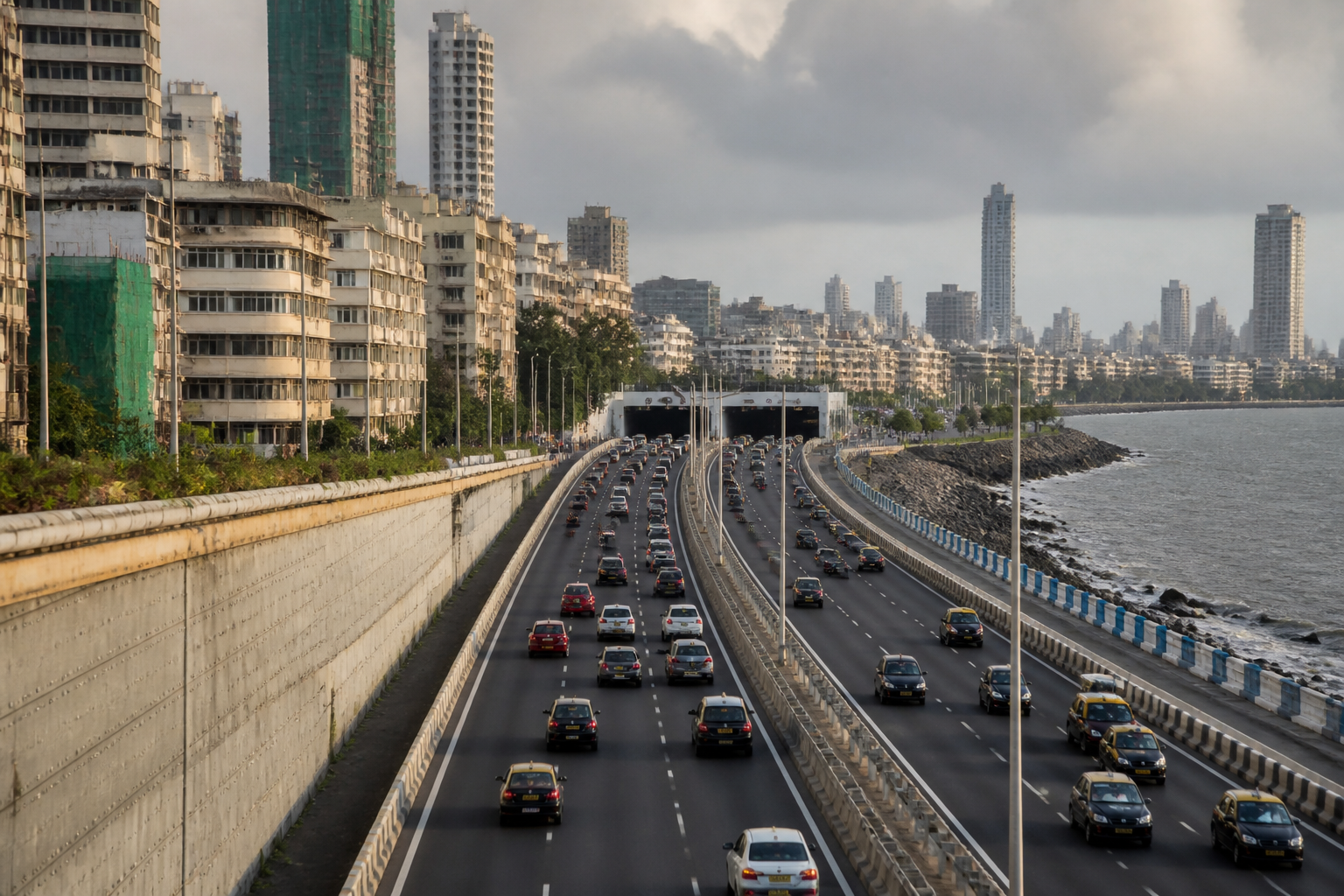
Mumbai Coastal Road has attracted substantially more traffic since it began operating around the clock, but its first year also exposes the limits of measuring urban transport success through vehicle volumes alone. Average daily traffic on the south section rose nearly 81% to 62,640 vehicles after 24×7 access began on August 15, 2025. Yet that figure remains below the levels projected when the Rs 13,984-crore project was planned, while access for public transport users remains limited.
The numbers tell a clear story about latent demand. Before round-the-clock operations, the road was open for 16 hours a day, from 7 am to midnight, and carried an average of 34,538 vehicles daily. This comprised 19,209 southbound and 15,330 northbound vehicles. After access was extended through the entire day and night, the average increased to 33,077 vehicles southbound and 29,563 northbound, producing a combined daily figure of 62,640.
The monthly data shows a similar rise. Before August 15, 2025, the road recorded about 11.35 lakh vehicle movements a month, including 5.76 lakh southbound and 5.58 lakh northbound movements. In the year after 24×7 operations began, the monthly average reached nearly 18.79 lakh vehicle movements, an increase of around 66%. Since the first section opened in March 2024, 4.11 crore vehicles have used the south section.
Those figures demonstrate that operating hours were a significant constraint on usage. When the road was unavailable overnight, some potential trips could not shift to it. Once that restriction was removed, motorists used the corridor more frequently. But the increase in actual traffic does not mean the road has achieved the demand forecast made during its planning stage.
Planners had estimated that nearly 68,000 cars would use the road in one direction alone once the project was commissioned. The present southbound average of 33,077 vehicles a day is less than half that projected one-way volume. The comparison is not an exact measure of performance because projected and actual traffic figures may reflect different assumptions about network conditions, operating hours and vehicle categories. It does, however, show that the road is carrying considerably less traffic than the level anticipated in the original planning narrative.
That gap is central to understanding what the Coastal Road has delivered. The project has created a fast, signal-free connection along Mumbai’s western edge, but its effect cannot be assessed only by asking whether vehicles have shifted onto it. The more important question is whether the corridor has improved the city’s overall mobility system or primarily created additional capacity for private vehicles and taxis.
Architect and urban planner Alan Abraham argued that the road’s traffic volumes remain well below projections despite its high construction cost. He also questioned whether adding road capacity necessarily improves traffic conditions, saying that more roads can attract more cars or divert existing traffic without resolving congestion across the wider network. His assessment places the Coastal Road within a familiar urban transport problem: a new corridor can make one movement faster while leaving bottlenecks at its connecting points unchanged.
The report identifies those connecting points in the northward journey. Traffic congestion continues near the MHADA junction in Bandra East and again near the university after the smooth stretch towards Bandra. This means the Coastal Road’s utility depends not only on the road itself but also on the performance of the network into which it feeds. A signal-free section can reduce travel friction within its own limits, yet motorists may still encounter delays where the corridor ends or merges with other roads.
The proposed extension towards the north is therefore being viewed by some residents as the next major test of the project’s network value. Susieben Shah of the Malabar Hill Citizens Forum described the road as a game changer for local residents because of improved connectivity and perceived savings in time and fuel. She also said residents were looking forward to the northern extension, while noting the continuing congestion beyond the currently smooth section.
That resident experience is important because it shows why traffic counts alone do not capture the full effect of infrastructure. For people travelling between south Mumbai and areas served by the road, a more predictable journey can change the practical geography of the city even when the road does not meet its original traffic forecast. At the same time, benefits can be uneven if the corridor improves private vehicle travel without creating comparable options for people who do not drive.
The Coastal Road’s public transport gap is particularly significant because the corridor prohibits pedestrians, two-wheelers and heavy vehicles. Public transport users are consequently dependent on BEST buses. The report says only two routes, A84 between Dr Shyama Prasad Mukherjee Chowk and Oshiwara Depot, and A78 between NCPA and Byculla, are currently operating along the route.
This creates a structural contradiction. A major public project financed by taxpayers serves as a high-speed transport link, but the modes available to use it are restricted. MLA Rais Shaikh has asked the BEST general manager to deploy additional buses, warning that the corridor could become effectively exclusive to car and cab users. The issue is not simply whether buses are present; it is whether public transport has been planned as a core function of the corridor or added after the road’s design and operating rules were already established.
Abraham made a similar argument, saying there was nothing inherently wrong with building a road for private cars, but that the difficulty arose when such investment was not accompanied by stronger public transport. The available evidence does not establish how many travellers have shifted from buses or trains to the Coastal Road, or how journey times have changed across the wider network. It does establish, however, that the road’s access model leaves non-motorised users out and provides only limited bus coverage.
The project’s operational resilience is another part of its first-year record. The report refers to tunnel fires, water leakage and theft of cables and other infrastructure. In July, a car fire inside the southbound tunnel below Girgaon Chowpatty led some motorists to leave their vehicles and run out, temporarily shutting traffic and causing a major jam near Breach Candy. In another July incident, maintenance workers found that bolts and copper wiring had been removed from an electric pole at Worli, leaving the structure vulnerable to collapse over a busy road.
These incidents do not by themselves establish a systemic failure, but they underline the demands created by a long, enclosed and technology-dependent road system. A tunnel corridor requires functioning ventilation, firefighting, surveillance, electrical systems, emergency access and clear procedures for motorists. The risk is not limited to the initial incident; panic, blocked lanes or delayed access for rescue vehicles can extend disruption well beyond the original problem.
Civic officials said the Integrated Command and Control Centre at the Breach Candy interchange brings traffic management, tunnel ventilation, firefighting, surveillance and mechanical and electrical systems onto a single platform. An official said the systems had worked as designed during tunnel fires and attributed the delay in resuming traffic during the July incident to the difficulty rescue vehicles faced in moving through motorists affected by panic.
Transport expert Vivek Pai said incidents of this kind are considered during the planning of a project of this scale and that preparedness should remain the focus. He called for regular drills and ensuring that motorists know how to respond when something goes wrong. His comments shift attention from the expectation that major infrastructure will operate without disruption to the less visible institutional work required to keep it safe.
The road is also part of a wider sequence of links rather than a self-contained solution. Pai said it had already changed travel to south Mumbai from areas such as Bandra and that the benefits could extend further to motorists from Andheri West and Versova once the Versova-Bandra Sea Link is completed. That assessment points to the importance of network integration, but the supplied evidence does not establish a completion date or quantify the additional traffic that future links might bring.
After one year of 24×7 operations, the evidence supports three conclusions. First, extending operating hours sharply increased use, showing that the corridor responds to demand when access is available. Second, current traffic remains below the one-way volumes projected during planning, so the project has not yet demonstrated the scale of utilisation originally anticipated. Third, its success is constrained by the limited availability of buses, the exclusion of pedestrians and two-wheelers, congestion at connecting points and the need for robust emergency preparedness.
The next stage of the Coastal Road’s story will therefore depend on more than rising vehicle counts. Authorities will need to track how the corridor connects with future links, how BEST services operate along it, how congestion behaves at its ends and how quickly tunnel and infrastructure incidents are managed. Those measures will determine whether the project functions as an integrated urban transport asset or remains primarily a high-capacity road for private vehicles.
