


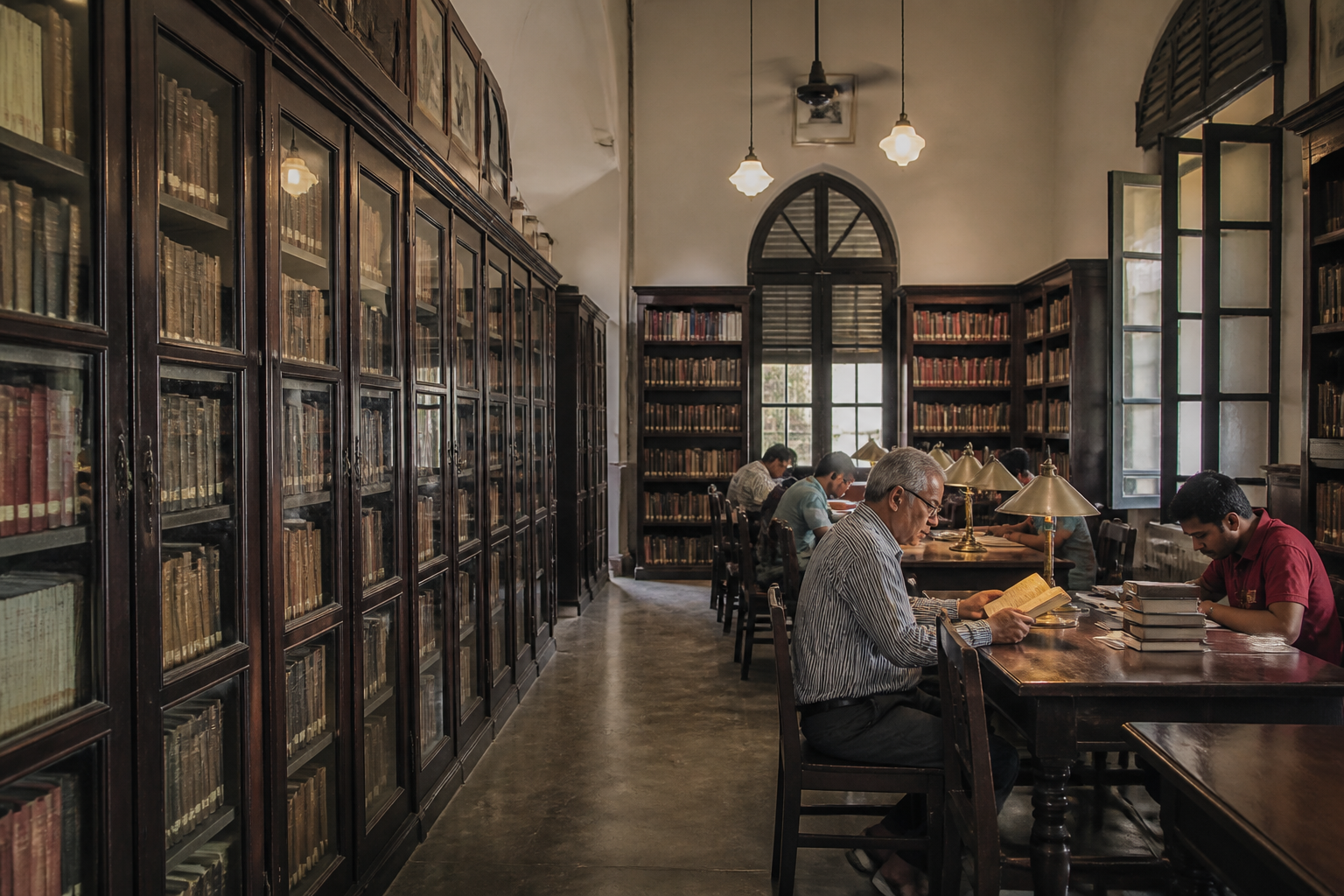
The reopening of Mohammed Ali Library Kolkata after three years of restoration is more than the return of a reading room. It is a case study in how an old urban institution can be preserved when its physical structure, archival systems and community support have all weakened together.
The 96-year-old library on Kanai Seal Street in central Kolkata resumed operations on Teachers’ Day after structural repairs, improvements to lighting and the renovation and reinforcement of its wooden shelves. Located on the ground floor of Barry House, close to Zakaria Street, the library had suffered from damp, decaying racks, loose pages and unstable furniture. Its revival was supported by a community-funded drive and accompanied by an archival programme covering indexing, cataloguing and digitisation.
The intervention matters because the library’s value was never limited to the number of people who could sit inside it. Founded in 1930 by Mulla Mohammad Jan to encourage reading among neighbourhood youngsters, it was renamed in 1931 after Mohammad Ali Jauhar, the freedom fighter, scholar and co-founder of Jamia Millia Islamia. Over time, the institution became a regular reading and study space for generations of residents, students and researchers.
That history also explains why the restoration could not be treated as a routine interior renovation. A public library combines a building, a collection and a pattern of use. Damage to any one of these elements affects the others. A leaking or damp environment threatens books; poor shelving makes handling unsafe; inadequate cataloguing makes material difficult to find; and a deteriorating reading room reduces the institution’s ability to serve its users.
At Mohammed Ali Library, these problems had accumulated gradually. The library’s books were exposed to damp, its wooden shelves were decaying and some racks had become unstable. Inadequate labelling and cataloguing made parts of the collection difficult to access, while the reading room needed brighter lighting and repairs to its furniture. The restoration therefore addressed both the visible condition of the premises and the less visible systems required to keep a collection usable.
The scale of the collection makes that distinction important. The library holds more than 15,000 books and periodicals dating back a century. Among its significant holdings are a 1901 Urdu translation of the Ramayana, an Urdu translation of the Mahabharata, issues of Tahzeeb-e-Niswaan, one of the pioneering Urdu women’s journals of the early 20th century, and original copies of Awadh Punch, an Urdu satirical weekly.
These holdings give the library a role that extends beyond neighbourhood reading. They represent forms of publishing and intellectual exchange that are difficult to replace once damaged or lost. The collection also reflects the layered social and literary history of the city, where institutions serving particular linguistic or neighbourhood communities can preserve material that may not be available in larger, more formal repositories.
The restoration’s most consequential feature may be the digitisation programme. Around 50% of the library’s rarest books and century-old journals have already been digitised, with the remaining collection expected to be digitised soon. Digitisation does not eliminate the need to conserve the original material, but it can reduce repeated handling and create an additional layer of protection against age, humidity and physical deterioration.
The sequence is significant. Digitisation without cataloguing can produce a large but difficult-to-use archive. Physical conservation without documentation leaves the collection vulnerable to future damage and makes it harder to track what exists. At Mohammed Ali Library, indexing, cataloguing and digitisation are being pursued alongside repairs to the premises and shelves. That combination turns restoration from a one-time cosmetic exercise into a broader attempt to make the institution functional again.
The library’s experience also shows the practical meaning of maintenance in older urban buildings. Structural repairs are often associated with large public infrastructure, but the same principle applies to smaller civic spaces. Shelves, lighting, furniture, moisture control and access arrangements determine whether a public institution remains safe and usable. When such work is postponed, repair costs and the risk to collections both increase, even if the deterioration is initially easy to overlook.
In this case, the restoration was driven through community support rather than described as a large public capital project. That is important, but it also identifies a structural vulnerability. A library that depends on periodic volunteer or community-funded interventions may be able to recover from a crisis, yet its long-term survival still depends on routine maintenance, collection management and continuing access to resources. The supplied account confirms the restoration and the community-funded drive, but does not establish a permanent funding model for future upkeep.
The institutional question is therefore not only who restored Mohammed Ali Library, but how such work can be sustained after reopening. The library is now open seven days a week from 2 pm to 10 pm for readers, students and researchers. That operating schedule reconnects the institution with its users, including older members, several of whom are in their 80s and have returned to the reading space. Continued use will be central to whether the restored premises remain a living neighbourhood institution rather than becoming a preserved but underused archive.
Access also has an intergenerational dimension. Older readers return to a familiar place, while students and researchers gain access to a collection that includes rare books and periodicals. The library’s function is consequently both social and archival: it provides a place to read and study while maintaining materials whose value may not be immediately visible in everyday use.
The reopening highlights a wider challenge for cities with ageing cultural and educational institutions. Urban heritage is often identified through prominent buildings, monuments or officially protected sites. Smaller libraries, reading rooms and community institutions can be less visible, even though they support daily civic life and preserve local memory. Their deterioration may not generate the same public attention as the failure of major infrastructure, but the loss can be equally irreversible when rare material is damaged.
Mohammed Ali Library’s restoration offers evidence of a more integrated approach. The building required repair, the shelves required reinforcement, the reading room required better lighting, and the collection required cataloguing and digitisation. None of these interventions alone would have been sufficient. The institution needed its physical and archival functions to be addressed together.
What remains uncertain is the next stage. The report does not provide the restoration cost, identify the full set of participating institutions or explain how the remaining digitisation will be financed and managed. It also does not establish whether the library has a long-term conservation plan for humidity, storage and periodic repair. Those details will determine whether the reopening marks a durable revival or the end of one emergency intervention.
For now, the library has reopened, half of its rarest books and century-old journals have reportedly been digitised, and its reading room is again serving the public. The immediate achievement is the recovery of a functioning civic space. The longer test will be whether regular maintenance, archival management and community access can protect it from returning to the condition that made restoration necessary.
