


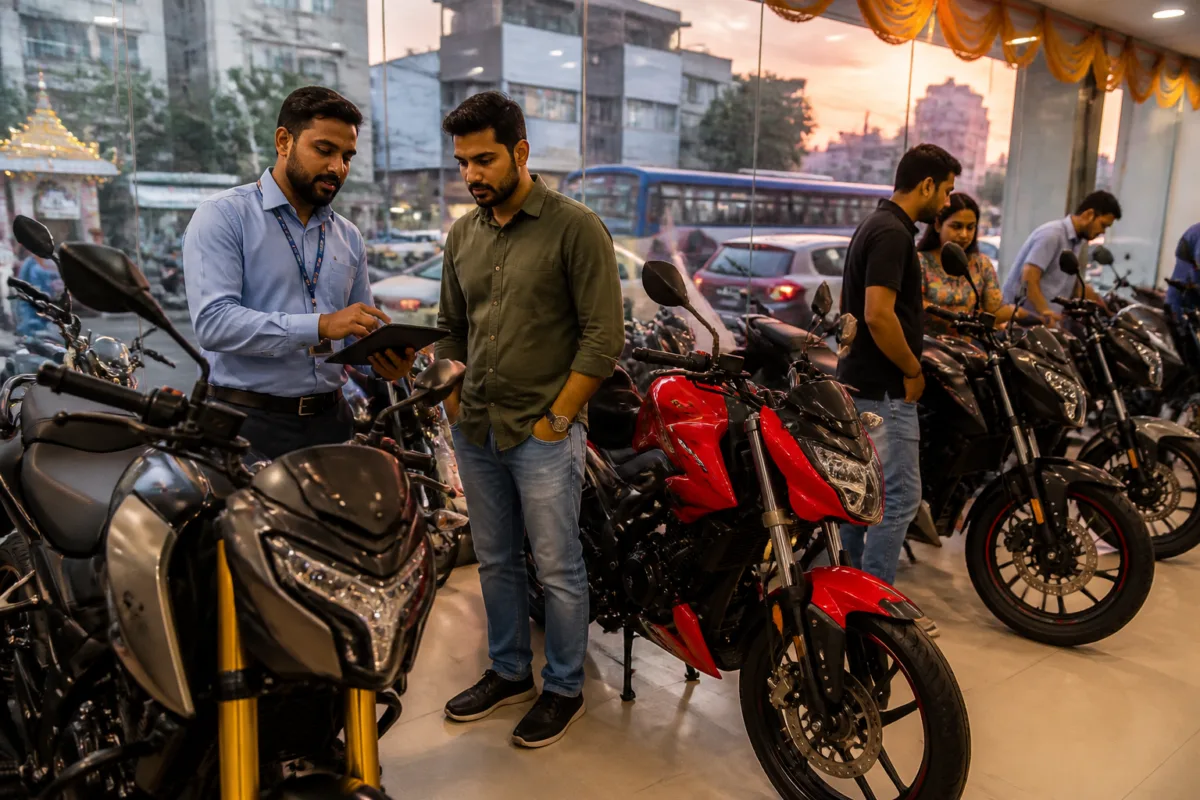
Motorcycle festive discounts are doing more than attracting buyers during India’s peak sales season: they are revealing how quickly a tax cut can be absorbed by rising input costs and manufacturer price revisions. Across the 125–250cc market, companies are offering benefits worth as much as ₹11,000 even as the listed prices of popular motorcycles have moved higher.
The immediate contest is between temporary affordability and permanent price increases. TVS Motor’s Raider, launched a year ago at ₹95,600, now lists at ₹1,03,170, an increase of nearly 8 per cent. Its festive promotion advertises savings of up to ₹11,000 for eligible buyers. Hero MotoCorp is offering a cash bonus of up to ₹10,000 on the Xtreme 160R, while Bajaj Auto has structured benefits of ₹6,000–₹8,900 across several Pulsar models.
These offers matter because motorcycles remain both transport assets and household financial decisions. For many buyers, the relevant calculation is not simply the showroom price. It is the down payment, monthly instalment, financing rate, service cost and the amount of cash that must be paid immediately. Manufacturers are therefore using discounts, fee waivers, servicing packages and financing offers to reduce the upfront burden without necessarily reversing the price increases built into their portfolios.
The market is also being shaped by a policy change that initially improved affordability. The goods and services tax on motorcycles up to 350cc was reduced from 28 per cent to 18 per cent in September 2025. The reduction lowered prices by thousands of rupees, but subsequent manufacturer-led increases have partly eroded that benefit. The result is a market in which the headline tax relief remains important, but the final price paid by customers depends increasingly on commodity costs, product positioning and promotional terms.
## How the price relief was absorbed
Manufacturers have linked their price revisions to higher input costs. Bajaj Auto indicated earlier this year that steel costs had risen by about 15 per cent and copper costs by about 20 per cent. Its April price revisions recovered only around 40 per cent of the additional burden. TVS Motor said pricing had offset roughly a third of commodity inflation, while it raised prices across much of its portfolio in August and revised Raider prices again in October by up to ₹2,600. Hero MotoCorp also implemented increases averaging around ₹2,000 per vehicle.
This sequence explains why festive savings can appear substantial without representing a full return to earlier price levels. A discount of ₹6,000 or ₹8,000 may reduce the current transaction cost, but it does not necessarily remove the cumulative effect of several price revisions. In the Raider example, the advertised saving of up to ₹11,000 can potentially offset more than a year’s increase for eligible buyers. Yet the underlying listed price remains higher than when the model was launched.
The distinction is important for understanding the market. A temporary offer changes the price of a transaction for a limited period and under specified conditions. A manufacturer price revision changes the base from which future financing, resale and promotional calculations begin. The two mechanisms can operate simultaneously: the customer receives short-term relief while the industry preserves a higher long-term price structure.
Bajaj’s festive campaign illustrates the range of tools being used. The Pulsar 125 receives benefits worth ₹6,000, the NS125 ₹6,200 and the Pulsar 150 ₹7,200. The packages rise to ₹7,500 on the N160 and NS160, ₹7,900 on the N250, ₹8,000 on the NS200 and ₹8,900 on the RS200. The benefits include cash discounts, processing-fee waivers and free servicing rather than a single uniform reduction in the listed price.
TVS’s offer is similarly conditional. Its advertised Raider savings incorporate financing offers that vary by location and buyer eligibility. TVS Credit is separately promoting interest rates starting at 5.99 per cent on eligible models. Hero’s smaller Xtreme 125R carries a listed bonus of up to ₹3,000, along with roadside assistance for eligible online bookings. These conditions make the effective cost of ownership dependent on the customer’s financing route and the exact variant purchased.
## The premium commuter shift
The incentives are arriving as manufacturers try to move buyers towards better-equipped motorcycles. Hero’s top-spec Xtreme 125R offers dual-channel ABS. Selected TVS Raider variants feature connected displays and upgraded braking equipment, while Honda’s SP125 offers RoadSync smartphone connectivity. These features allow manufacturers to present higher-priced motorcycles as upgrades rather than merely more expensive versions of basic commuters.
That product strategy is significant because it gives companies another way to defend revenue per vehicle while operating in a price-sensitive market. Instead of competing only on the lowest purchase price, manufacturers are adding safety, connectivity and equipment to justify a higher ticket. Festive discounts then help narrow the immediate affordability gap between a standard commuter and a more premium model.
For households, however, the upgrade decision depends on whether the additional features can be accommodated within monthly budgets. A buyer comparing motorcycles may assess a promotional interest rate differently from a cash discount or free servicing. The final decision can also depend on the down payment and the duration of the loan, neither of which is captured by the advertised maximum saving alone.
This is why financing and service packages have become central to the competition. They allow companies to shape the customer’s perception of affordability without relying solely on a permanent reduction in the ex-showroom price. They also connect motorcycle sales more closely to the broader retail credit system, in which the cost and availability of finance influence demand alongside income and product preference.
## Demand has recovered, but durability is untested
The stakes are high because two-wheeler retail sales have recently shown strong momentum. According to the Federation of Automobile Dealers’ Associations, two-wheeler retail sales rose 33.1 per cent to 17.90 lakh units in September 2026. Manufacturers are now trying to sustain that momentum through the festive period and beyond.
The sales increase indicates that demand has responded to improved purchasing conditions, new products or both, but the available evidence does not establish how much of the growth is durable. The September performance came after the GST reduction and ahead of the full effect of the current festive campaigns. It therefore provides evidence of a strong market, but not yet of how customers will behave once the offers expire.
The timing of the promotions makes that question particularly relevant. Several offers run only until October 31, while the price increases that preceded them remain part of the market’s base structure. If demand weakens after the incentives end, it would suggest that temporary affordability played a significant role in the recent buying cycle. If customers continue upgrading, manufacturers may have stronger evidence that equipment, safety and connectivity are encouraging purchases even at higher prices.
The distinction also affects how the industry interprets growth. Higher sales during a promotional period can reflect genuine expansion in ownership and replacement demand, but they can also bring forward purchases that might otherwise have occurred later. The source material does not establish the share of either effect. What it does show is that companies are actively using time-bound benefits to protect demand while managing cost pressures.
## The policy and institutional chain
The motorcycle price story is therefore produced by several institutions rather than by manufacturers alone. The GST reduction changed the tax component of the purchase price. Commodity markets affected the cost of steel and copper. Manufacturers revised prices across their portfolios. Dealers and finance companies determine how promotional benefits are presented and applied. FADA’s retail data provides a market-level measure of the resulting sales activity.
This chain matters because a tax reduction does not automatically translate into a permanent improvement in affordability. Its effect depends on what happens to input costs, company pricing decisions and the financing conditions available to customers. In the motorcycle market, the GST benefit lowered prices initially, but subsequent increases have partly reduced the visible gain.
The structure also makes comparison difficult for buyers. One offer may be a cash bonus, another a processing-fee waiver, another free servicing and another a financing rate available only to eligible customers. The maximum advertised value is therefore not necessarily the amount every buyer will receive. Location, model, variant, lender and booking channel all influence the effective benefit.
From an urban mobility perspective, this is more than a retail promotion cycle. Motorcycles provide a flexible form of transport for households that may not have access to reliable public transport or may need a vehicle for work, education and daily travel. The price of entry affects how easily people can acquire or replace that mobility asset. Yet the supplied evidence does not establish how these promotions are distributed across cities, income groups or occupational categories.
The immediate evidence confirms a market trying to balance three pressures: stronger retail demand, higher production costs and customer sensitivity to the final monthly burden. The next test will come after October 31, when several promotional offers expire. At that point, the industry will have to assess whether buyers were responding mainly to temporary savings or whether the shift towards better-equipped motorcycles has created a more durable willingness to pay.
For now, the central lesson is clear. Motorcycle festive discounts are cushioning the effect of repeated price increases, but they have not erased the affordability challenge. The GST reduction, commodity inflation, manufacturer pricing and retail finance are interacting to determine what a two-wheeler costs in practice. The market’s next phase will show whether festive incentives merely protect short-term volumes or support a lasting expansion of premium commuter demand.

