


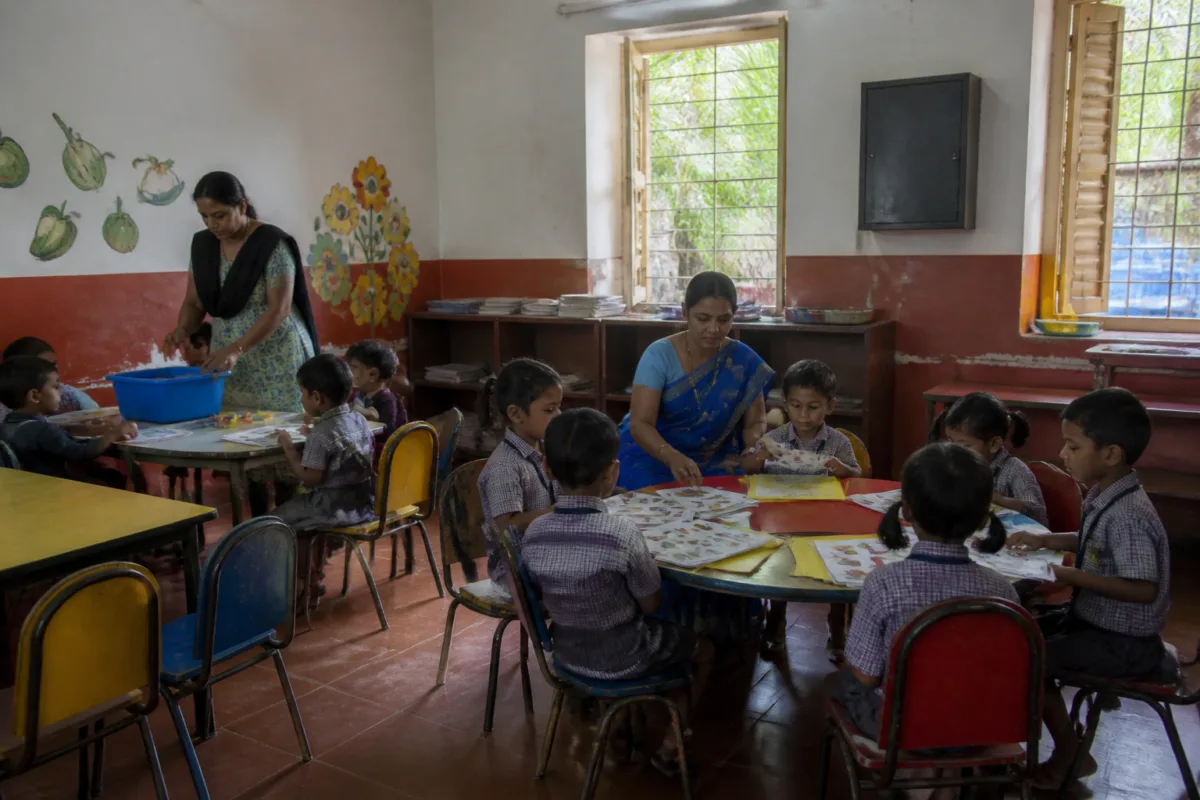
At Neura government primary school in Goa, the failure to fill one pre-primary vacancy has left two teachers managing seven classes. The immediate problem is administrative, but the larger warning is about the future of the state’s government-school network: children are increasingly moving to aided and private schools even as the government’s own pre-primary sections are supposed to feed enrolment into its primary classrooms.
The school’s pre-primary teacher completed a contract two months ago. Since then, students in nursery, lower kindergarten and upper kindergarten have been left without the teacher who was expected to handle those classes. Parents approached education department authorities and were assured that an appointment would be made, but they told the Times of India that no appointment had materialised.
The result is not simply an unfilled post. It is a breakdown in the transition between early childhood education and formal primary schooling. Two teachers are now expected to manage seven classes across the school. One parent told the newspaper that the quality of education could not be even average under those conditions.
That complaint points to a basic capacity problem. A school may continue to remain officially open, but its ability to provide meaningful classroom instruction depends on whether it has enough teachers for the number and spread of classes it conducts. When a vacancy remains open for months, the institution’s formal existence and its actual educational capacity begin to diverge.
The Neura case also matters because it sits at the beginning of the government-school pipeline. Pre-primary sections are intended to bring younger children into the state school system before they enter the primary grades. If these sections lack teachers or structured classroom activity, families may decide against enrolling their children in the government system at the first point of contact. That decision can affect enrolment several years later, when the child reaches Class I.
The available enrolment data indicates that this pipeline is already weakening. According to Directorate of Education data cited in the report, enrolment in Classes I to IV in Goa’s government primary schools fell from 17,027 students in 2025-26 to 15,163 in 2026-27. The reduction was 1,864 students, or nearly 2,000 in a single academic year. The report describes it as the biggest-ever dip in government primary school enrolment in the state.
This decline is not presented as an isolated fluctuation. The report places it within a continuing shift from government primary schools to government-aided and private schools. It also notes that hundreds of government primary schools have shut down in Goa over the past decade because of low enrolment. The precise number of closures is not provided in the supplied material, but the direction of change is clear: fewer children are entering the government system, and low enrolment is making the survival of individual schools more difficult.
That creates a self-reinforcing institutional problem. Falling enrolment can make a school appear less viable, while staffing shortages can make it less attractive to families. If reduced student numbers are followed by fewer teachers, fewer classes or weaker early-years provision, parents may be more likely to choose an aided or private school. The resulting fall in enrolment can then strengthen the case for further consolidation or closure.
The Neura school illustrates how that cycle can begin at the local level. The immediate trigger is a teacher’s contract ending. But the consequences extend beyond the vacancy itself. Nursery, lower kindergarten and upper kindergarten are separate stages of early education, and the report says two teachers are handling seven classes in total. Without sufficient staff, classroom time, supervision and continuity become difficult to maintain, even if the school remains operational on paper.
The institutional responsibility rests with the education department, which received the parents’ grievance and gave an assurance of appointment. The report does not establish why the post remained vacant, whether recruitment was delayed, whether a substitute teacher was available, or whether the department has a defined timeline for filling short-term vacancies. Those unanswered questions are important because a staffing gap caused by a contract ending requires a different administrative response from one caused by a sanctioned-post shortage or a wider recruitment freeze.
The distinction also matters for planning. If the state has enough sanctioned posts but cannot appoint teachers quickly, the problem may lie in contracts, recruitment procedures or administrative coordination. If posts are not sanctioned because enrolment is low, the state faces a more difficult policy choice: whether to maintain small schools as local public institutions or consolidate them into larger facilities. The supplied report does not provide the department’s position on that question.
The issue is also linked to the National Education Policy, 2020. The report states that the policy requires pre-primary education to be brought within the fold of formal schooling and calls for regulation of what and how children are taught from the age of three. The policy objective therefore depends not only on recognising pre-primary education but on providing the staff and institutional capacity needed to deliver it.
A pre-primary section without a teacher may satisfy an administrative structure in name while failing to provide the experience intended by the policy. The gap between policy design and delivery becomes especially visible in government schools because these institutions often serve as the most accessible public option for families who cannot or do not want to pay private-school fees. When capacity is uneven, families may read the shortage as a signal about the reliability of the entire system.
The enrolment figures make the scale of the pressure measurable. Government primary enrolment across Classes I to IV fell by 1,864 students in one year, from 17,027 to 15,163. That is a decline of about 11 per cent. The fall is large enough to affect school-level planning, teacher deployment and the viability of schools with already small cohorts. It also means that the question facing Goa is not simply how to fill one post at Neura, but how to prevent a wider loss of confidence in its government schools.
At the same time, the available evidence does not establish that the staffing gap at Neura caused the state-wide enrolment decline. The report presents the vacancy and the enrolment trend together as connected concerns, but it does not provide a causal study, school-wise enrolment data or evidence from parents across the state. Other factors may also influence school choice, but they are not identified in the supplied material. The defensible conclusion is narrower: teacher shortages at the pre-primary level can undermine the feeder function of government schools at a time when the system is already losing students.
This is the larger urban and public-institution question raised by the Neura case. Schools are part of the everyday infrastructure of settlements, particularly in villages and peripheral areas where access, distance and continuity matter to families. A school closure or a weakening of its early-years section changes how households organise childcare, travel and education. It can also reduce the number of public institutions available within a community, even when the immediate decision is described only as a staffing or enrolment matter.
The next test is whether the education department converts its assurance to parents into an appointment and whether similar vacancies exist elsewhere. The report does not state when a teacher will join Neura, whether the vacancy has been filled since the reported visit, or what measures the department plans to take to address the wider enrolment decline. Those details will determine whether the school’s problem remains a temporary staffing lapse or becomes another step in the contraction of Goa’s government-school network.

