


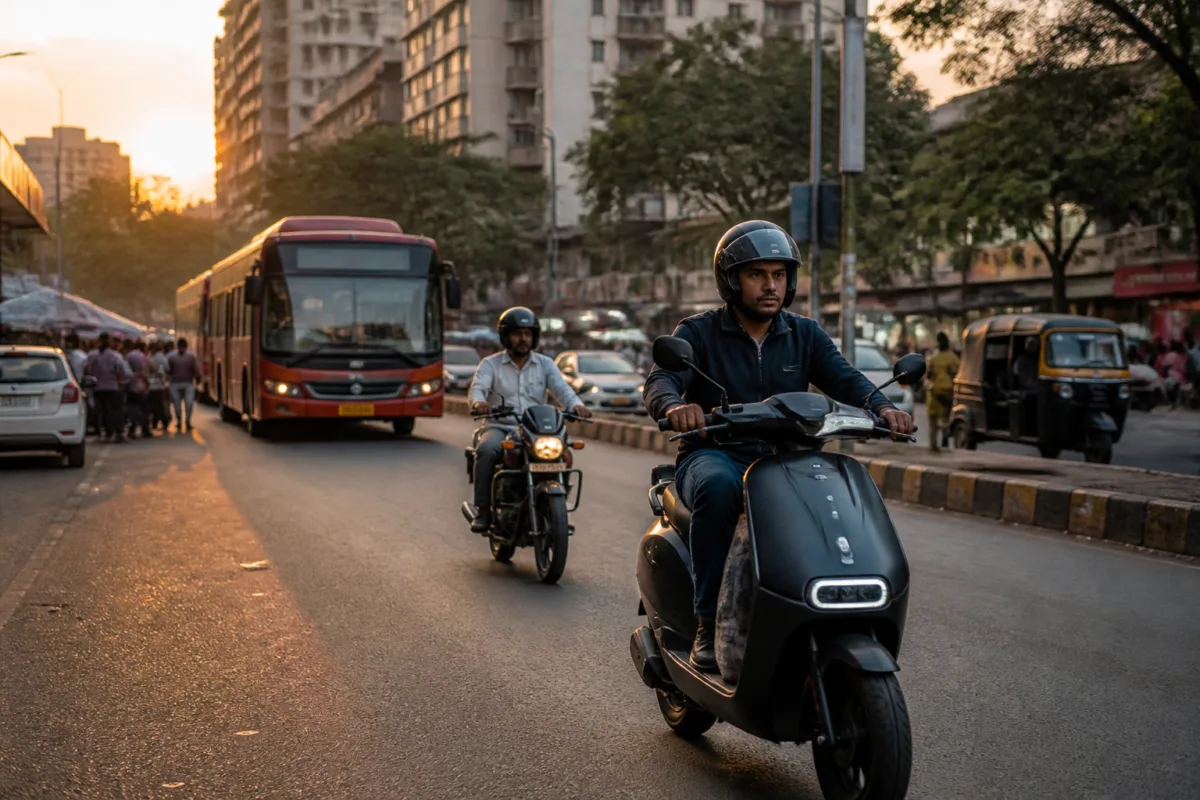
Hero MotoCorp’s latest earnings update reveals that India’s two-wheeler transition is being shaped by more than consumer demand. The company is trying to protect margins against commodity inflation while making its electric scooter business profitable, expanding flex-fuel vehicles and reducing dependence on a small number of overseas markets. Together, these moves show how manufacturers are adapting to an urban mobility market where technology, fuel availability, supply chains and affordability remain closely connected.
The company expects its operating profit margin to remain stable in the December quarter of financial year 2026-27 despite continued inflation in raw material costs. Chief financial officer Vivek Anand said the pressure would be addressed through cost rationalisation, an accelerated savings programme, improvements in the economics of its VIDA electric scooter business and selective price increases.
That response is significant because two-wheelers remain central to how millions of people access work, education and services in Indian cities and towns. Yet the economics of this market are under pressure from both sides. Manufacturers face higher input costs, while customers remain sensitive to vehicle prices and running costs. A company’s ability to absorb inflation without sharply raising prices can therefore influence the pace at which households replace older vehicles or shift to newer technologies.
Hero’s performance in the September quarter provides the immediate financial context. Consolidated net profit rose 41 per cent year on year to Rs 1,861 crore, while consolidated revenue increased 23 per cent to Rs 14,971 crore. The revenue figure included a one-time gain of Rs 397 crore connected to the equity consolidation of an associate company after it raised funds through a qualified institutional placement and private placement.
The company’s margin outlook also reflects a wider divergence within the vehicle industry. Major passenger vehicle makers, including Maruti Suzuki and Hyundai Motor India, reported lower net profits in the second quarter amid rising raw material costs. Major two-wheeler manufacturers, including Bajaj Auto, TVS Motor and Hero MotoCorp, continued to increase net profits during the same period.
For urban mobility, the difference matters because two-wheelers operate in a more price-sensitive and high-volume market. Their use is not limited to private commuting. They are also part of delivery networks, informal work arrangements and connections between residential areas and public transport stations. Cost increases can therefore affect both household mobility and the operating expenses of businesses that depend on motorcycles and scooters.
The most important structural signal in Hero’s update comes from VIDA, its electric scooter business. VIDA generated revenue of about Rs 1,000 crore during the quarter, while its drag on earnings before interest, tax, depreciation and amortisation narrowed to Rs 168 crore from Rs 232 crore in the preceding quarter. The company said the improvement resulted from better unit economics, cost optimisation and a higher share of higher-margin products.
Hero also said VIDA turned gross-margin positive during the quarter, ahead of its earlier guidance. Gross margin measures the revenue remaining after the direct cost of producing and selling a product, before other operating expenses. The improvement does not mean that the business has become fully profitable, since its EBITDA drag remained negative, but it indicates that the economics of each unit are moving in a more favourable direction.
That distinction is important in the electric two-wheeler market. Scaling sales without improving production costs can increase revenue while deepening losses. The reduction in VIDA’s EBITDA drag suggests that Hero is attempting to move beyond a volume-first strategy and build a business that can eventually support broader investment in electric mobility.
Production capacity is being expanded alongside the effort to improve unit economics. VIDA’s monthly production capacity reached 30,000 units in September, and Hero is working towards increasing it to 45,000 units by the fourth quarter. The company also recognised Rs 63 crore in production-linked incentive accruals and said nearly 100 per cent of its electric vehicle portfolio had received PLI certification by October.
The figures show how industrial policy is part of the electric mobility equation. Production-linked incentives can support manufacturers as they invest in domestic production and qualifying technologies, but certification and capacity do not by themselves resolve the challenges faced by consumers. Purchase prices, financing, service networks, battery confidence and charging access continue to influence whether electric two-wheelers become practical at scale.
Hero’s own flex-fuel rollout demonstrates a similar gap between vehicle capability and supporting infrastructure. The company has dispatched nearly 15,000 flex-fuel vehicles in India in a little over two months, but the rollout remains limited to selected dealerships because E85 fuel is not available across the country.
E85 contains up to 85 per cent ethanol. Hero chief executive officer Harshavardhan Chitale said some customers had begun buying the vehicles in areas where only E20 fuel was available, expecting to use E85 when it becomes locally accessible. The company’s experience points to a recurring challenge in transport transitions: vehicle technology can arrive before the network required to use it consistently.
For electric vehicles, the corresponding constraint is charging infrastructure. For flex-fuel vehicles, it is the distribution of compatible fuel. In both cases, the consumer’s decision depends on infrastructure that is outside the direct control of the vehicle manufacturer. This makes the transition a coordination problem involving companies, fuel suppliers, regulators and local infrastructure systems rather than a simple product launch.
The company is also seeking to reduce its dependence on a few export markets. Hero expects exports to return to double-digit growth in the third and fourth quarters after logistical disruptions affected shipments to Colombia and Bangladesh. Chitale said Colombia accounts for close to 25 per cent of the company’s exports and that both markets had created challenges during the quarter, although recovery was visible towards the end of the period.
The concentration of export exposure creates a supply-chain risk. Disruptions in one or two markets can affect production planning, inventory movement and revenue growth even when domestic demand remains resilient. Hero plans to expand in Brazil, Mexico and Africa, including through a manufacturing facility in Brazil. It expects its flex-fuel portfolio to support growth there and plans further launches and market entries in Africa.
This diversification is not only a corporate strategy. It also reflects how vehicle manufacturing is increasingly tied to regional regulatory and infrastructure conditions. A product designed for one fuel regime or consumer market may need changes before it can scale elsewhere. Local manufacturing can reduce logistical dependence, but it also requires sustained investment and an understanding of local demand.
Hero’s parts business remained strong, with revenue rising 27 per cent year on year in the September quarter. The company plans to invest Rs 1,500 crore during FY27 and had deployed about Rs 600 crore during the first half. Its Global Parts Centre 2.0 expansion is expected to double parts-handling capacity and become fully operational by the end of the next calendar year.
The parts business and the planned logistics expansion underline the importance of after-sales networks in two-wheeler mobility. The value of a vehicle to an urban household depends not only on the initial purchase but also on the availability, price and speed of repairs and replacement components. A larger parts-handling system can support that network, although the supplied information does not establish how the benefits will be distributed across locations or customer segments.
Hero expects the two-wheeler industry to record mid-to-high single-digit growth in the second half of the current financial year. That expectation sits alongside continued commodity inflation, selective price action and investments in electric and alternative-fuel technologies. The company is therefore managing several transitions at once: protecting margins, improving electric vehicle economics, building capacity, diversifying exports and expanding service infrastructure.
The evidence confirms that India’s mobility transition is not following a single path. Electric scooters, flex-fuel vehicles and conventional two-wheelers are developing in parallel, each constrained by a different combination of cost, infrastructure and market conditions. VIDA’s improving margins show progress on the manufacturing side, while the limited availability of E85 shows how infrastructure can restrict adoption even when products are ready.
The developments to monitor are specific: whether VIDA can reduce its EBITDA drag further as capacity rises, whether Hero’s export markets recover, how quickly the Brazil and Africa expansion takes shape, and whether fuel and service infrastructure develops alongside new vehicle technologies. For cities, the larger question is whether manufacturers’ product transitions are matched by the networks that make those products affordable and usable in everyday travel.

