


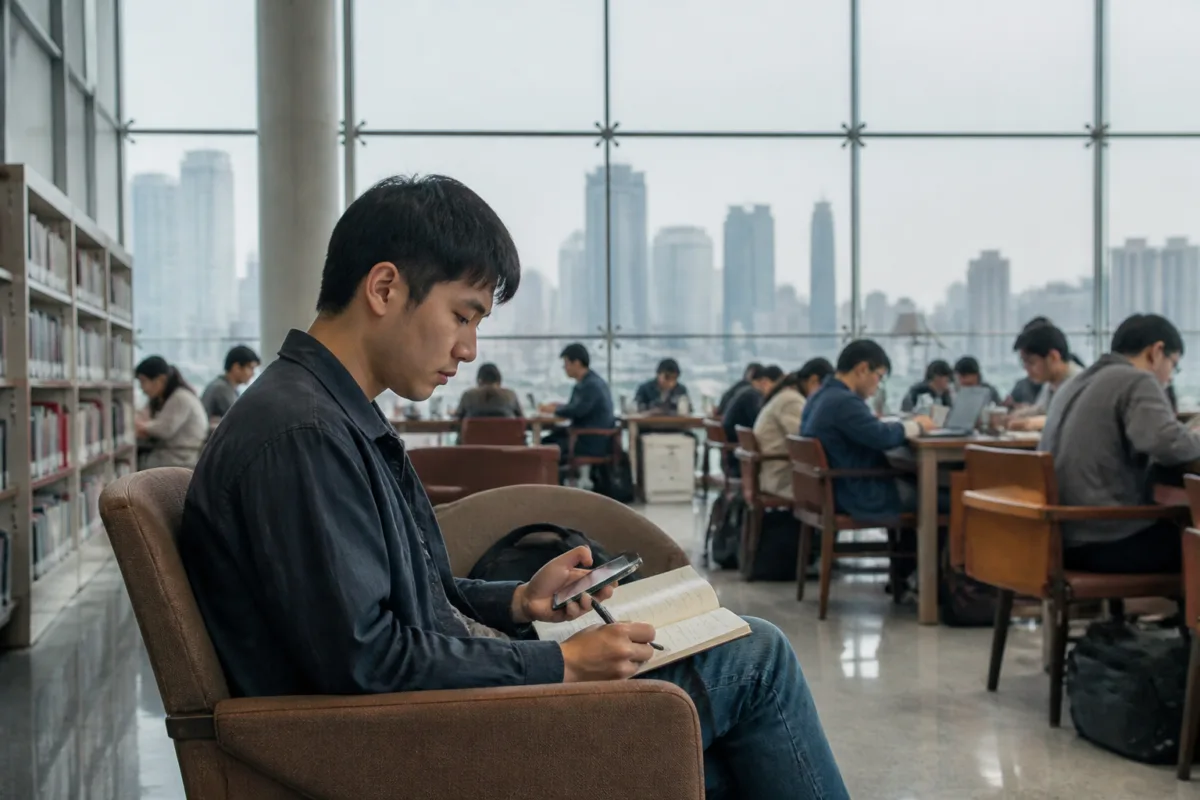
China’s unemployment crisis is no longer visible only in job applications, company payrolls or economic data. It is also appearing in the daily routines of people who leave home each morning, spend the day in libraries, parks, cafes or shopping malls, and return in the evening as if they had completed a normal working day. They have no workplace to report to, but maintaining the appearance of employment has become a way to manage family pressure, social expectations and the anxiety surrounding a difficult labour market.
The trend, described in a Reuters report carried by the Times of India, is being discussed widely on Chinese social media. Posts about people pretending to go to work have attracted more than 70 million views on Red Note, 610 million views on Douyin and up to 320 million views through related hashtags on Weibo. These figures do not establish how many people are unemployed or following such routines, but they show that the subject has become a significant public conversation.
The urban setting is central to this phenomenon. A person without a job still needs somewhere to spend the working day, particularly when returning home could invite questions from parents, relatives or housemates. Libraries, public parks, cafes and shopping malls become informal waiting rooms for a labour market that has not provided a stable place in the formal economy. The city’s everyday spaces are therefore being used not only for leisure, study or consumption, but also to conceal economic insecurity.
For 32-year-old Coco Li, a former employee of a Chinese state-owned property firm, the pressure of appearing employed shaped even ordinary communication with her family. After leaving her job more than six months earlier, she considered posting a photograph of a home-cooked meal in a family group chat but stopped because her mother might ask why she was at home during working hours. Li told Reuters that she feared her mother’s concern would create an endless cycle of anxiety without solving her employment problem.
Li’s experience illustrates the difference between being unemployed and being able to disclose unemployment. In a household where work is treated as proof of stability, leaving home at a fixed time can become a form of social protection. The routine does not generate income, but it can postpone difficult conversations and reduce the immediate pressure to explain a period without work.
That pressure is intensified by the geography of large Chinese cities. The source report describes people moving between public and commercial spaces during the day, often creating routines that resemble those of office workers. For some, the choice of location may depend on cost, privacy or availability. A library offers a place to remain for several hours without repeated spending, while a cafe or shopping mall can provide the appearance of an ordinary weekday schedule. The need to occupy time, however, can itself consume money and emotional energy.
The visibility of these routines has also altered how some urban residents interpret crowded weekday spaces. Zhang, a 36-year-old visual effects producer who said she lost her job in AI-driven redundancies in August, told Reuters that she had not expected a library to be completely full on a weekday. Her observation is significant not because it measures unemployment, but because it captures how labour-market disruption can become visible indirectly through changing patterns of public-space use.
The report places the trend within a wider set of economic pressures. Manufacturers, facing intense competition, have been cutting prices and reducing payrolls while expecting remaining employees to carry heavier workloads, according to the report’s account of third-quarter data. The property-market crisis and tight local-government finances have also affected jobs and incomes. Automation and the rapid adoption of artificial intelligence are adding another layer of uncertainty, particularly in sectors where tasks can be reorganised or roles eliminated.
These pressures do not affect only factories or technology companies. The property sector has a wider urban role because it links developers, construction activity, state-owned enterprises, local government revenue and household confidence. The source material does not provide a detailed breakdown of job losses by sector, but it identifies China’s prolonged property-market crisis as one of the factors affecting employment and income. For workers such as Li, who previously worked for a state-owned property firm, the sector’s difficulties are part of the personal experience of leaving a job and finding no straightforward replacement.
Local-government finances are another institutional part of the story. The report identifies tight local-government finances as a pressure on jobs and incomes, but does not specify individual city budgets, financing mechanisms or employment programmes. Even so, the connection matters: when local administrations face financial constraints, the effects can extend beyond public balance sheets into the pace of urban activity and the availability of stable employment. The supplied evidence does not establish a direct causal chain for every person featured, but it places their experiences within a broader system of economic adjustment.
The pattern also raises questions about the relationship between technological progress and employment security. Diana Fu, an associate professor of Chinese politics at Cornell University, told Reuters that pretending to go to work can help people save face and may also help defuse collective discontent. She argued that the practice helps preserve social stability while Beijing pursues automation and technological competition with the United States. Her assessment frames the private routine as part of a larger tension: the state and economy may seek faster technological change, while workers continue to depend on employment for income, identity and social standing.
That tension is especially visible in the account of Zhang, who said her job loss resulted from AI-driven redundancies. The report does not state whether her former employer replaced all affected workers with AI systems or quantify the number of redundancies. It does, however, place her experience alongside manufacturing payroll cuts and the broader adoption of automation. The evidence therefore supports a picture of multiple pressures converging on workers, rather than a claim that artificial intelligence alone is responsible for the employment situation.
Family structure makes the consequences more immediate. Susan Sun, 28, said she had concealed her layoff from an internet company since late last year. When her mother and stepfather moved from a smaller hometown to live with her in Chongqing while seeking work, maintaining the appearance of employment became more difficult. Sun left before 9 am and returned after 6 pm, following the rhythm of a working day despite having no job.
Sun told Reuters that she was living on monthly unemployment benefits of 1,864 yuan and the remaining money from her severance package. The figure provides one of the few concrete indicators of the financial conditions described in the report. It also shows why the routine cannot be considered cost-free. Unemployment benefits and severance may provide temporary support, but travel, food and time spent outside the home can gradually reduce available resources. The report says that Sun was willing to live on little, while the greater difficulty came from her parents’ concern and repeated reminders to save money because the economy was weak.
This creates an unusual urban contradiction. Cities offer a large supply of places where a person can spend the day without an employer, yet access to those spaces is not always economically neutral. Public libraries and parks may reduce spending, but commercial spaces can require regular purchases. The city can absorb unemployed people physically without necessarily providing the institutional support needed to help them return to work.
The comparison with South Korea and Japan during the Asian financial crisis of the 1990s adds historical context, although the report does not provide a detailed comparison of unemployment rates, welfare systems or urban conditions. It notes that some salarymen in those countries concealed joblessness during that period. The recurring pattern is the importance of appearances when employment carries social value beyond the wage itself. A person may be without work, but still feel compelled to perform the schedule and movements associated with having a job.
The strength of the current Chinese discussion lies partly in its scale online. A post documenting a month of unemployment and 80 unsuccessful job applications shows how joblessness is being recorded as a daily process rather than a single event. Other users share practical guidance on filling working hours, avoiding relatives’ questions and maintaining a routine. The online conversation transforms a private coping mechanism into a recognisable social category, allowing people to identify others facing similar conditions.
At the same time, visibility on social media should not be mistaken for a complete measure of the labour market. The figures cited by the report are views, not unique users, and they do not show how many people have adopted the practice. They demonstrate attention and recognition, but not the total scale of unemployment. The source also does not provide a city-by-city comparison or data on how many people receive unemployment benefits.
The institutional question is whether employment disruption is being met only through individual adaptation. The people described in the report create personal systems for managing time, family expectations and limited money. Yet the underlying causes identified include property-market weakness, local-government financial pressure, payroll reductions, automation and AI-driven redundancies. These are structural forces that cannot be resolved through routine alone.
Yige Dong, an assistant professor of sociology at the University at Buffalo, told Reuters that China’s social safety net is relatively thin compared with the support systems available in Japan and South Korea during the 1990s. The report does not quantify that difference, but the observation points to the importance of income support and social protection when workers lose jobs during a period of economic transition. Without adequate support, unemployed people may have to spend scarce resources not only searching for work but also hiding the fact that they are searching.
China’s pretend-work routines therefore reveal more than a cultural preference for saving face. They show how the experience of unemployment is distributed through households, public spaces and digital platforms. Libraries filling on weekdays, people leaving home before 9 am and social-media posts about unsuccessful applications are all indirect signs of labour-market stress. None alone can measure the problem, but together they show how economic insecurity is entering the ordinary geography of the city.
What remains uncertain is the scale and durability of the trend. The supplied report does not establish how many people are involved, whether the routines are concentrated among particular age groups or cities, or how long individuals can sustain them financially. The developments that deserve monitoring are the employment effects of property-market weakness, local-government financial constraints, manufacturing payroll reductions and AI-related restructuring, alongside the adequacy of unemployment support. For now, the evidence confirms that joblessness is being managed not only through applications and benefits, but also through carefully maintained urban routines that make unemployment less visible to families and society.

