


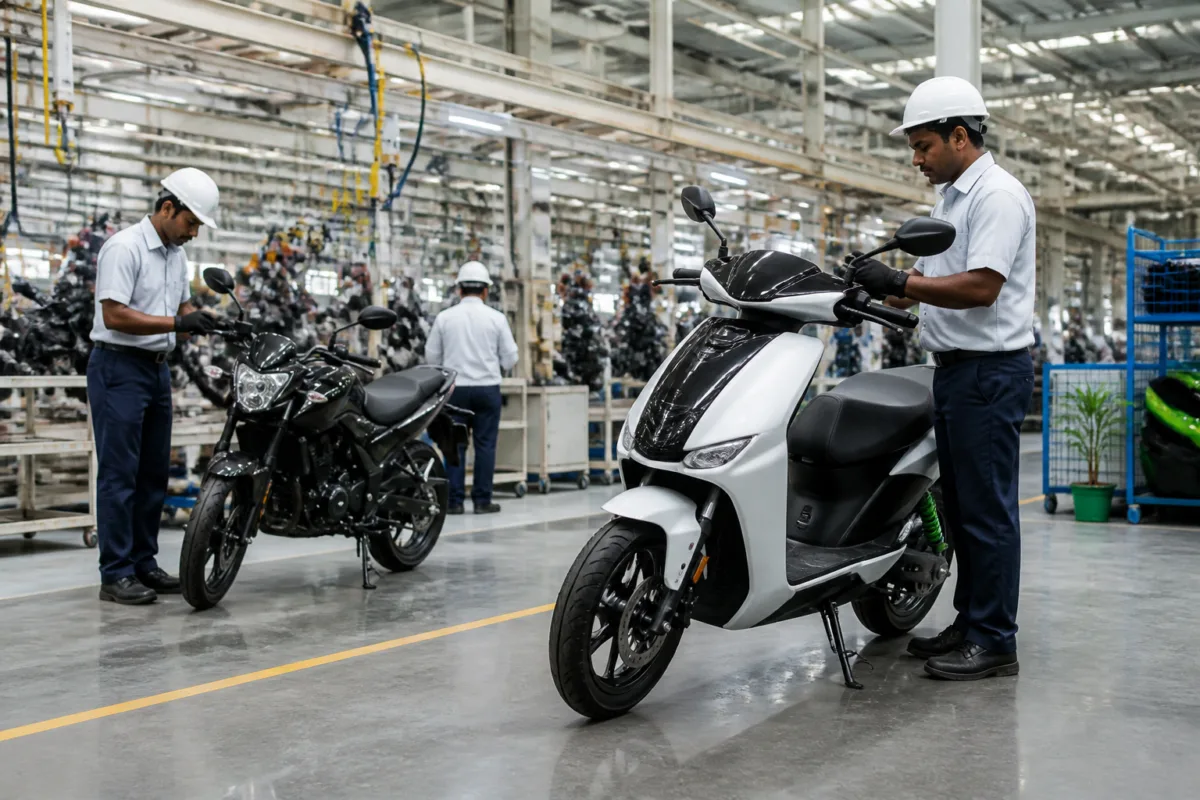
Hero MotoCorp’s decision to maintain its investment programme despite pressure on margins offers a useful view of how India’s two-wheeler industry is managing the transition between established internal-combustion-engine products and a growing electric-vehicle business. The company has retained its full-year capital-expenditure guidance of ₹1,500 crore while expanding capacity, investing in its parts network and scaling its Vida electric scooter portfolio.
The announcement came after a quarter in which the company said commodity-cost increases affected profitability. Yet Hero MotoCorp’s management argued that cutting growth expenditure would risk weakening the company’s market position at a time when premium scooters, electric two-wheelers and international operations are becoming more important to its business mix.
That combination is significant for urban mobility because two-wheelers remain closely tied to everyday travel in Indian cities and towns. Changes in their price, availability, technology and operating economics affect commuting choices, delivery activity and access to employment. The company’s investment decisions therefore provide more than a snapshot of one manufacturer’s financial strategy: they show how a major mobility business is allocating capital while demand patterns are changing.
Hero MotoCorp Chief Executive Officer Harshvardhan Chitale said during a post-earnings call with analysts that the company was not prepared to reduce investment required to drive growth and expand market share. He pointed to the second quarter as evidence that the company could absorb commodity-cost pressure while continuing to gain Vahan share in every month of the quarter.
The company reported that its consolidated revenue from operations grew 23.4 per cent year-on-year to ₹14,970.5 crore in the July-September quarter. Its net profit rose 42 per cent year-on-year to ₹1,861 crore, according to the information supplied by the company and reported by The Hindu BusinessLine. These results form the immediate financial backdrop to the decision to preserve capital spending.
The key distinction in Hero MotoCorp’s position is between discretionary expenditure and investment considered necessary for future growth. Chitale said the company expected several levers to improve performance in the coming quarters, including better unit economics for its products. He described the required investments behind growth and market-share expansion as non-discretionary from the company’s perspective.
This approach places capacity and product development at the centre of the company’s strategy. Chief Financial Officer Vivek Anand said Hero MotoCorp remained on track with its full-year capital-expenditure guidance of ₹1,500 crore. During the first half of the financial year, the company had already deployed close to ₹600 crore towards key projects.
Part of that spending has gone into established product lines. Hero MotoCorp said it had expanded capacity for the Splendor range and doubled its internal-combustion-engine scooter capacity to 80,000 units a month. This is an important counterpoint to the company’s EV push. The investment programme is not an immediate replacement of conventional two-wheelers with electric models; it is a parallel expansion across product categories.
That dual-track strategy reflects the present structure of the market described in the company’s update. The existing internal-combustion-engine business continues to provide scale, while the electric business is being expanded across production, pricing and distribution. The company’s investment choices indicate that it does not see the EV transition as a reason to reduce support for its established portfolio.
The Vida business is the clearest indicator of the change taking place inside the company. Retail volumes for Vida rose 74 per cent year-on-year to 66,000 units in the quarter. Monthly production reached 30,000 units in September, while the portfolio was diversified across broader price points. The company also said Vida became gross-margin positive during the quarter, resulting in ₹70 crore of spending optimisation compared with the previous quarter.
These figures show two different stages of EV development. Volume growth indicates that the product is gaining operational momentum, while gross-margin improvement suggests that the business is moving beyond a purely expansion-led phase. However, the supplied information does not establish whether Vida is profitable at the operating or net-profit level. The confirmed point is narrower: the business became gross-margin positive and reduced spending by ₹70 crore compared with the previous quarter.
Hero MotoCorp also said 70 per cent of its EV portfolio received production-linked incentive certification during the quarter. It had received certification for nearly 100 per cent of its portfolio earlier in the month. The PLI framework is therefore part of the company’s EV economics, although the supplied material does not specify the amount of incentive received or the precise products covered.
The certification matters because electric-vehicle manufacturing is being shaped not only by customer demand but also by production-linked industrial policy. For manufacturers, eligibility can affect the economics of scaling production and the competitiveness of products. In Hero MotoCorp’s case, the company’s comments connect EV expansion with both operating improvement and the formal certification process.
The investment in the parts business adds another layer to the story. Hero MotoCorp has announced ₹700 crore for a new automated parts centre, identified as its second global parts centre, or GPC 2.0. The facility is intended to double the company’s parts-handling capacity and support availability for Indian and international markets.
Parts availability is an operational issue with direct consequences for vehicle ownership. A larger and more automated distribution system can support servicing and repairs across a wider vehicle base, although the supplied information does not provide a completion date, location or projected employment figure for the new centre. The company’s stated objective is to support both domestic and global markets as its parts and accessories business grows.
This investment also shows why the transition to electric mobility cannot be measured only through vehicle sales. Manufacturing capacity, after-sales systems, supply chains and product economics all influence whether a mobility platform can scale. Hero MotoCorp’s capital programme includes each of these components: conventional vehicle capacity, electric production, brand-building expenditure and parts logistics.
The company’s festival-sales data provides another indication of its current market position. Hero MotoCorp said sales had grown 24 per cent over a broader festival period designed to avoid distortions created by the timing of the previous year’s GST change and the resulting pent-up demand. Chitale said the company was not seeing market-share erosion on this broader comparison.
The qualification around the comparison is important. The company did not rely only on a year-on-year comparison from the start of Navratri, because the previous year’s GST change had created an unusually strong demand effect. Instead, management used a longer period to assess sales performance. The supplied material does not provide absolute festival sales volumes, but it does provide the company’s reported 24 per cent growth rate and its interpretation that market share had held.
Taken together, the figures point to a business attempting to protect scale while changing its product mix. The company is expanding ICE scooter capacity to 80,000 units per month, increasing Vida production, strengthening parts handling and maintaining spending on brand building. Each investment addresses a different constraint: product availability, EV scale, ownership support or consumer demand.
For urban mobility, the broader question is whether electric two-wheelers can move from a growth segment into a dependable mass-market option without weakening the affordability and availability that have made two-wheelers important to Indian households. The company’s data shows progress in retail volumes, production and gross margins, but it does not establish how Vida compares with conventional vehicles on total ownership cost, charging access, resale value or usage across different city contexts.
Those unanswered questions are central to the next phase of the transition. Production capacity can increase supply, but adoption also depends on the ability of customers to access vehicles, maintain them and use them reliably. Similarly, PLI certification can support manufacturing economics, but it does not by itself demonstrate the scale of consumer adoption or the financial sustainability of the business.
The available evidence nevertheless confirms a clear strategic choice. Hero MotoCorp is not treating margin protection as a reason to pause expansion. It is retaining ₹1,500 crore of annual capital-expenditure guidance, deploying investment across ICE and EV capacity, committing ₹700 crore to parts infrastructure and reporting stronger Vida volumes alongside improving gross margins.
The next developments to monitor are the company’s execution of the remaining capital programme, the expansion of Vida’s monthly production beyond the September level, the completion of the new automated parts centre and the extent to which EV portfolio certification translates into sustained sales and stronger unit economics. For now, Hero MotoCorp’s investment pattern shows an industry preparing for a more varied two-wheeler market rather than making a sudden shift away from its established base.

