


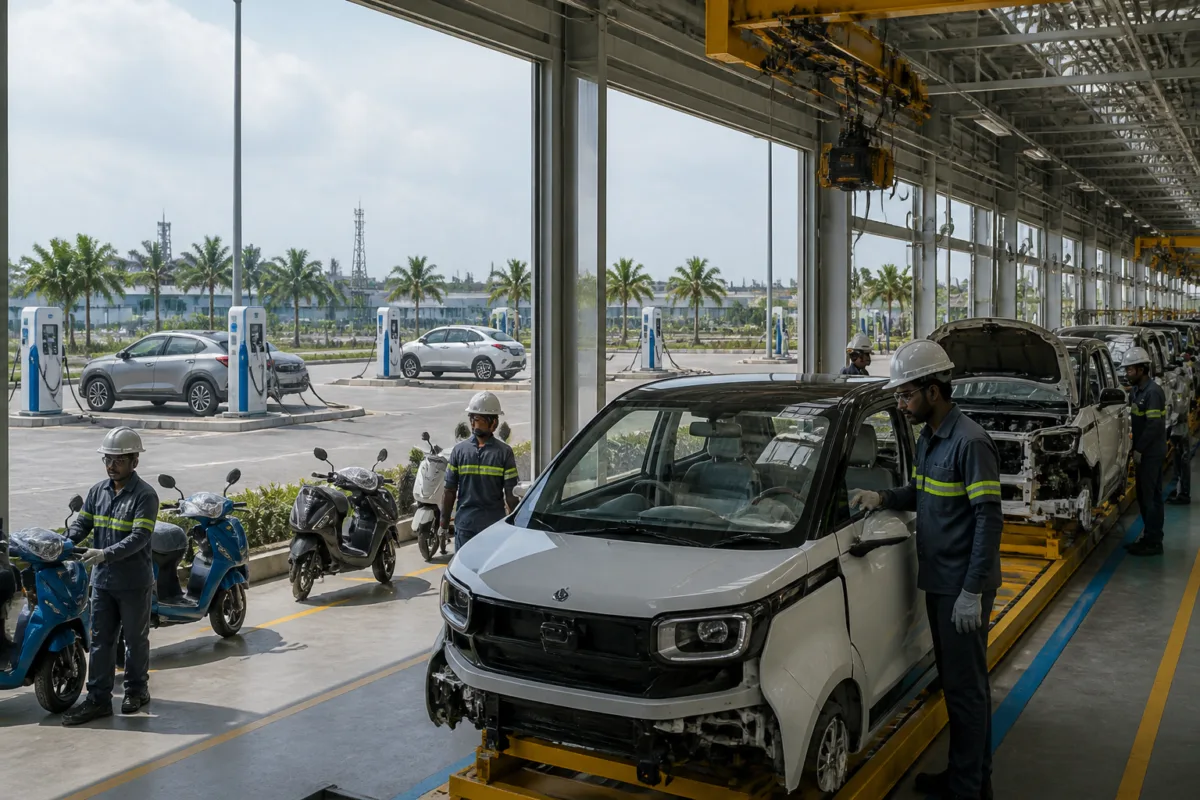
VinFast is positioning its proposed expansion in India around two connected requirements of electric mobility: manufacturing capacity and access to charging infrastructure. The Vietnam-based company plans to begin electric two-wheeler production at its facility in Thoothukudi, Tamil Nadu, while expanding its four-wheeler portfolio and charging network.
Company officials told PTI that VinFast plans to enter India’s electric two-wheeler market with two models as early as the first half of 2027. A two-wheeler production line has already been installed at the Thoothukudi facility, according to Anurag Saxena, Market CEO for two-wheelers at VinFast India.
The company is initially studying battery-powered scooters and has not yet disclosed a specific range for the planned models. Saxena said the vehicles could also offer a battery-swapping option. VinFast is conducting trials and pursuing dealership tie-ups across cities, he said.
The proposed two-wheeler entry would add another manufacturing stream to a facility that the company is using for electric cars. Tapan Ghosh, CEO of VinFast Asia for the four-wheeler business, said the company aims to reach the facility’s current annual capacity of 50,000 four-wheelers. The plant can potentially be expanded to produce 1,50,000 four-wheelers annually, with the company also considering supplies to other Asian markets from India.
VinFast currently sells four electric car models in India, according to the report: the VF 6, VF 7, VF MPV 7 and Limo Green. The company plans to introduce the VF 5 early next year and has said it intends to add at least two car models in India every year. Its product strategy is focused partly on compact SUVs, which Ghosh said were attracting interest from first-time buyers seeking an option more powerful than entry-level hatchbacks with engines of 1,000 cc or below.
The expansion also has a localisation component. VinFast officials said local sourcing currently accounts for 15 per cent of the company’s requirements and is expected to double. A higher local-sourcing share could broaden the domestic supplier base for electric-vehicle manufacturing, although the company has not provided further details on the materials, components or suppliers involved.
Charging access is the other major infrastructure element in the company’s plans. VinFast officials said VinGroup has invested USD 500 million in India so far and has a broader investment plan of USD 2 billion across sectors, including charging stations. V-GREEN, described as a VinGroup arm, is setting up charging stations and entering tie-ups with existing charging companies to expand coverage for two- and four-wheeler customers.
The company said it is offering free charging until 2029, along with a long-term battery guarantee and a buyback option for pre-owned VinFast vehicles after the registration period. Officials said the same strategy would be applied to two-wheelers. These are company-provided commercial terms and their implementation will depend on the availability of participating charging locations and dealerships.
VinFast has also recently signed an agreement with the Tamil Nadu government to acquire another 500 acres for a future expansion of the facility, according to the PTI report. The proposed land addition would give the company room to scale manufacturing, but the report does not specify the acquisition value, construction schedule, approvals or the precise development planned on the land.
Taken together, the company’s plans point to an industrial strategy in which vehicle assembly, supplier localisation, retail dealerships and charging access are developed alongside one another. The immediate built-environment implications are concentrated in Thoothukudi, where manufacturing capacity and land requirements could increase, and in the cities where VinFast plans dealership and charging tie-ups. The scale and timing of that expansion remain dependent on the company’s future investment and rollout decisions.

