


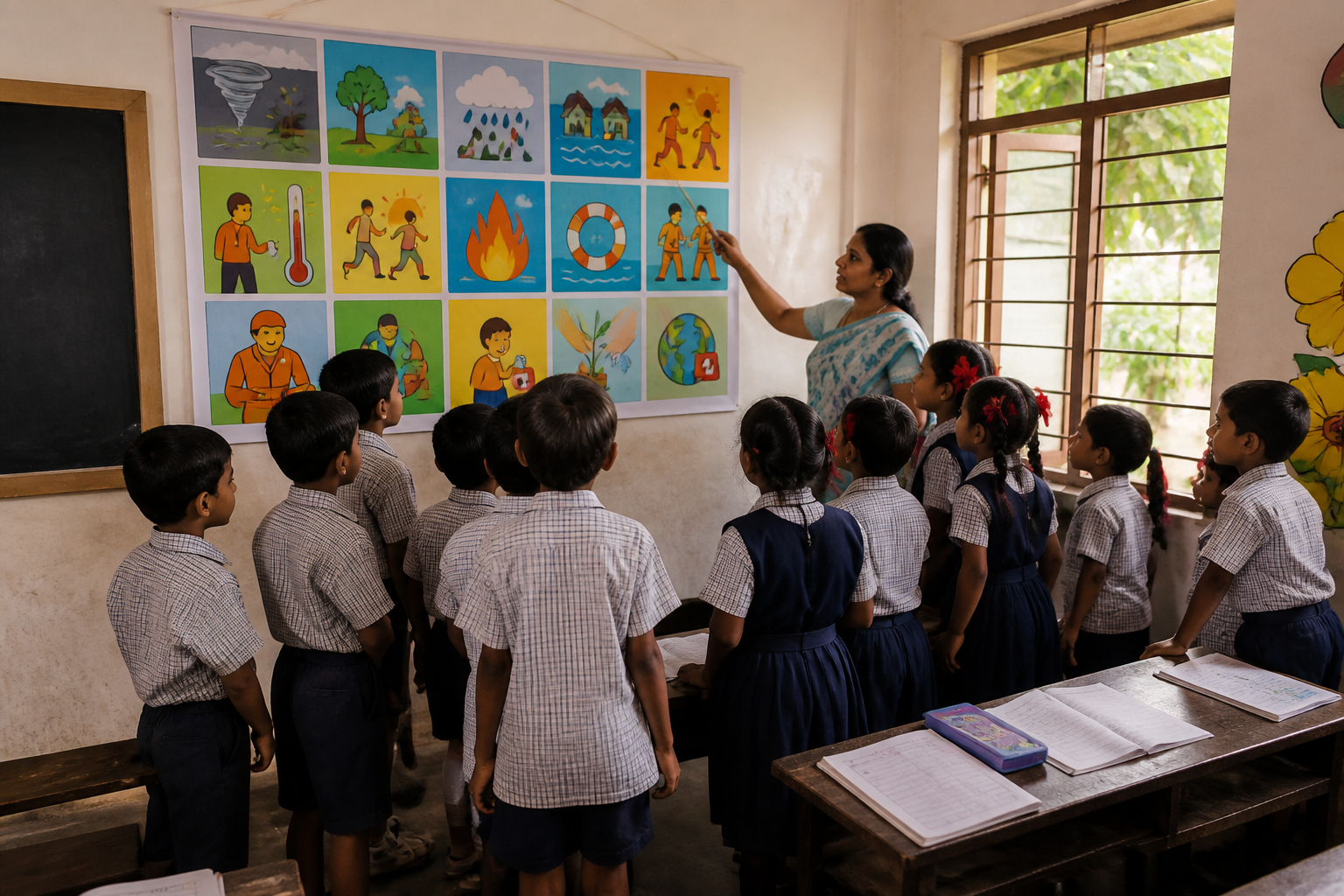
A disaster preparedness alphabet developed by a Palghar official for his toddler has moved into government classrooms in Maharashtra, showing how emergency knowledge can be introduced through a familiar school-learning format. The chart is not part of the formal syllabus, but it is being used as a supplementary resource to explain hazards, response systems and safety behaviour to children.
That shift matters because disaster management is often encountered by citizens only when an emergency is already under way. The alphabet attempts to move some of that learning earlier, into the routine environment of primary education. Its terms range from alert systems and evacuation to floods, landslides, chemical hazards, rescue operations and risk reduction. In doing so, it treats preparedness not only as an administrative function but also as a form of public knowledge.
The initiative was created by Vivekanand Kadam, Palghar District Disaster Management Officer. According to the account of its development, Kadam began thinking in 2024 about the effects that climate change and disasters could have over the next two to three decades. He initially prepared the alphabet for his toddler, Vedansh, before expanding it into a learning tool for schools. It was formally launched on July 26, 2025, on Kargil Vijay Diwas.
Kadam said he consulted a United Nations climate dictionary while selecting the terms. The result is a 26-letter chart that uses short explanations and visual learning to introduce concepts that can otherwise appear technical or distant to young students. The approach is built around repetition and familiarity: children encounter disaster-related vocabulary through the same alphabet structure used to learn basic words.
The selection of terms reveals the breadth of the initiative. A stands for Alert, B for Bunker and C for Cyclone. Other entries include E for Environmental Degradation, F for Flood, G for Glacier Melting, H for Hazard, M for Mitigation and R for Risk Reduction. Z stands for Seismic Zone and explains that different regions have different levels of vulnerability to earthquakes.
The chart also introduces the institutional systems that operate during emergencies. N refers to the National Disaster Response Force, O to an Operation Centre, P to a Public Address System and Q to a Quick Response Team. V explains Very High Frequency, the radio band used by emergency teams, while W refers to the World Meteorological Organization and U to a United Nations office.
This combination is significant. Children are not being taught only the names of hazards; they are also being introduced to the people, agencies and communication systems involved in responding to them. The inclusion of public address systems, radio communication and operation centres connects individual safety behaviour to the wider machinery of disaster management.
Other entries are more specific and reflect the variety of risks that the chart seeks to cover. I stands for Isolation Ward, J for Jumping Net, a safety net used in rescues from heights, X for Xylene, which introduces chemical hazards, and Y for Yachting Accident, linking the alphabet to water safety and boating incidents. K for Know Your Strengths asks children to understand their own abilities and limits so they can act safely and seek help.
The chart therefore operates across three levels. It introduces the hazards themselves, explains concepts such as mitigation and risk reduction, and describes the response infrastructure that becomes important during an emergency. That structure gives the material a practical purpose, even though the source account does not establish how the lessons are assessed against a formal learning standard or how consistently they are delivered across schools.
The initiative’s use in classrooms also places teachers at the centre of translation and interpretation. The terms are explained in Marathi, although the chart itself uses English disaster-management vocabulary. This allows technical words to remain recognisable while making their meaning accessible to local students. The approach also acknowledges that disaster communication depends not only on the existence of information but on whether people understand it in the language and context in which they live.
The alphabet has travelled beyond Palghar. Pawan Khandke, the District Disaster Management Officer in Parbhani, said the charts had been distributed in 50 Zilla Parishad primary schools. Children receive homework and assignments based on the material, and students who perform well are recognised, he said. This indicates that the chart is being used as more than a poster: in at least some schools, it has become the basis for classroom activity and student participation.
At the same time, the available evidence describes an initiative that remains supplementary rather than a formal state-wide curricular programme. The account does not provide the total number of schools using it, the number of districts that have adopted it, or an evaluation of whether students retain the concepts or respond differently during drills and emergencies. Those gaps do not remove the value of the experiment, but they define what can currently be established about its reach and effectiveness.
The administrative design is also notable. The material did not originate as a large centrally announced scheme. It began with a district disaster-management officer and was later adapted for schools, with other districts taking it up. That pathway suggests a model in which local officials create communication tools suited to their responsibilities and educational institutions provide a ready setting for distributing them.
Such a model places disaster management within the everyday public infrastructure of the school system. Government schools already connect administrations with children, families and neighbourhoods. A classroom lesson can therefore become a route through which safety vocabulary reaches households as well. The supplied account does not measure that wider effect, but the possibility is built into the format: children learn the terms, complete assignments and encounter the subject repeatedly.
The choice of an alphabet is equally important from an institutional perspective. Disaster preparedness is frequently communicated through advisories, drills, posters and emergency instructions, all of which can become episodic or difficult to remember. The alphabet creates a fixed sequence that teachers and students can revisit. It also allows different districts to use a common structure while explaining terms through local teaching practices.
However, the chart cannot replace operational preparedness. Knowing the meaning of evacuation, alert or quick response does not by itself establish whether a school has a functioning evacuation plan, an accessible public address system, trained staff or safe assembly areas. The source material does not claim that the alphabet performs those functions. Its role is narrower: it provides an entry point into the language of disaster management.
That distinction is central to understanding the initiative. Public awareness is one part of resilience, while infrastructure, institutional coordination and response capacity are others. The chart addresses the first of these by making risks visible to children. Its long-term value will depend on whether that awareness is connected to practical exercises, clear school procedures and reliable local response systems, none of which are detailed in the available account.
The evidence currently confirms three developments: the chart was created by a Palghar district official, it was formally launched in July 2025 and it has been adopted as a supplementary classroom resource, including in 50 Zilla Parishad primary schools in Parbhani according to that district’s disaster-management officer. It does not yet establish a statewide implementation framework or measurable outcomes.
The larger urban and public-systems question is how governments can make disaster knowledge routine before an emergency occurs. Maharashtra’s school-based alphabet offers one locally developed answer. Its significance lies less in the novelty of the chart than in the institutional route it represents: disaster management entering classrooms through district administration, teacher-led explanation and repeated contact with children. The next developments to monitor are its wider adoption, the consistency of classroom use and whether it becomes linked to formal school safety and emergency-preparedness practices.
