


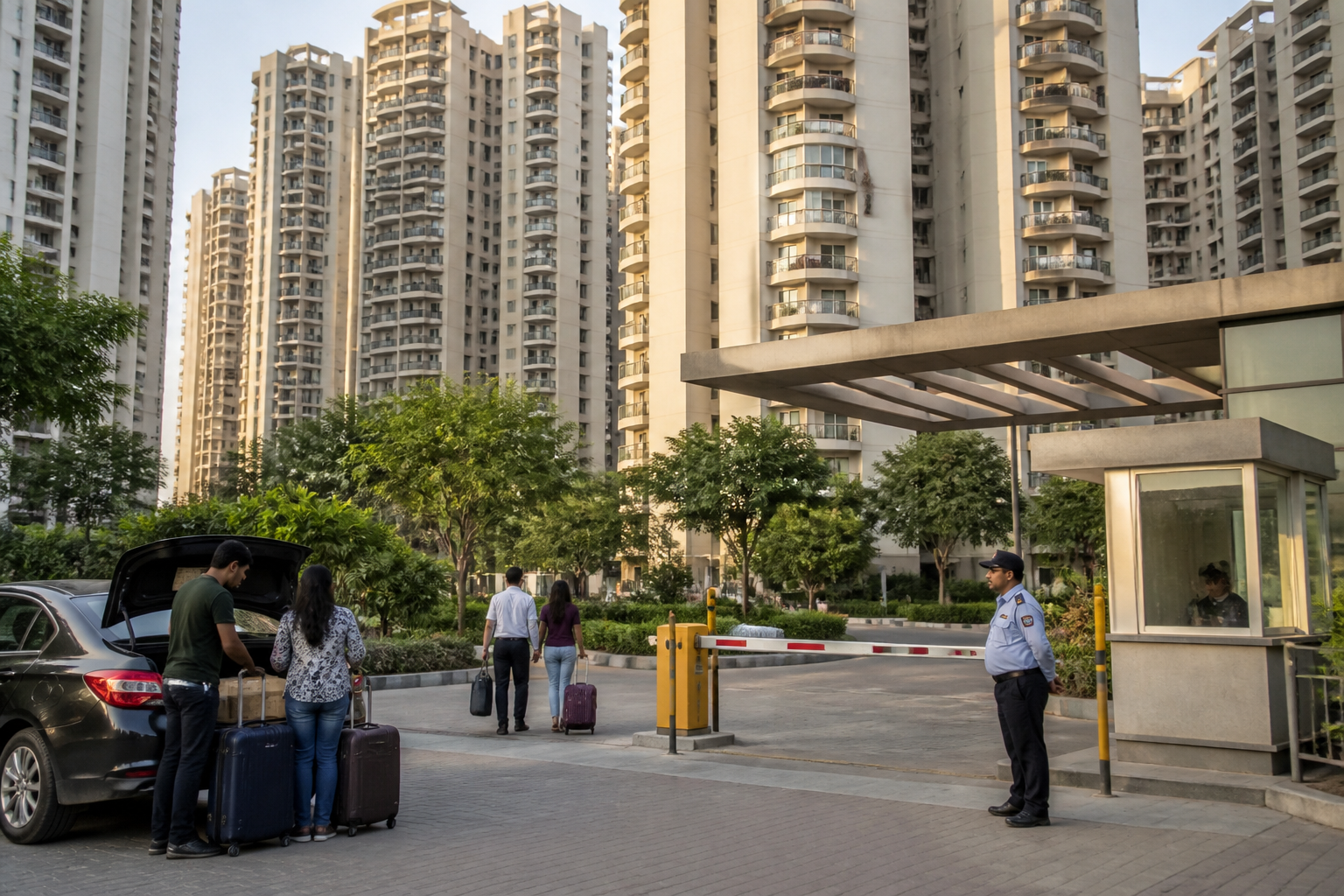
A new tenancy policy at Supertech’s Supernova in Noida Sector 94 has placed bachelor and student tenants at the centre of a dispute over who can occupy privately owned homes, how apartment associations should regulate residents and where the boundary lies between community safety and tenant choice. The policy asks homeowners to give such tenants one month’s notice and replace them, preferably with families, unless the tenancy committee clears the arrangement.
The decision is not simply a housing-society rule about preferred tenants. It reflects a recurring urban governance problem: apartment complexes are expected to function as secure, orderly residential communities, but they are also collections of individually owned homes whose owners depend on the rental market. When complaints about noise, short-term stays or alleged illegal activity rise, resident associations often become the first institutions to impose controls. The Supernova policy shows how those controls can extend from regulating conduct to reviewing the identity and category of tenants.
The policy, titled the ‘Policy for Regulation of Tenancies, Occupancy and Resident Conduct, 2026’, was issued recently by the Supernova Apartment Owners’ Association. It asks owners not to rent flats to students and bachelors in the first place, and to prefer families, working professionals or members of any other “lawful category”. If an owner wants to continue with a student or bachelor tenant, the tenancy committee may review the decision. The policy says that if the committee does not provide clearance, the owner must have the premises vacated within a month of receiving notice from the committee.
That framework creates a layered system of control. The owner remains the formal landlord, but the association and its tenancy committee acquire a decisive role in determining whether a proposed occupant can remain. The policy therefore treats tenancy not only as a private contract but also as a matter of collective residential administration. Its stated purpose is to regulate occupancy and resident conduct, but its operation depends on deciding which forms of occupancy are acceptable within the complex.
The association’s justification is linked to complaints in Supernova East and West, a residential complex of around 500 flats. The policy lists alleged nuisance involving loud music, smoking and drinking, as well as alleged illicit activities including drug consumption, illegal call centres involved in online fraud and prostitution rackets. It also refers to concerns that flats are being used for short-term stays and commercial purposes rather than sanctioned residential use.
These complaints point to a genuine management challenge in large apartment developments. A residential building is designed around assumptions about occupancy, access control, common-area use and the capacity of security systems. Short-term guests, frequent tenant turnover and commercial activity can make it harder for an association to know who is using a property and for what purpose. The policy’s restriction on the number of occupants inconsistent with a flat’s size or sanctioned residential use is aimed at that operational problem.
But the policy also places different issues within the same regulatory frame. Loud parties, overcrowding, commercial misuse and alleged criminal activity are conduct or use-of-premises concerns. Being a bachelor or a student is an occupant category. Treating these as interchangeable can shift the focus from what a resident does to who the resident is. The supplied report does not establish that bachelor or student tenants were responsible for all, or any specific proportion, of the complaints cited by the association.
An incident referred to in the policy’s background illustrates how security concerns can shape residential rules. On October 1, a video circulated on social media showing Tushar Sharma, a Sector 15 resident, allegedly operating a rented facility in Spira, a Supernova tower, arguing with a security guard after reaching the wrong gate. The report says Sharma allegedly forced his way into the premises in a car. Noida Police later arrested him on preventive grounds, seized his vehicle and issued challans.
The incident is separate from the general question of tenancy, but it appears to have contributed to the atmosphere in which the association introduced tighter rules. The report does not say that Sharma was a bachelor or student tenant, nor does it establish that the incident was connected to the wider complaints about tenancy practices. That distinction matters because individual incidents can trigger broad housing policies even when the evidence linking them to an entire category of residents is not demonstrated.
The central institutional question is who should decide whether a tenancy is acceptable. Apartment associations have responsibilities for common areas, security procedures, occupancy management and resident conduct. The Supernova policy also seeks to ensure that flats remain within sanctioned residential use, which is a planning and building-use concern rather than merely a question of resident preference. At the same time, the policy’s practical effect is to give a private committee the power to review and potentially end a tenancy involving a bachelor or student.
The source report does not provide the policy’s full enforcement process, the committee’s composition, the criteria for clearance, the appeal mechanism or the legal basis for requiring a tenant to leave within one month. It also does not record responses from affected tenants, homeowners, Noida authorities or the police on the policy itself. Those gaps prevent a conclusion about how the rules will operate in individual cases or whether they will withstand external scrutiny.
What is clear is that the policy attempts to solve multiple pressures through one instrument. It addresses short-term and commercial use, occupancy levels, alleged nuisance and alleged criminal activity, while also expressing a preference for families and working professionals. The breadth of that approach may make administration simpler for the association, but it can also make enforcement less transparent if clearly defined conduct violations are not separated from broad tenant classifications.
The policy also reveals the growing importance of private governance in India’s apartment cities. In a large residential complex, the association controls many of the systems residents encounter daily: security gates, visitor access, common facilities, internal rules and responses to complaints. These bodies often operate between the individual household and public authorities. They are close enough to respond quickly to local problems, but their decisions can affect housing access and tenancy security without the same visibility associated with municipal or statutory institutions.
Supernova’s proposed controls are therefore part of a broader tension within urban housing. Owners want the ability to rent out their homes, while associations want predictable occupancy and control over building use. Residents want protection from nuisance and unsafe activity, while tenants need rules that are clear, consistently applied and not based only on social assumptions. The policy’s emphasis on sanctioned residential use addresses a legitimate built-environment concern, but the report does not show how the association will distinguish unlawful use from lawful occupancy by a particular type of tenant.
The complex’s size makes the issue more significant than a dispute involving a single landlord and tenant. With around 500 flats in Supernova East and West, even small changes in rental patterns can affect security operations, parking, visitor management and common-area use. Conversely, a blanket preference for certain household types can narrow the rental options available to students and single workers in a city where proximity to jobs and education often shapes housing demand. The supplied material does not provide rental data or quantify how many flats are occupied by such tenants, so the scale of that effect remains unestablished.
The evidence currently confirms three things: the association has issued a tenancy and conduct policy; it has linked the rules to complaints about nuisance, alleged illicit activity, short-term stays and commercial use; and the policy allows committee review of tenancies involving students and bachelors. It does not establish how many tenants have received notices, whether any tenancy has already been terminated under the rules, or whether Noida’s civic or planning authorities have approved or reviewed the policy.
The next stage will depend on implementation. The key questions are whether the tenancy committee publishes objective clearance criteria, whether owners and tenants can challenge decisions, how alleged misconduct is verified, and whether the association applies the same standards to families, working professionals and other occupants. Until those details are available, Supernova’s policy is best understood as an important case of private housing governance responding to urban pressures, but not as evidence that a broad tenant category is responsible for the complex’s reported problems.
