


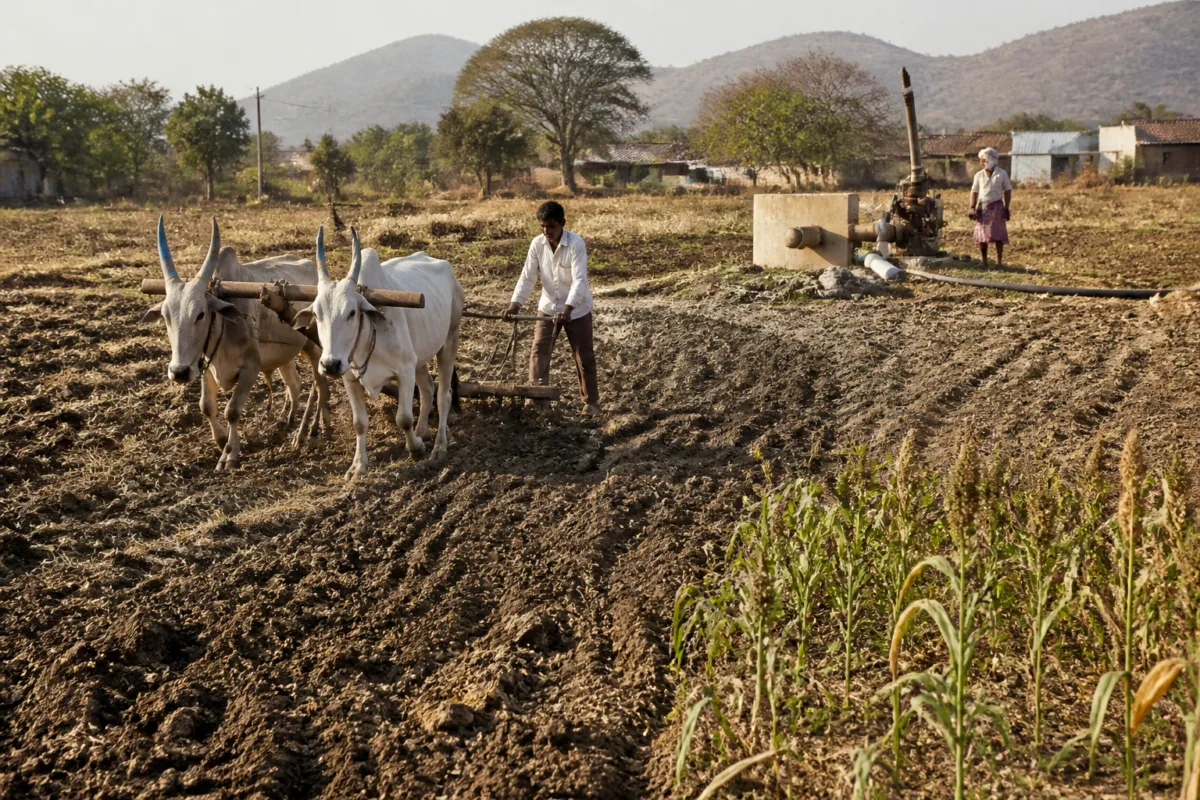
Maharashtra’s rabi sowing deficit has become a measurable indicator of how drought conditions are reshaping the state’s winter agricultural economy. State agriculture department data cited by the Times of India show that only 8.92 lakh hectares had been brought under rabi cultivation by November 12, compared with 14.32 lakh hectares during the same period last year. The 5.40 lakh hectare gap represents a decline of nearly 38% from last year’s pace.
The immediate issue is not simply that sowing has started late. It is that farmers are making crop decisions around the availability of water at each stage of cultivation. The state agriculture department says deficient retreating monsoon rainfall and prolonged dry spells have reduced soil moisture, leaving many farmers unable to sow even where rabi cultivation had originally been planned. Fields with assured irrigation are being prioritised, while farmers without reliable water are delaying cultivation or reducing the area they plant.
This makes the sowing data a window into the relationship between rainfall, groundwater dependence and farm-level risk. Reservoirs, lakes and wells had adequate water after the initial phase of the monsoon, according to the report, but that initial availability did not translate into sufficient soil moisture through the beginning of the winter season. The subsequent dry spell and inadequate retreating rains altered the conditions under which farmers normally begin rabi cultivation.
The distinction matters because rabi crops depend on a combination of residual moisture and irrigation. In drought-prone parts of Marathwada and western Maharashtra, farmers rely heavily on moisture left in the soil after the monsoon and on limited well irrigation. When both are weak, the cultivation calendar becomes less important than the question of whether water will be available during critical growth stages.
State agriculture commissioner Suraj Mandhare said severe water scarcity and deficient retreating monsoon rains had hampered rabi sowing. He told the Times of India that farmers were prioritising jowar and chickpea, or gram, over more water-intensive wheat and sugar cane. The department is also promoting economical use of available water and providing subsidised seeds for crops such as jowar, maize and gram to help maintain fodder availability.
The crop-wise figures show how this adjustment is taking place. Gram accounts for about 43% of the state’s major rabi crop mix and has reached approximately 3.79 lakh hectares, or 15% of its average area. Rabi jowar, which accounts for about 30% of the crop mix, has reached around 3.16 lakh hectares, equivalent to 21% of its average area. Maize has covered about 82,569 hectares, or 22% of its average area.
Wheat presents the clearest picture of the water constraint. Its sowing stood at only 53,626 hectares, barely 5% of the average wheat area of 11.80 lakh hectares. Wheat requires assured irrigation at critical stages, making it more exposed to uncertainty over wells and other water sources. The agriculture department expects wheat acreage to decline as farmers avoid making investments in crops that may require several irrigations.
The pattern suggests that farmers are not responding to drought by abandoning cultivation uniformly. Instead, they are changing the composition of what they sow and restricting cultivation to land where the water risk is more manageable. That is a rational short-term response to uncertainty, but it also shows how rainfall variability can influence the rural economy before any final harvest figures are available.
The state’s average rabi area is 57.80 lakh hectares. Against that benchmark, the 8.92 lakh hectares recorded by November 12 represents only a small portion of the season’s expected area. The agriculture department says sowing can continue until the end of December, so the current figure is not the final acreage. However, the timing of sowing is itself significant. A late start can compress the crop cycle and reduce the time available for cultivation, particularly for farmers who miss the optimum sowing window.
Agricultural experts cited in the report said final rabi acreage would depend more on soil moisture and assured irrigation than on the calendar. This is an important institutional signal. Administrative targets and seasonal averages can indicate the scale of planned cultivation, but they cannot bring fields under production when farmers lack water at the point of sowing or during crop growth.
The experience of Solapur illustrates the gap between a state-level sowing plan and ground-level conditions. Solapur district agriculture officer S. Bhosale said there was no soil moisture in several jowar-growing tehsils and that officials could not recommend sowing that season in those areas. The statement indicates that the problem has moved beyond a simple delay in farm operations. In some locations, the basic agronomic conditions required to begin cultivation may not exist.
Agricultural universities have advised farmers to prioritise low-water crops such as gram, rabi jowar and safflower. They have recommended that wheat and other irrigation-dependent crops be grown only where protective irrigation is available during critical growth stages. Short-duration varieties and water-saving systems such as sprinklers and drip irrigation have also been suggested.
These measures reveal the limits and possibilities of the current response. Crop substitution can reduce water demand, while subsidised seeds can help farmers access alternatives. Short-duration varieties may reduce exposure to a prolonged dry period, and efficient irrigation can help stretch limited supplies. But each measure depends on local conditions, including access to irrigation equipment, the availability of suitable seed and the ability of farmers to bear cultivation costs when the outcome remains uncertain.
The agriculture department’s role is therefore extending beyond recording sowing progress. It is monitoring district-level conditions, promoting selected crops, supporting fodder availability and communicating recommendations about irrigation and crop choice. The response is being organised around water scarcity rather than a single crop failure. That approach is visible in the emphasis on economical water use and in the decision to promote crops with lower water requirements.
At the same time, the figures show that administrative support cannot fully offset a deficit in water availability. The department expects sowing to continue until the end of December, but a senior agriculture official cited in the report said the final area was expected to remain significantly lower because there was no possibility of additional water. The remaining sowing window therefore does not necessarily represent recoverable acreage. It represents time during which farmers may still act, but only where soil moisture or irrigation makes cultivation viable.
This distinction is central to understanding drought resilience in Maharashtra. A season can begin with apparently adequate water in reservoirs, lakes or wells and still develop into a serious agricultural constraint if rainfall stops early and soil moisture falls. Water availability is not only a question of stored volume. It is also a question of where the water is located, whether it can reach fields, whether farmers can access it and whether it will remain available when crops need irrigation.
The current crop mix also shows how drought affects the geography of cultivation. Farmers with assured irrigation can continue to consider crops that require more water, while those dependent on residual moisture must move towards lower-water alternatives or leave fields uncultivated. This creates different levels of resilience within the same state and even between neighbouring farming areas.
The 5.40 lakh hectare deficit is consequently more than a comparison with last year’s sowing pace. It captures the combined effect of deficient retreating rainfall, dry spells, weak soil moisture and limited irrigation access. It also records the point at which farmers begin to reduce exposure by changing crop choices. The numbers do not establish the final impact on yields or farm incomes, but they show that water stress is already influencing production decisions.
What remains uncertain is how much additional area will be sown by the end of December and how productive late-sown crops will be. The supplied data also do not establish the eventual effect on food supply, prices or household incomes. What they do confirm is that Maharashtra’s rabi season has started under significant water pressure, with the sharpest constraints visible in wheat and in drought-prone districts that depend on soil moisture and limited well irrigation.
The next stage of the season will therefore be determined by field-level water conditions rather than by the calendar alone. The agriculture department will continue monitoring sowing through the end of December, while farmers will decide whether available moisture and protective irrigation justify cultivation. Those decisions will determine how much of Maharashtra’s planned rabi area can ultimately be brought under production.

