


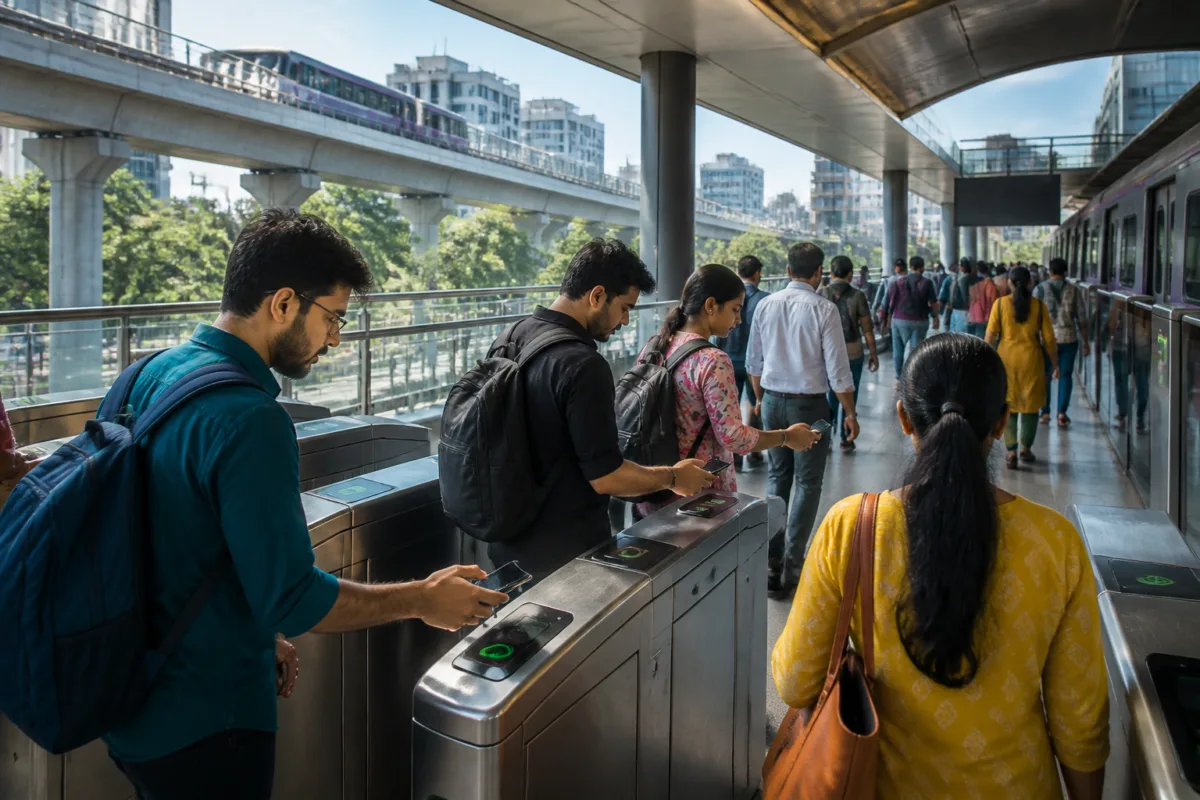
Pune’s planned single QR ticket for all three Metro corridors is more than a convenience upgrade. It is an attempt to make a fragmented metropolitan rail network behave like one passenger system, even though its corridors are operated through separate institutional and fare-collection arrangements.
Maha Metro and the Pune Metropolitan Region Development Authority are working on an integrated ticketing system that will allow passengers to book journeys across all three corridors with one QR code. The software is expected to be ready in about three months, according to Atul Gadgil, Maha Metro’s director of works, as quoted by The Times of India. Paycraft, a ticketing technology company based in Mumbai and Hyderabad, has been awarded the software development contract.
The integration will cover Maha Metro’s Vanaz-Ramwadi and Pimpri Chinchwad Municipal Corporation-Swargate corridors, along with PMRDA’s Maan-Civil Court Pink Line. At present, the two networks operate separate fare-collection systems. A passenger whose journey involves both networks can book and pay for the full trip through a common platform but still receives two QR codes and must scan both while changing lines.
That arrangement reveals the difference between a journey being sold through one digital interface and the underlying transport system actually being integrated. For passengers, the distinction is experienced at the interchange. A ticket may be purchased in a single transaction, but the trip continues to be divided at the point where one operator’s network ends and another’s begins.
The proposed system aims to remove that break by creating a central clearing house. The clearing house will calculate the total fare and distribute the appropriate share between Maha Metro and PMRDA according to the distance travelled on each operator’s network. The settlement is expected to be completed either on the same day or the following day, Gadgil said.
This is the central institutional issue behind the QR-code change. The passenger sees one ticket, but the operators still need a reliable mechanism to determine how much of the fare belongs to each network. That requires a common system for journey data, fare calculation, transaction reconciliation and settlement. Without those layers, a single QR code would only conceal the operational division rather than resolve it.
The proposed arrangement also shows why integrated ticketing is difficult in a metropolitan area with multiple transport authorities. Pune’s three corridors are not simply extensions of one line managed through one fare system. Maha Metro and PMRDA have separate collection arrangements, and the software must connect those systems without disrupting the accounting responsibilities of either operator.
For commuters, the immediate benefit is a simpler transfer. The Times of India quoted an IT professional who regularly travels from Kalyaninagar to Hinjewadi as describing the present requirement to use two QR codes as cumbersome. A unified ticket would reduce the number of actions required during an interchange and make the booking process easier to understand for passengers whose journeys cross operator boundaries.
The Kothrud-Hinjewadi journey illustrates the practical importance of this change. A passenger travelling between the two areas may need to use more than one Metro corridor and therefore encounter the separation between the networks. The planned system would allow the passenger to make one payment at the time of booking and use one QR code for the complete journey.
The significance of that change will depend on whether the back-end integration works as consistently as the passenger-facing interface. A single ticket must represent the complete journey accurately, including the total fare and the distance covered on each operator’s network. The clearing house must also ensure that both operators receive their respective shares within the stated settlement window.
The available information does not establish the final fare rules, the exact interchange procedures, the technical standards that will connect the two systems or how exceptions such as failed scans and refunds will be handled. Those details will determine whether the integration functions as a seamless metropolitan ticket or remains primarily a common booking facility.
The timing of the proposal is linked to the expansion of the network available to passengers. PMRDA’s Maan-Civil Court Pink Line recorded 2,66,558 passenger journeys during its first eight days of operations, from November 4 to November 11. Its highest daily count was 48,679 on the opening day, followed by 40,329 on November 5.
The daily figures then moved sharply lower. Ridership stood at 34,647 on November 6 and 34,243 on November 7 before falling to 18,908 on November 8. It rose to 32,979 on November 9 and then declined to 30,699 on November 10 and 26,074 on November 11. The figures show substantial variation during the line’s initial operating period rather than a steady daily pattern.
An estimated daily ridership of around 2 lakh to 2.5 lakh has been cited for the line. The first eight days nevertheless recorded an average of about 33,300 passenger journeys per day when the reported figures are added together. The difference between the estimate and the early observed average underlines why actual operating data will matter as the corridor settles into regular use. The supplied report does not establish whether the estimate is a target, a forecast or a longer-term operating expectation.
The early ridership pattern also matters for ticketing design. A system introduced during the expansion of a corridor must handle both routine commuters and passengers who are still learning how the network connects. The more operators, lines and interchange points a passenger encounters, the greater the need for the fare system to present the journey as one understandable transaction.
The proposed clearing house provides the administrative bridge. It is not merely a payment gateway. It must connect the commercial interests of two public transport networks while presenting passengers with a single product. The stated distance-based apportionment model means that the system will need to identify the portion of a journey completed on each network and use that information for settlement.
That model also places importance on the quality and availability of journey data. The operators will need to recognise where a passenger enters, where the journey changes networks and where it ends. The report does not specify whether the calculation will be based on stations selected during booking, actual scans, entry and exit records, or another method. The implementation details remain to be disclosed.
Pune’s experience therefore highlights a broader urban transport problem: network expansion can outpace institutional integration. New corridors increase the physical reach of public transport, but passengers do not experience the system as a map of authorities. They experience it as a single trip involving time, transfers, payment and reliability. When governance is divided but the journey is continuous, the gaps appear at the interchange.
Integrated ticketing can reduce one such gap, but it does not by itself integrate services, timetables or passenger information. The announcement concerns a common QR ticket and fare settlement. It does not state that the two operators will adopt a common timetable, coordinated service standards or a unified customer grievance system. Those functions may remain separate unless addressed through other arrangements.
The institutional arrangement also raises a question about accountability. If a passenger is charged once for a combined journey, the system must make clear which authority handles a failed transaction, an incorrect fare, an unreadable QR code or a refund request. The supplied report does not identify the proposed responsibility for these issues. That information will become important once the system is used at scale.
The software contract awarded to Paycraft establishes the technology provider for the integration work, but the operators remain responsible for the operating framework. The system will have to work across separate fare-collection arrangements and produce settlements that both networks can accept. The three-month timeline therefore marks a software delivery target, while the wider test will be whether the system is dependable in daily passenger use.
For Pune, the immediate policy signal is positive: the city’s Metro expansion is being accompanied by an effort to remove a barrier created by fragmented administration. But the evidence currently confirms an announced integration project, not a completed unified ticketing system. The next milestones are the software’s readiness, the operating rules for the central clearing house and the experience of passengers transferring between Maha Metro and PMRDA corridors.
The proposed single QR ticket addresses a visible inconvenience, but its deeper importance lies in whether two separate transport systems can share the data and revenue processes required to deliver one metropolitan journey. Pune’s next test will be to move from a common payment promise to a consistently integrated passenger service.

