


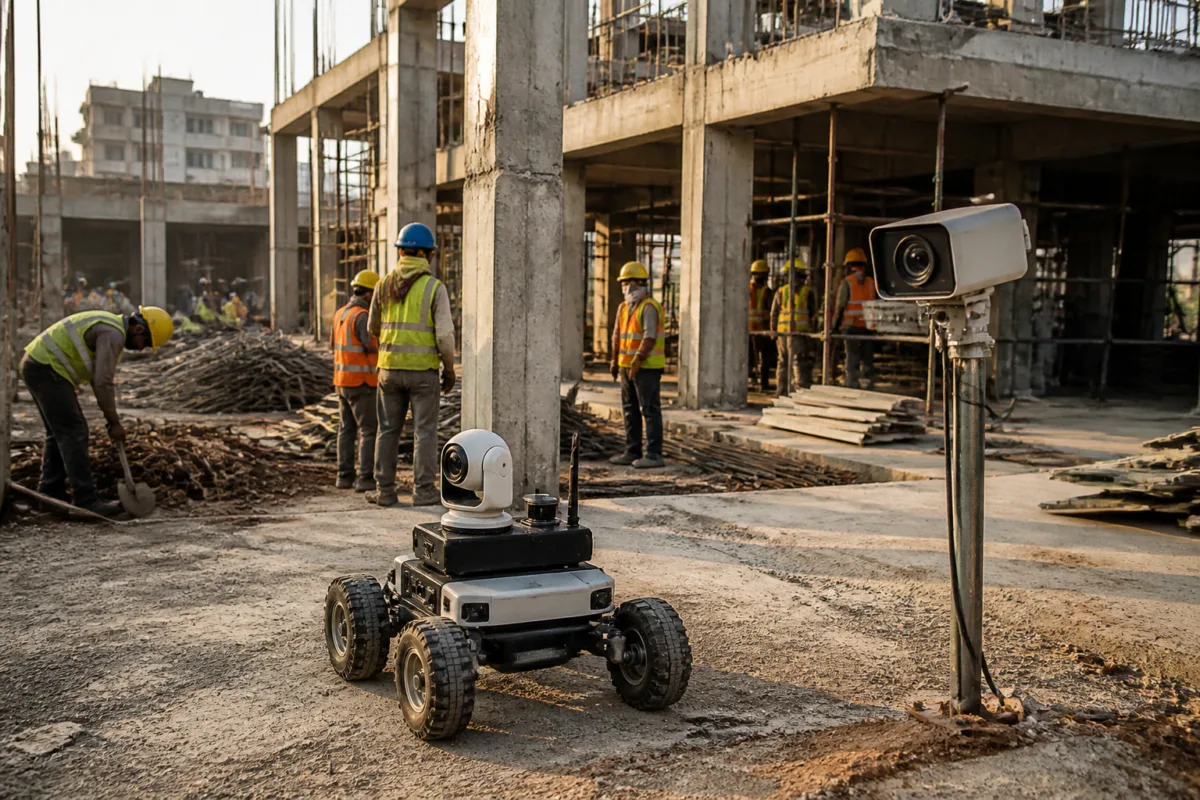
AI construction safety tools developed by CEPT University students are being tested at construction sites in Ahmedabad, with applications ranging from real-time helmet detection to wall measurement and automated inventory tracking.
The Safe Guard project uses computer vision and YOLO-based deep learning to identify whether workers are wearing helmets and protective vests. The system processes live feeds from CCTV and Wi-Fi cameras, allowing safety conditions to be monitored in real time across different floors, sections and work areas.
Tapan Betai, a faculty member at CEPT University’s Faculty of Technology and guide for the studio “Industry 4.0 in Future Construction Technology”, said the project began as a student exercise and demonstrated high accuracy. Developed by Kirtan Gajjar, Safe Guard recently received the Project Excellence Award.
Construction sites often involve large numbers of workers moving between multiple work zones, making continuous manual checks difficult for supervisors. The use of camera-based detection is intended to support those checks by identifying missing protective equipment as work is taking place. The report does not specify the number of sites using the system, the scale of deployment or whether it has received regulatory approval.
The safety-monitoring project was one of several initiatives developed by CEPT students after studying construction-site practices involving inventory, measurements and existing technologies. Dwija Shah, another faculty guide for the studio, said the students examined how artificial intelligence, machine learning and the Internet of Things could be applied to conventional construction processes.
Another project, called Wall-E and developed by Umang Kerai, uses a robot fitted with a levelling tube to assess whether walls have the required level, slant or undulation. The system is designed to measure wall surfaces during and after plastering, reducing the need for manual intervention at every stage of the process.
A separate project by Vansh Gajjar combines computer vision, IoT and robotics for construction-site inventory and line marking. Computer vision is used to help count materials such as bricks, reinforcement bars and cement bags, while an Arduino-based system enables a robot to navigate uneven site conditions and draw precise lines for workers.
The projects reflect three operational problems that commonly affect construction sites: maintaining worker compliance with safety requirements, checking quality during finishing work and tracking materials across changing work areas. In each case, the proposed technology is intended to supplement site supervision rather than replace the construction workforce.
Most of the studio’s projects were executed at construction sites in Ahmedabad. Senior officials said some projects are at an advanced stage of implementation, while efforts are also under way to secure intellectual property rights. The report does not provide a deployment schedule, commercialisation plan or details of the officials involved.
The next stage for the projects will depend on implementation and intellectual property processes, according to the information available from CEPT University. The university has not disclosed a broader rollout timeline or performance data from long-term site use.

