


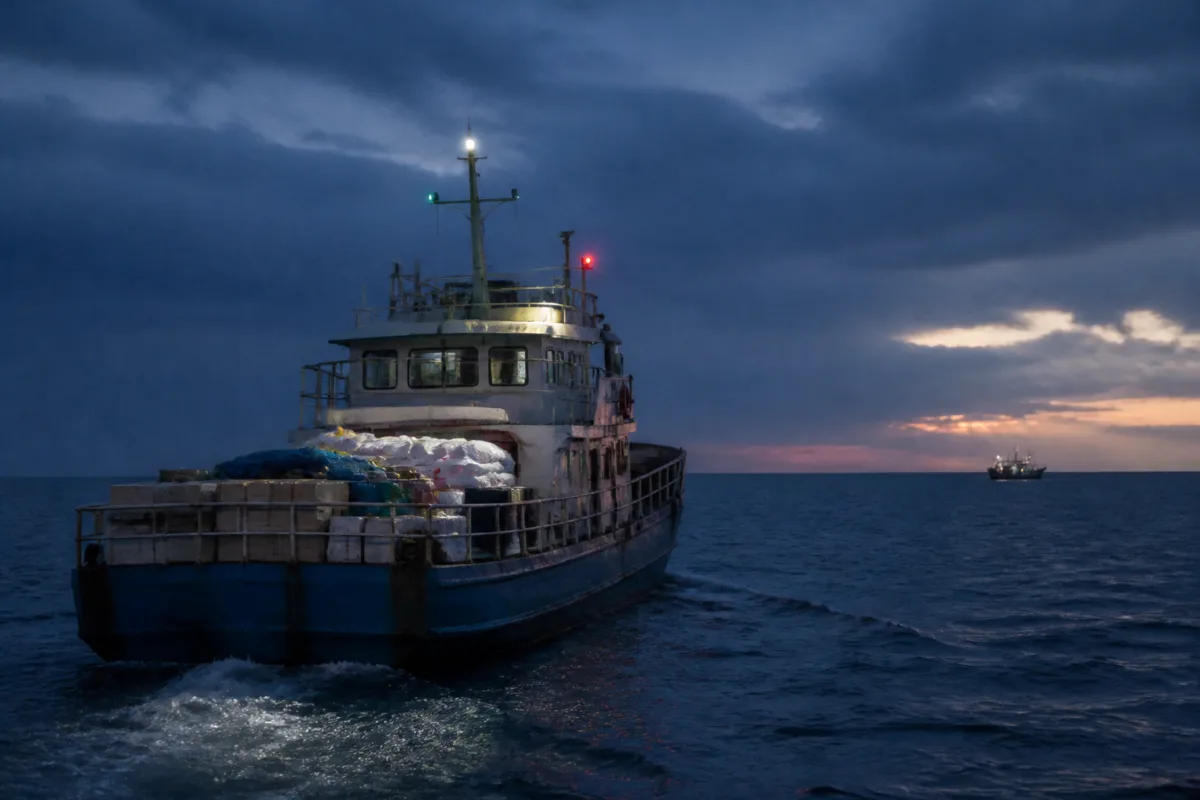
The collision that sank the cargo vessel M.S.V. Jesus Heart off the Kerala coast has exposed how dependent Lakshadweep’s construction supply chain is on small cargo vessels—and how difficult accountability becomes when a vessel involved in a serious accident disappears. Eight crew members survived after an unidentified fishing boat struck the vessel and left without stopping, but more than Rs 1.5 crore worth of cargo was lost and the vessel is considered beyond recovery.
The incident occurred around midnight on October 20, when the Jesus Heart was travelling from Beypore to Kavaratti with 170 tonnes of cargo. According to the report by Kerala Kaumudi, the vessel was struck approximately 19 nautical miles from Beypore by a large fishing boat. The impact reportedly hit the front section of the cargo vessel, allowing water to rush in and sinking it within minutes.
The case has since moved from Kozhikode Coastal Police to Kochi Coastal Police because the accident site falls within Kochi’s jurisdiction. The transfer is significant because the first investigating unit reportedly found no leads about the unidentified boat. Kochi Coastal Police are now examining Coast Guard radar information and have begun efforts to secure the Coast Guard’s assistance in locating the vessel.
This is not only a case of a damaged boat and lost cargo. It is also a test of the systems used to monitor movement in busy coastal waters, record distress calls, identify vessels after collisions and protect the maritime routes that connect mainland ports with island communities. The available account shows that rescue was possible because the stranded crew had access to a small boat and transmitted a warning through VHF radio. It also shows that the vessel that allegedly caused the collision did not remain at the scene to provide assistance.
The Jesus Heart was carrying a mixed cargo intended for Kavaratti, including construction materials, furniture, air-conditioners, paint, a car, motorcycles and food supplies. The cargo profile reflects the multiple functions of these vessels in island logistics. They are not carrying a single industrial commodity. They transport the materials and goods needed for construction, maintenance, household consumption and everyday economic activity in Lakshadweep.
The report states that the Jesus Heart, owned by Sundari of Thoothukudi, had been launched in 1990 and operated to Kavaratti three times a month. Its loss therefore affects more than one voyage. A vessel with an established service pattern represents a recurring link in the supply chain, and its disappearance can place additional pressure on the remaining vessels serving the route. The supplied report does not establish whether replacement capacity has been arranged or whether the lost cargo has been recovered.
The vessel’s age is another relevant part of the story, although the available information does not establish that its age contributed to the accident. The Jesus Heart had been in service since 1990. The report says that recovery is unlikely and estimates the loss at more than Rs 1.5 crore. It does not provide a detailed assessment of the vessel’s insurance status, the cargo owners’ compensation arrangements or the findings of any technical inspection.
The immediate safety question concerns the unidentified boat. Kerala Kaumudi reports that the boat approached without a navigation light at night and struck the cargo vessel on its side before leaving. That account, if established by the investigation, would raise questions about night-time visibility, vessel identification and compliance with safety practices in open water. At this stage, however, the identity of the boat and the circumstances of the collision remain unresolved.
The rescue sequence demonstrates the value of basic communication and nearby maritime support. After the crew sent a distress message through VHF radio, the tug Rasko 4 was the first to reach the site. The eight crew members—Michael, 56; Selton, 63; Bhaskaran, 51; Dominic, 60; Kishan, 23; Klipton, 25; Ayyappan, 36; and Susai Edison, 70—were able to board the vessel’s small boat. The Coast Guard later brought them to Beypore port.
That sequence also reveals the difference between rescue and accountability. The crew survived, but the vessel sank, its cargo was lost and the alleged striking vessel remained unidentified in the account available so far. A successful rescue can prevent loss of life without resolving the institutional questions that follow: who was operating the other boat, whether it was registered and trackable, whether radar records can identify its movement, and whether the collision was reported by any nearby vessel or station.
The jurisdictional transfer adds another layer. The case was initially investigated by Kozhikode Coastal Police but was moved after authorities determined that the accident location came under Kochi Coastal Police. Such a transfer may be administratively necessary, yet it can also delay the early stages of evidence collection. Radar records, radio logs, vessel sightings and accounts from nearby craft can become increasingly difficult to reconstruct as time passes. The report says Kochi police are relying in part on Coast Guard radar data, making those records central to the next stage of the investigation.
The case also illustrates the geographic complexity of maritime governance. The cargo was loaded at Beypore, the accident occurred offshore, the vessel was headed to Kavaratti and the crew was eventually taken back to Beypore. Different institutions and jurisdictions can therefore become involved in a single incident: coastal police, the Coast Guard, port authorities, vessel owners, cargo owners and the administration responsible for the island destination. The report does not specify the precise division of responsibilities among these bodies, but the movement of the investigation between coastal police units shows how location determines the first institutional response.
For Lakshadweep, the loss of a cargo vessel has an urban and infrastructure dimension. Island settlements depend on maritime transport for materials that cannot be produced locally at the same scale. The cargo listed in the report includes building supplies as well as consumer goods, linking maritime safety directly to construction activity, housing maintenance and the availability of everyday products. A disruption on the route can therefore affect both project delivery and household supply, even when the original incident takes place far from the islands themselves.
The story also highlights a vulnerability in infrastructure planning: a supply chain can be essential without being visibly recognised as urban infrastructure. Ports, cargo vessels, radio systems, navigational equipment and rescue services form the logistical network behind construction and daily life in island settlements. When one vessel is lost, the impact is not limited to the owner or the crew. It can extend to contractors awaiting materials, residents expecting goods and public agencies managing limited transport capacity. The supplied report does not quantify those wider effects, but the nature of the cargo makes the connection clear.
At the same time, the available evidence has limits. There is no confirmed identification of the fishing boat, no published radar finding, no account from the suspected vessel and no formal investigation report in the supplied material. The estimated loss of more than Rs 1.5 crore is attributed to the report, but the basis of that estimate is not detailed. Nor is it established whether the collision resulted from a navigation failure, poor visibility, equipment failure, human error or another cause.
Those gaps are important because the central public-interest issue is not simply that a boat sank. It is whether a serious collision involving a cargo route can be investigated quickly enough to identify the responsible vessel and establish what happened. The next evidence is expected to come from Coast Guard radar information and related assistance sought by the Kochi Coastal Police. Until those records or other official findings are available, the identity and responsibility of the other vessel remain unresolved.
The incident confirms three facts: the Jesus Heart sank after a collision while carrying 170 tonnes of cargo to Kavaratti; all eight crew members survived through an emergency response involving VHF communication, a tug and the Coast Guard; and the vessel that allegedly struck it has not yet been identified in the supplied report. The investigation’s progress, the examination of radar data and any official finding on the collision will determine whether the case becomes an identified maritime-safety violation or remains an unresolved loss on an essential island supply route.

