


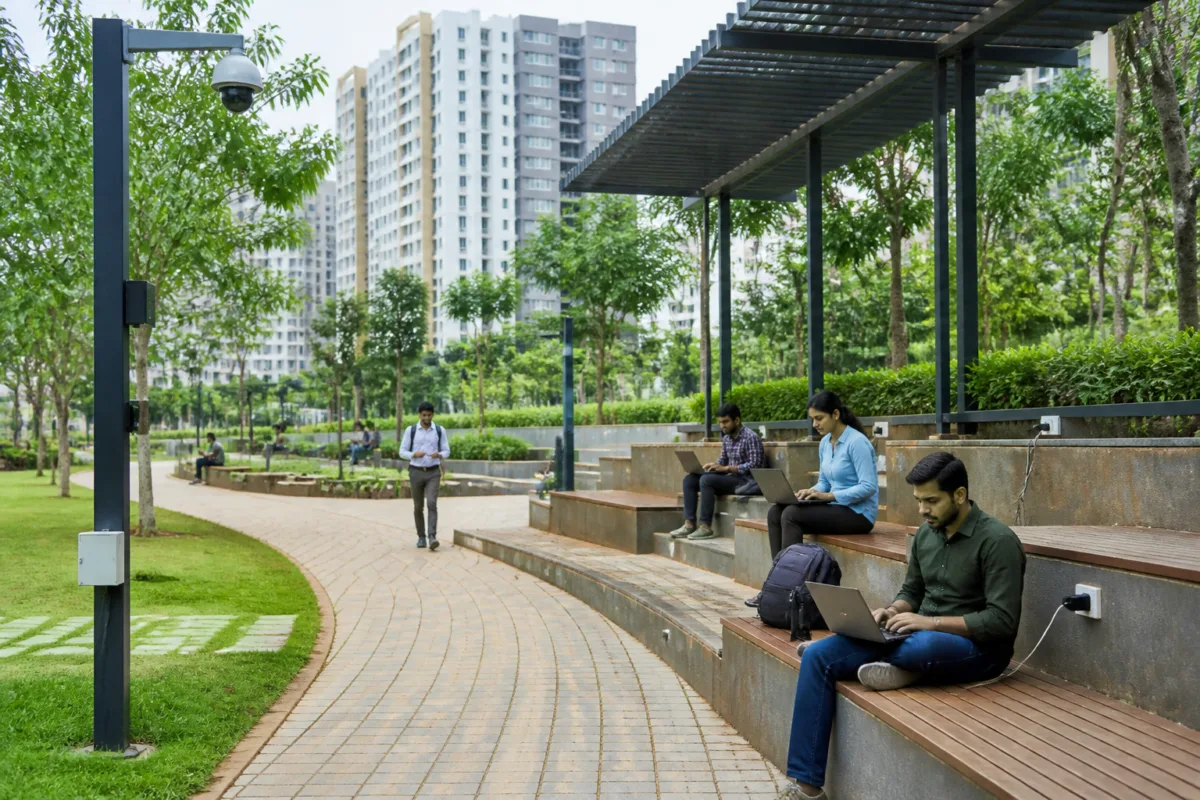
Cyberabad’s proposed Work from Park initiative is being presented as a way to let residents work in greener, quieter surroundings. But the plan also raises a larger urban question: can public parks become genuinely shared civic infrastructure without losing their primary role as accessible, safe and inclusive open spaces?
The Cyberabad Municipal Corporation (CMC) plans to introduce Wi-Fi-enabled workspaces in 30 to 40 public parks, beginning with two pilot projects. A park at Madhava Hills Colony near Madhava Welfare School in Masjid Banda, Serilingampally, is among the locations identified, while sites in Kukatpally and Madhapur are also under consideration. The pilot facilities are expected to be ready around New Year, with wider expansion dependent on public response, according to a report by Deccan Chronicle.
The proposed facilities would include free Wi-Fi, laptop charging points, tiered seating, benches, CCTV cameras, walking tracks and kiosks serving coffee and snacks. The corporation is also considering a nominal user fee of ₹50 to ₹100. CMC commissioner Srijana said the objective was to make public parks more than recreational spaces and allow people to work in a green environment while making better use of these areas.
That framing places the initiative within a broader shift in how cities think about public space. Parks are often planned as places for walking, play and leisure, but their value extends beyond those activities. They provide relief from dense construction, create informal meeting spaces and can support everyday activities that are otherwise pushed into private or commercial settings. In Cyberabad, where workspaces, residential colonies and technology-sector employment coexist within a rapidly urbanising landscape, a park-based work facility could serve residents who need a temporary place to work without travelling to an office or paying for a café.
The important distinction is between adding useful activity to a park and converting a public park into a paid or semi-private amenity. The source report does not establish how much space would be reserved for workstations, how long users could occupy them, whether bookings would be required or how the proposed fee would be applied. Those details will determine whether the initiative expands access or creates a new layer of competition for limited public space.
The proposed user fee is particularly significant because the initiative is otherwise described as providing free Wi-Fi and public facilities. A fee of ₹50 to ₹100 may be nominal for some users but meaningful for others, especially students, informal workers and residents who may need occasional access rather than a regular workspace. The supplied information does not specify whether concessions, time limits or free-use periods are being considered. Nor does it state whether the kiosks would be operated directly by the corporation or through private vendors.
These operational questions matter because public parks are civic assets, not simply vacant land available for any new use. A work area requires electricity, maintenance, security, furniture and digital connectivity. It also introduces demands that may not exist in a conventional neighbourhood park. Users working on laptops may need stable seating, shade, lighting and reliable charging points. Other park users may need uninterrupted walking areas, play spaces and quiet zones. Designing these functions together will require decisions about layout, access and maintenance rather than only the installation of equipment.
The Work from Park plan is part of a much larger programme of park creation and renewal. CMC is developing around 300 parks on vacant civic land selected from nearly 700 corporation-owned properties. Another 90 existing parks are planned for renovation and upgrading. The new parks are expected to open to the public by February, according to the report.
This land pipeline gives the initiative a significant institutional context. The corporation is not proposing isolated workstations in a handful of established parks; it is simultaneously expanding and upgrading the overall public-space network. That raises questions about how different types of parks will be classified and managed. A small neighbourhood park, a larger recreational park and a work-oriented green space may all need different maintenance standards and operating rules. The supplied material does not indicate whether CMC has published such a framework.
The choice of locations also reflects the uneven geography of Cyberabad. Madhapur, Kukatpally and Serilingampally are dense and economically active areas with different patterns of housing, employment and daily movement. A park-based workspace could reduce the need for some short trips if residents can work closer to home. However, the report does not provide expected user numbers, parking provisions, public transport access or a rationale for selecting the pilot sites. Without that information, it is not yet possible to assess whether the pilots are designed around demand, land availability or administrative convenience.
The wider package announced by CMC suggests that the corporation is attempting to link public-space development with civic participation and administrative transparency. It is planning a two- to three-day programme called “Listening to Children” around November 20 in collaboration with UNICEF. The programme is intended to understand children’s concerns about street lighting, neighbourhood safety and civic amenities. Srijana said the suggestions would be documented, while a dedicated cell was proposed to ensure follow-up action.
This is relevant to the park plan because children are among the most frequent users of neighbourhood open spaces, even when parks are designed and managed primarily through adult administrative priorities. Issues such as lighting, visibility, safe access and the condition of play areas can determine whether a park functions as a public asset or remains underused. The announcement of a follow-up cell is important, but the supplied report does not establish its structure, authority, staffing or timeline.
CMC is also planning to install completion boards at civic project sites. These boards would display expenditure, completion dates, contractor details and contact numbers of supervising engineers. They would also specify the two-year defect liability period during which contractors are responsible for maintenance. The commissioner said the purpose was to let residents know how much was being spent, who was executing each project and who was responsible for maintenance.
For park construction and renovation, this information could make a practical difference. Public-space projects often involve recurring maintenance rather than a single construction event. Furniture breaks, lighting fails, walking surfaces deteriorate and landscaping requires continued care. Displaying the contractor and supervising engineer’s details gives residents a visible point of reference, while the defect liability period identifies a formal responsibility after completion. The mechanism will be useful only if complaints are recorded, acknowledged and acted upon, but the report does not provide details of that process.
The corporation’s other proposals extend the same governance approach into infrastructure and waste management. It is planning a one-kilometre pilot using recycled plastic to manufacture roadside posts, footpath tiles, streetlight poles, benches and dustbins. It is also exploring green-waste processing facilities in every ward, with 200 to 300 square yards proposed for each unit. Telangana State Southern Power Distribution Company Limited is expected to provide chipping machines and sheds under its corporate social responsibility initiative. The processed green waste could be used to produce biochar or briquettes, reducing the volume transported to the Jawaharnagar dumping yard.
These proposals connect the park programme to the material systems behind urban services. Parks generate green waste, while park upgrades require furniture, paving, lighting and waste bins. If the recycled-plastic and green-waste pilots proceed as described, some of those inputs could be linked to local processing and reuse. The report, however, does not state the anticipated quantities, procurement standards, processing capacity or environmental assessment for the recycled products. Those details will be necessary to judge whether the projects are viable demonstrations or limited pilot interventions.
Taken together, the announcements show a corporation trying to manage public space through several overlapping ideas: activate parks, expand green cover, involve children, disclose project information and reduce waste sent to the dumping yard. The strength of the approach lies in treating parks as part of a wider civic system rather than as isolated landscaping projects. Its unresolved challenge is implementation. Each proposal involves a different operating model, from digital connectivity and user fees to contractor accountability and ward-level waste processing.
The Work from Park initiative therefore should be assessed on more than the novelty of working outdoors. The key tests will be whether the pilots remain accessible, whether workspaces coexist with existing park uses, whether fees and operating rules are transparent, and whether maintenance responsibilities are enforced. CMC’s planned completion boards and consultation programmes could provide some of the accountability mechanisms required, but their effectiveness will depend on how they are implemented.
The immediate milestones identified by the corporation are the launch of two Work from Park pilots around New Year, the opening of new parks by February, the proposed children’s programme around November 20, and the development of the recycled-plastic and ward-level green-waste pilots. These steps will show whether Cyberabad’s public-space strategy can move from a collection of proposals to a functioning civic network that is green, usable and accountable.

