


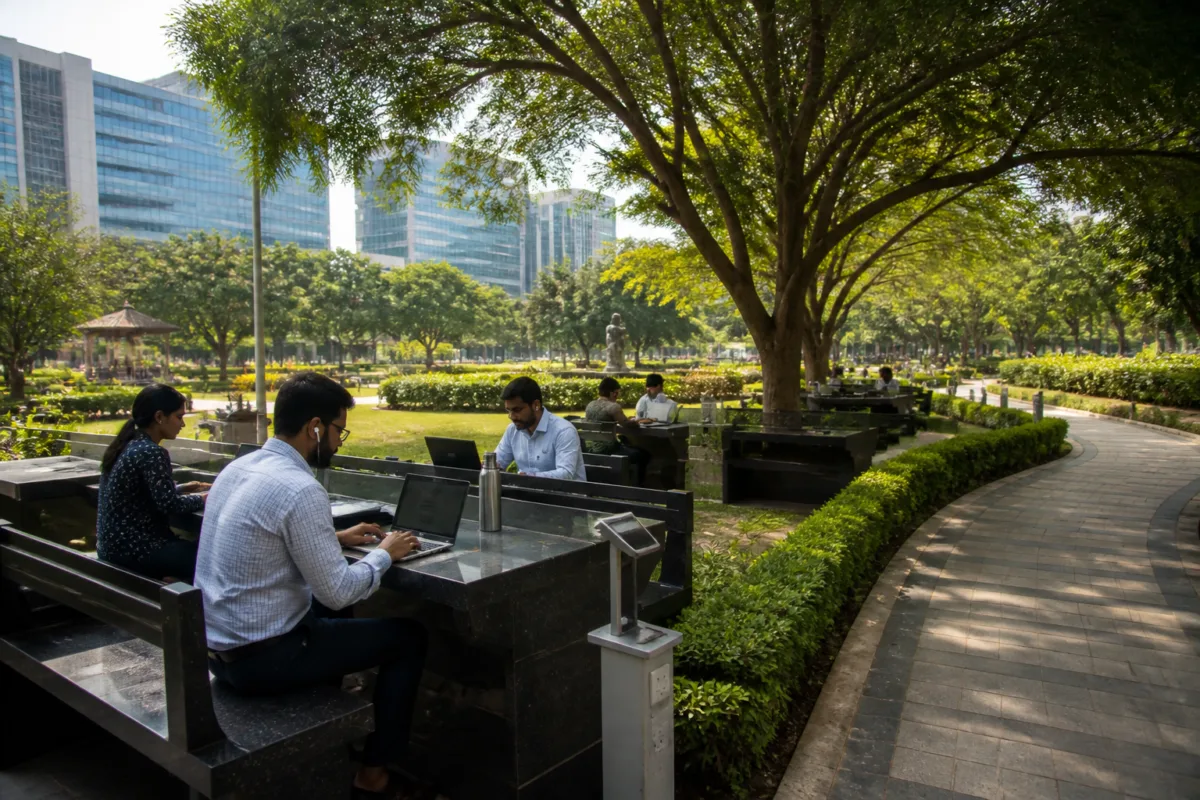
Cyberabad public parks across Hyderabad’s IT corridor will be converted into outdoor work-from-home zones under a plan to provide Wi-Fi, workstations, charging facilities and other amenities for remote workers and professionals.
Cyberabad Municipal Corporation Commissioner G Srijana said 30 to 40 green spaces measuring more than one acre had been identified for the initiative across the Serilingampally, Kukatpally and Madhapur zones. The proposal is aimed at creating alternatives to conventional indoor workspaces while retaining the recreational and ecological functions of public parks.
The selected parks are expected to receive high-speed public Wi-Fi, ergonomic outdoor seating, weather-resistant workstations and dedicated charging kiosks. Parking facilities and cafeterias are also planned, although the civic body has not announced a final implementation schedule for the workspaces.
The corporation is considering user charges of Rs 50 or Rs 100 per person for access to the proposed facilities, Srijana said. The fee structure remains under consideration and no final decision on access charges was announced.
The initiative is focused on areas with a large concentration of technology companies, commercial establishments and residential communities. By using existing green spaces, the civic body plans to combine work-related amenities with public open-space infrastructure in a region where the commercial footprint and workforce have expanded rapidly.
The corporation is also exploring the possibility of involving IT companies in the development of green spaces through corporate social responsibility initiatives. The source report did not specify the companies being approached, the proposed funding arrangements or the maintenance responsibilities under such partnerships.
Alongside the outdoor work zones, the CMC plans to inaugurate 300 new parks within its limits by January 2027. The commissioner said the expansion was intended to support urban forestry, improve local air quality and provide larger green spaces for the region’s growing residential and corporate workforce.
The civic body is repairing 97 existing parks for general public use, including by daily walkers and visitors. The work forms part of an effort to convert scattered open plots into accessible public spaces as the technology hub continues to expand.
The planned changes place public parks at the centre of several urban functions: recreation, ecological improvement and, in selected locations, informal work. Their implementation will depend on how the corporation manages user access, maintenance, charging infrastructure, parking and the balance between commercial-style amenities and free public use. The next milestones are the finalisation of the user-charge proposal, the rollout of facilities in the selected parks and the inauguration of the planned new parks by January 2027.

