


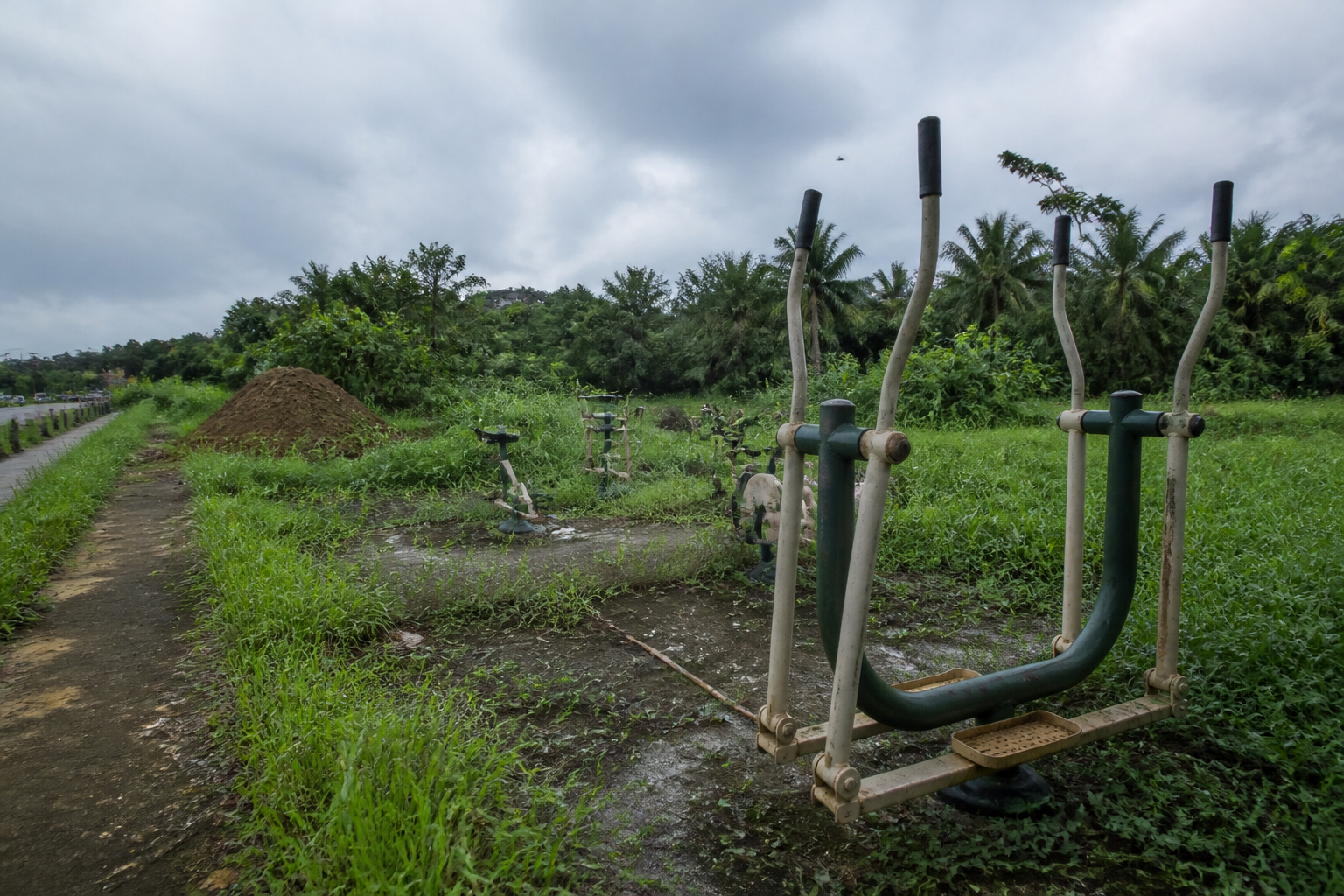
An open gym built for residents in Thuravumkara, near Kanjoor in Ernakulam district, is now surrounded by overgrown vegetation, deposited soil and an increasingly unclean environment. The deterioration of the facility, reported by Mathrubhumi, is more than a local maintenance complaint: it shows how a public asset can lose its function when responsibility is divided between institutions and administrative boundaries do not match everyday use.
The open gym was established by the district panchayat during the tenure of district panchayat member Sharada Mohan. It was intended to provide residents of Thuravumkara and nearby Naithodu with a place for exercise and health-related activity. Officials from the nearby Coast Guard facility also use the gym for exercise, according to the report. Its users therefore extend beyond a single neighbourhood, even though the facility is located in a sparsely inhabited area.
The immediate problem is physical neglect. Large quantities of soil removed during Water Authority pipeline work were deposited near the open gym. The area, including the soil-deposit site, is now covered with vegetation. The overgrowth has left the surroundings unclean and has reportedly led to sightings of reptiles. Residents say that many people approach the facility with apprehension and have demanded that the grass and vegetation be cleared urgently.
They have also asked that the soil deposited in connection with the pipeline work be removed and that the authorities establish a regular maintenance system. These demands point to two separate but connected responsibilities. One concerns the condition of the land after utility work. The other concerns the continuing upkeep of the public facility itself. When neither task is clearly assigned, a small intervention can become a long-term civic failure.
The location’s administrative history helps explain the problem. The open gym was previously situated on land belonging to Sreemoolanagaram panchayat. The area was affected when land was divided for the construction of an airport runway. It now lies on the boundary of Thuravumkara ward in Kanjoor panchayat, while records continue to identify the location as being within Sreemoolanagaram panchayat, according to the report.
That distinction matters because local bodies generally organise services, maintenance and responses within their recorded jurisdiction. A facility may be used by people from one area, situated near another, and recorded under a third administrative identity. In such circumstances, an authority may regard the asset as outside its formal responsibility even when residents expect the nearest panchayat to maintain it.
The report says the open gym was proposed after some land in the area remained unused. The district panchayat member allocated funds for the facility, while Kanjoor panchayat provided the initial arrangements required to start it. The facility therefore emerged through cooperation between different levels of local administration rather than through one institution’s complete control.
That cooperative beginning has not translated into a clearly defined maintenance arrangement. The technical issue in the land records is cited as a reason for Kanjoor panchayat’s lack of attention to the gym. Residents are now asking the two panchayats to reach an understanding and protect the facility. Their request is essentially for an operational solution to a legal and administrative ambiguity.
The case illustrates a recurring difficulty in managing small public assets. Large infrastructure projects usually have formal project authorities, contracts, completion procedures and designated operating agencies. Smaller public facilities such as open gyms, parks, walking spaces and community exercise equipment can be created through local allocations or ward-level initiatives, but their post-construction responsibilities may be less clearly documented.
An open gym requires relatively modest infrastructure compared with a road, water network or public building. Its equipment may be located outdoors and exposed to weather, vegetation and surrounding land-use changes. The cost of keeping it usable may involve routine grass cutting, cleaning, inspection, minor repairs and protection from encroachment or waste dumping. If these tasks are not assigned to a named agency, the facility can become unusable without any formal decision to close it.
The Thuravumkara case also shows how utility work can alter the condition of a public space. Soil removed for pipeline installation was deposited beside the gym, and the resulting area has become part of the overgrown surroundings. The report does not establish which agency authorised the dumping or who is responsible for restoring the site. That unanswered question is important because temporary arrangements connected to construction and utility works can become permanent hazards when restoration is not monitored.
The issue is therefore not simply whether a panchayat should cut the grass. It involves coordination between the agency carrying out pipeline work, the local bodies associated with the land, the district panchayat that established the gym and the authority responsible for responding to residents. Without coordination, each institution can address only part of the problem, while the public asset continues to deteriorate.
The facility’s location adds another layer. The report says there are no houses in the immediate area. The land was left vacant after the airport runway construction altered the surrounding parcel, and the open gym was conceived as a productive use for otherwise unused space. This is a familiar urban and peri-urban planning logic: a leftover or fragmented parcel is converted into a public amenity.
But a vacant parcel is not automatically an easy site for public use. Its access, ownership, boundaries, maintenance obligations and relationship to nearby infrastructure must be settled before and after construction. When a site has been physically divided by a major project such as an airport runway, administrative records and on-ground geography may no longer align. A facility placed there can serve a real community need while remaining institutionally vulnerable.
The users named in the report also demonstrate why the facility should not be treated as an isolated or redundant asset. Residents of Thuravumkara and Naithodu use it, and Coast Guard personnel from the nearby establishment reportedly exercise there. The presence of multiple user groups indicates that the open gym has a practical role despite its location away from homes. Its current condition limits that role and may discourage use altogether.
The concerns about reptiles and unclean surroundings also raise a basic public-safety question. The supplied report does not document an injury or a confirmed health incident, and no such claim should be inferred. It does, however, record residents’ apprehension about entering an overgrown facility. For an exercise space, perceived safety is itself central to whether the investment serves its intended purpose.
The available evidence does not state the cost of establishing the gym, the date of its construction, the duration of the neglect, the ownership status of the land or the terms of the pipeline work. It also does not record a response from the Kanjoor panchayat, Sreemoolanagaram panchayat, the district panchayat or the Water Authority. Those gaps matter because they leave unresolved who has the formal power and financial responsibility to act.
What is clear is the sequence of institutional involvement. The district panchayat supported the creation of the facility. Kanjoor panchayat helped provide its initial arrangements. The site’s recorded administrative identity is linked to Sreemoolanagaram panchayat. Water Authority work affected the surrounding land. Residents now want both panchayats to reach an agreement. This is a classic coordination problem created by overlapping responsibilities rather than by the absence of public demand.
A practical resolution would first require the authorities to identify the land and asset records, inspect the condition of the gym and determine which agency placed the soil at the site. The supplied report does not confirm that these steps have begun, so they remain matters for official clarification rather than established developments. The residents’ immediate request is narrower: clear the vegetation, remove the deposited soil and ensure regular upkeep.
The larger lesson is that public infrastructure is not complete when equipment is installed. Its usefulness depends on a maintenance chain that remains active after inauguration, funding and political attention have moved elsewhere. In a fragmented urban edge, that chain must account for land records, ward boundaries, utility works and the actual pattern of use.
The Thuravumkara open gym now sits at the intersection of those unresolved questions. The immediate condition of the site can be corrected through cleaning and restoration, but the longer-term issue will remain unless the panchayats and other concerned authorities agree on who will maintain the facility. Until that responsibility is recorded and acted upon, the open gym will remain an example of how a modest public amenity can be lost through administrative uncertainty rather than lack of public need.

