


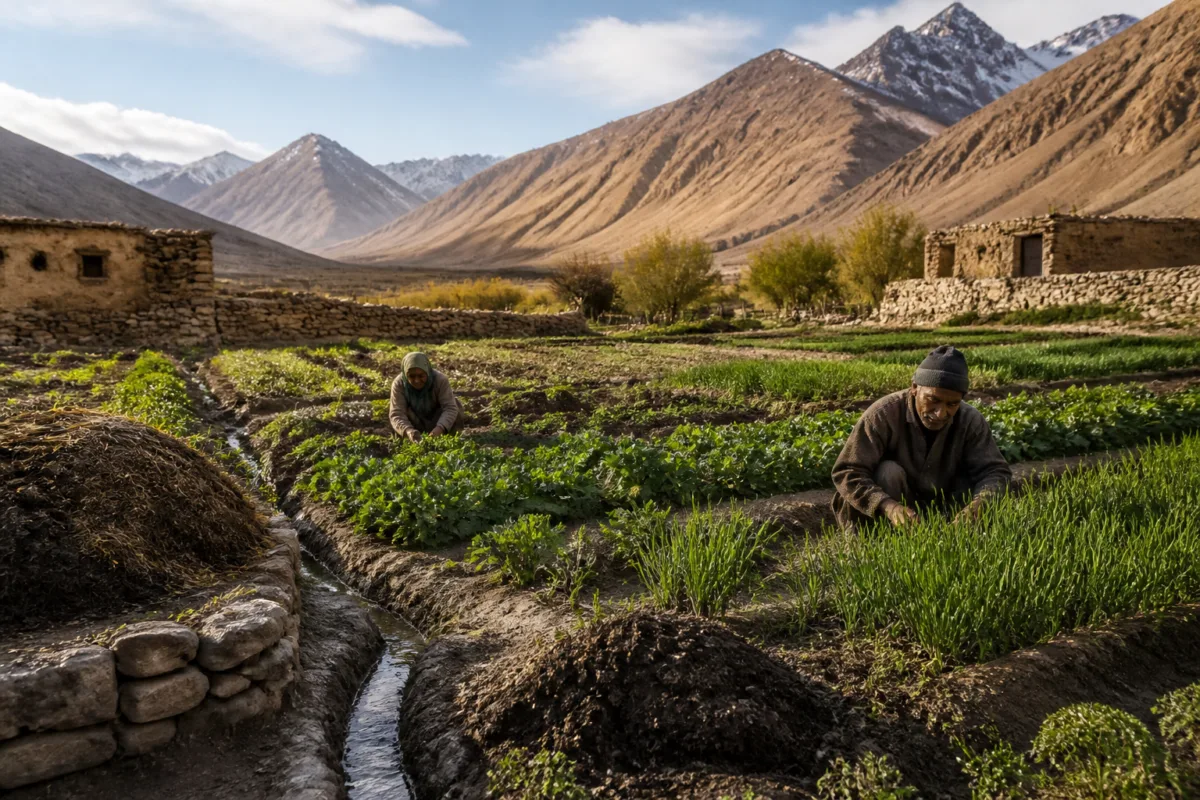
Ladakh’s declaration as India’s first 100% organic Union Territory is being presented as an environmental and agricultural milestone. But the more consequential question is whether the new status can be converted into reliable certification, stronger post-harvest systems, better market access and higher incomes for farmers across one of the country’s most difficult farming environments.
Lieutenant governor Vinai Kumar Saxena declared Ladakh fully organic, saying the transition would create new opportunities for farmers by increasing the value of locally grown produce. The announcement covers food crops as well as floriculture, including lily cultivation. The administration has identified apricots, sea buckthorn, buckwheat, barley and vegetables as products that could benefit from stronger branding and market linkages.
The declaration follows a series of administrative steps in 2026. In March, consignments of organic fertiliser were flagged off for distribution across Ladakh’s villages before the sowing season. In July, the lieutenant governor ordered a complete prohibition on the procurement, distribution, sale, marketing and use of chemical and synthetic fertilisers for agricultural practices across the Union Territory. The administration has also said that chemical fertilisers and pesticides are banned, with violations attracting penalties of Rs 10,000 or more.
Together, these measures show that Ladakh’s organic transition is not limited to a certification announcement. It is being implemented through restrictions on farm inputs, public distribution of organic fertiliser and an effort to connect production with certification and markets. That makes the policy an exercise in agricultural governance as much as an environmental programme.
The geography of Ladakh gives the policy its importance and its difficulty. The administration describes the region as having a fragile Himalayan ecosystem and unique agro-ecological conditions. Farming is shaped by high-altitude conditions, limited growing periods and the need to manage scarce soil and water resources. In that setting, a shift away from synthetic inputs is not simply a change in branding. It affects what farmers can obtain, how they maintain productivity and how produce moves from villages to consumers.
The lieutenant governor has linked the organic transition to the protection of soil and water resources, the preservation of traditional farming practices and the creation of sustainable livelihoods. A government spokesperson similarly said the move was intended to improve soil and water health, protect the Himalayan ecosystem and enhance farmers’ incomes. These objectives are closely connected, but they will not be achieved by prohibition alone.
The first institutional challenge is certification. Saxena said farmer certification would follow the declaration, indicating that the organic status of the Union Territory does not by itself complete the certification process for individual farmers or products. Certification is important because the commercial value of organic produce depends on whether consumers, buyers and institutions can verify how it was grown.
This distinction matters for Ladakh’s agricultural economy. An area-wide organic designation may establish a broad policy framework, but farmers still need usable certification systems, traceability and recognised channels through which produce can reach markets. Without those systems, the organic label may remain an administrative achievement rather than a mechanism for better price realisation.
The administration has identified post-harvest management, value addition, branding and stronger market linkages as the next parts of the transition. These are significant because the value of Ladakh’s produce is not determined only at the point of cultivation. Apricots, sea buckthorn, buckwheat, barley and vegetables require systems for handling, storage, processing, packaging and distribution if farmers are to capture more of the final value.
The supplied account does not specify the number of farmers covered, the area under cultivation, the volume of organic fertiliser being distributed, the certification schedule or the infrastructure available for storage and processing. It also does not provide price comparisons between organic and conventionally produced goods. Those gaps do not negate the declaration, but they show where the performance of the policy will eventually need to be assessed.
The policy’s enforcement design is another important feature. The administration has prohibited chemical fertilisers and pesticides and announced financial penalties for violations. Such restrictions create a clear regulatory position, but they also place responsibility on public agencies to ensure that compliant alternatives are available when farmers need them. The March distribution of organic fertiliser before sowing suggests that the administration recognised this operational requirement during the transition.
The timing of input distribution is particularly relevant in a region where delays can affect an entire growing cycle. If farmers are expected to stop using prohibited inputs, the availability, affordability and quality of alternative fertilisers become part of the policy’s credibility. The declaration therefore depends on a functioning supply chain that extends beyond the announcement and reaches individual villages before agricultural operations begin.
Ladakh’s administration has framed the transition as a combination of traditional knowledge and scientific support. Saxena said the government must strengthen organic value chains and protect natural resources while combining traditional wisdom with scientific support. This approach positions organic farming not as a return to the past alone, but as an attempt to organise existing farming practices within a formal system of certification, input management and market development.
That institutional combination will determine whether the policy produces durable benefits. Traditional practices may be well adapted to local conditions, but market access requires standardisation, quality control and reliable logistics. Scientific support can help address production and post-harvest challenges, but it must be tailored to Ladakh’s geography and farming traditions. The administration’s stated objective is therefore broader than replacing chemical inputs: it is to build an agricultural value chain around the region’s environmental and cultural distinctiveness.
The economic promise is also clear in the administration’s language. Saxena said the goal was to ensure better market access, improved price realisation and sustainable livelihoods. The emphasis on value addition and branding suggests that Ladakh wants its organic status to function as an economic identity for local produce. Products such as apricots and sea buckthorn could become more valuable if processing, packaging and consumer recognition develop alongside cultivation.
However, the report establishes an expectation rather than a measured outcome. It says the transition is expected to create opportunities and improve the value of local produce, but it does not yet provide evidence of increased farmer incomes, new buyers or higher prices. The distinction is important. Organic status can support market positioning, but its financial effect depends on certification, consumer demand, transportation, processing capacity and the distribution of revenue along the supply chain.
The same applies to environmental outcomes. The administration has stated that the policy will protect soil and water resources and safeguard the Himalayan ecosystem. Those are central reasons for the transition, particularly in a fragile high-altitude region. Yet the supplied material does not include baseline measurements or later indicators that would show how soil health, water quality or input use has changed. Such evidence will be necessary to distinguish policy intent from environmental performance.
Ladakh’s experience also raises a wider governance question: how should agricultural policy be designed for regions whose ecological limits are as important as their production potential? The administration is using regulation, input distribution, certification and market development together. This integrated approach reflects the reality that farming outcomes are shaped not only by what happens on a field, but also by procurement systems, logistics, enforcement and consumer trust.
The declaration consequently marks the beginning of an implementation phase rather than its conclusion. The immediate milestones are farmer certification, continued availability of organic inputs, enforcement of the restrictions, development of post-harvest systems and the creation of credible market linkages. The administration has said that these measures should bring real value to farmers while protecting natural resources.
What is established is that Ladakh has adopted a Union Territory-wide organic policy, prohibited chemical fertilisers and pesticides, begun distributing organic fertiliser and set out an agenda involving certification, value addition and branding. What remains to be demonstrated is whether those measures will produce higher and more stable farm incomes without weakening agricultural resilience. Ladakh’s organic status will ultimately be judged not only by its certification label, but by whether its farmers can sustain production and capture greater value from it.

