


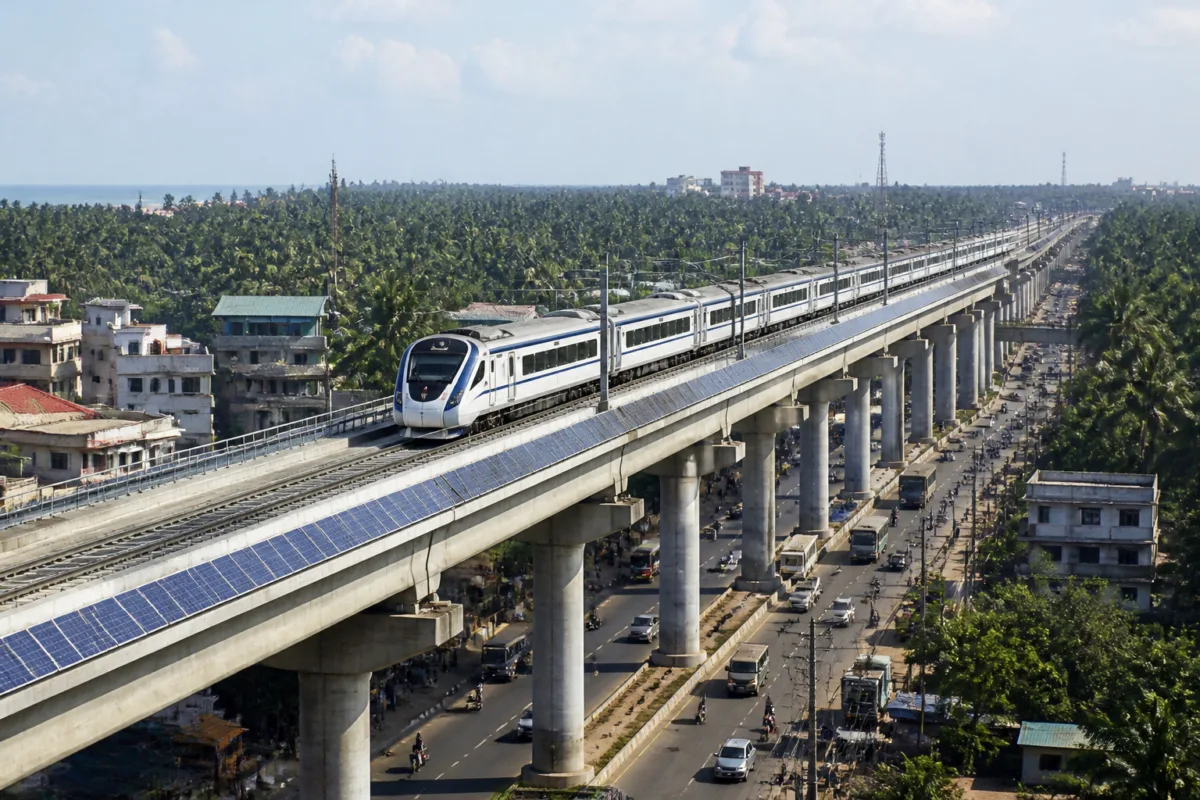
A proposed 472-km semi-high-speed rail corridor between Thiruvananthapuram and Kannur has returned to public attention after technocrat E. Sreedharan argued that it could require less investment than adding third and fourth railway tracks along Kerala’s existing rail route.
The project, estimated at about ₹60,000 crore, has been envisaged as an elevated corridor requiring limited land acquisition. Sreedharan said the structure could carry solar panels along both sides of its viaduct, helping reduce operating and maintenance expenses by about one-third. These are proposals presented by Sreedharan; the Kerala government is yet to formally respond to the interim report he submitted in May, according to the report cited by Livemint.
Sreedharan, a former Principal Advisor of the Delhi Metro Rail Corporation, was speaking after delivering a lecture on “High-speed rail for Keralam” organised by the Kochi centre of the Institution of Engineers (India).
The proposed design is intended to address one of the most difficult issues in large transport projects in Kerala: acquiring land in a densely populated state. By placing much of the corridor on viaducts, the proposal seeks to reduce the amount of land needed compared with a fully ground-level alignment. However, the source material does not provide a confirmed land-acquisition assessment, construction schedule or final alignment.
Sreedharan also proposed using standard-gauge tracks with a 15-tonne axle load. He said this would permit a slimmer viaduct than one designed for broad-gauge tracks, which support a 25-tonne axle load. The design speed has been proposed at 200 kmph, with a commercial average speed of 135 kmph.
Under the operating plan outlined by Sreedharan, 12-coach trains would run every 30 minutes. The frequency could be increased to one train every five minutes if passenger demand warranted it, he said. Stations would be placed roughly every 25 km, closer than the 40–50 km intervals cited for a high-speed rail system with a design speed of 350 kmph.
The proposed service would aim to connect Thiruvananthapuram and Kannur in three hours and 30 minutes. Sreedharan estimated that a fare of ₹800 for the full journey could shift about 30% of the one lakh rail passengers currently using the route to the semi-high-speed trains. He also said the corridor could attract passengers from road transport.
The funding model he outlined would involve the Centre and the Kerala government jointly financing 60% of the capital expenditure, with the remaining 40% raised through crowdfunding. The source material does not indicate that this funding structure has been accepted by either government or that a crowdfunding mechanism has been established.
Ernakulam district could be a significant beneficiary under the proposal, Sreedharan said. Four stations are envisaged in the district, including one near the international airport. Such a configuration would improve access between the airport, urban centres and the wider corridor if the project is approved and built.
The corridor’s most consequential question is therefore not only whether it can deliver faster travel, but whether its proposed cost, elevated construction model, energy system, financing plan and passenger assumptions can be independently assessed. The project is currently at the proposal and evaluation stage. A formal response to the interim report, followed by decisions on alignment, funding, approvals and implementation, would be required before the corridor could move towards construction.

