


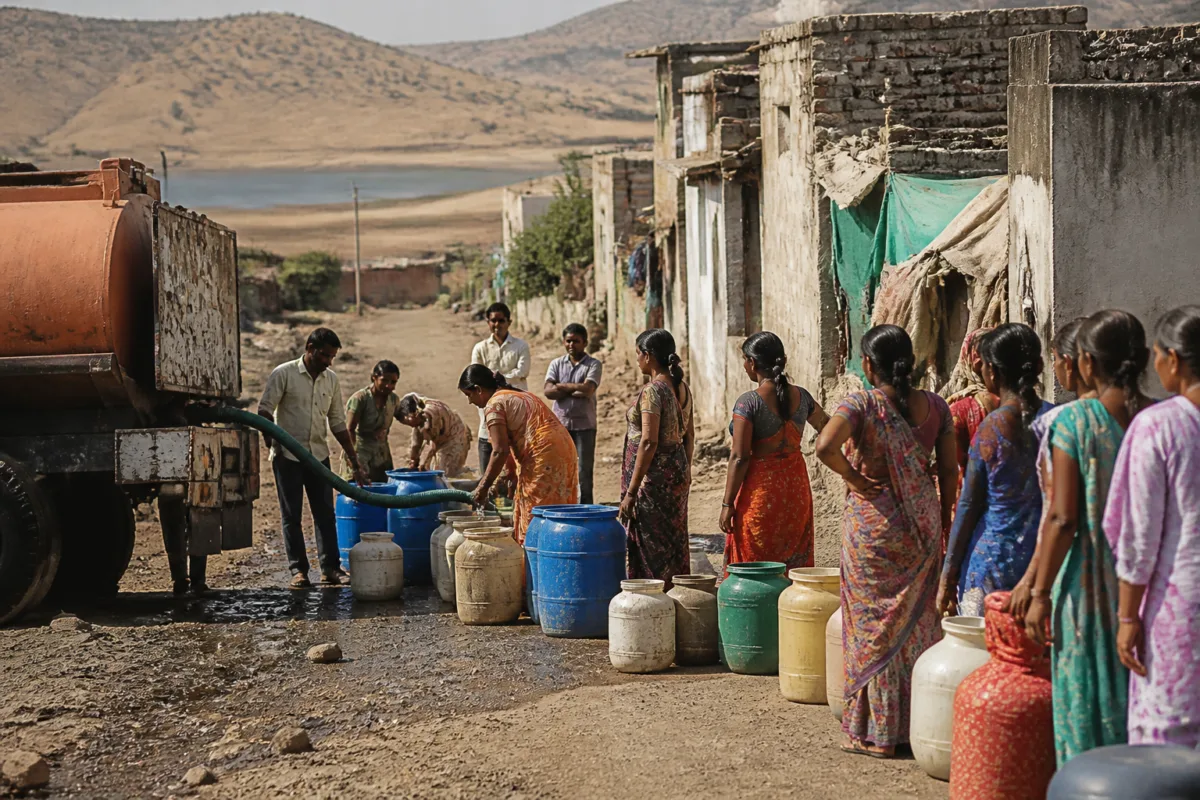
Maharashtra’s worsening water crisis is placing growing pressure on rural and settlement-level water infrastructure, with 1,323 tankers supplying 1,102 villages and 3,801 hamlets across 11 districts, according to the latest state government compilation cited by Mid-Day.
The Marathwada region is facing the sharpest stress. Nineteen dams there have reportedly run dry, while the number of tankers required across the state has doubled over the past month. Marathwada accounts for 668 of the deployed tankers, with Beed district alone using 326 vehicles to supply affected settlements.
The dependence on tankers reflects the weakening reliability of local water-supply schemes. Officials from the Water Supply Department have warned that demand could increase further as existing sources and distribution systems come under additional pressure.
Maharashtra’s overall dam storage was reported at 61.88 per cent of capacity, compared with 90.26 per cent during the corresponding period last year, citing Water Resources Department figures. Marathwada had the lowest regional storage level, at 33.79 per cent compared with 90.16 per cent during the same period last year.
Storage levels varied considerably across the state. Konkan had 79 per cent of capacity filled, followed by Pune division at 72.44 per cent and Nashik division at 71.30 per cent. Nagpur stood at 54.93 per cent and Amravati at 50.53 per cent.
The situation is particularly severe in Dharashiv and Beed. In Dharashiv, all dams were reported to have dried up except Lower Terna, which had 14 per cent storage. In Beed, the Majalgaon and Dhanegaon dams retained around 14 to 16 per cent storage, while the district’s other dams had reportedly run dry. Sources cited in the report said the administration was arranging tankers filled in neighbouring districts to supply affected settlements.
The state has declared drought conditions in 310 talukas, while surveys are under way in 13 additional talukas following requests for their inclusion on the list. Nashik district, despite having a significant number of dams, has deployed 43 tankers to meet local requirements.
The crisis has also prompted a planning response. Maharashtra’s Planning Department has issued a Government Resolution for the District Annual Plan for 2026–27, directing district authorities to review non-essential, water-intensive construction projects and temporarily defer eligible works. The stated objective is to redirect available funds towards urgent water-related requirements.
The framework prioritises completing pending pipelines, pumps, storage tanks and distribution networks; repairing damaged water-supply infrastructure; and connecting existing sources to areas facing shortages. It also identifies drinking water, livestock fodder, water conservation, public health and essential livelihood-related works as priorities.
This approach links drought mitigation to the condition and reach of basic infrastructure rather than relying only on emergency tanker supply. Tankers can provide short-term access, but the Government Resolution’s focus on pipelines, storage and distribution systems indicates that the state is also attempting to address gaps in permanent supply networks.
The Maharashtra government was expected to review the situation at its weekly Cabinet meeting on Wednesday, with the review likely to cover the implementation of existing scarcity-mitigation measures and the need to strengthen relief efforts. The report does not provide details of any decision taken at that meeting.
For communities already dependent on tankers, the immediate challenge is maintaining regular drinking-water access as reservoir levels fall. The longer-term test will be whether deferred construction spending can be redirected quickly into functioning water infrastructure, and whether those systems can connect reliable sources to settlements facing the most severe shortages.

