


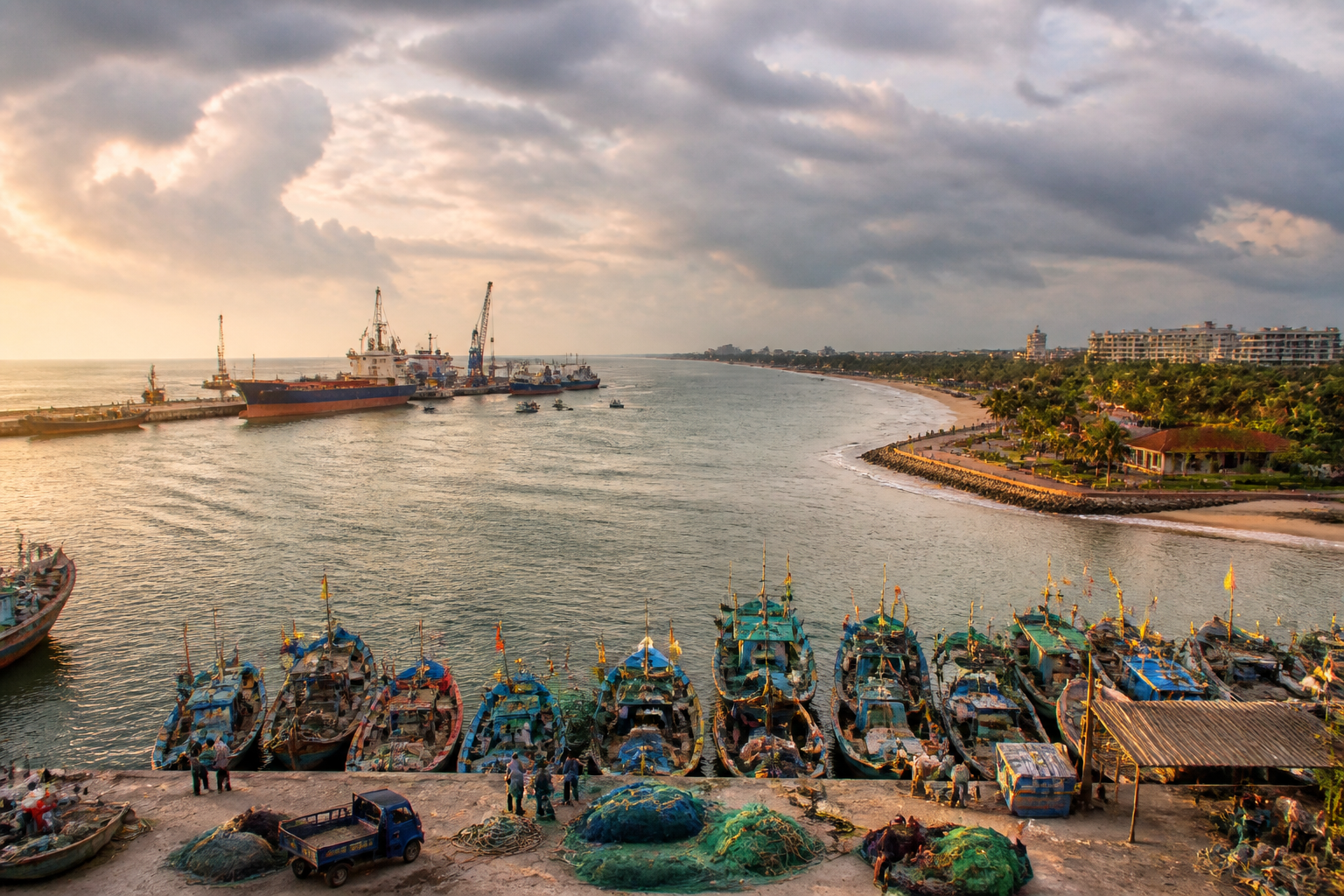
Karnataka’s coastal development plan is being assembled as a broad economic and infrastructure programme rather than a single tourism project. At its first Cabinet meeting held in the coastal region, the state approved proposals worth ₹32,611 crore, including projects valued at more than ₹16,000 crore for coastal development, according to a report by Prajavani. The decisions bring tourism, fisheries, ports, aviation, healthcare, language administration and regional connectivity into one policy frame.
The scale of the package is significant because the coastline is being treated simultaneously as an economic asset, an ecological zone and a lived region with distinct institutional demands. The Cabinet approved the Coastal-Malenadu Karnataka Tourism Policy 2026, proposed changes to the Coastal Zone Management Plan 2019, designated the coasts of Dakshina Kannada, Udupi and Uttara Kannada as a Special Marine Zone for fisheries-related economic activity, and gave in-principle approval to a water metro linking 12 centres between Mangaluru and Karwar.
These decisions do not yet amount to a completed coastal transformation. They are a mix of policy approvals, administrative sanctions, in-principle approvals, land allocations and project proposals. Their eventual effect will depend on how the state converts these announcements into detailed plans, funding arrangements, land-use decisions, environmental clearances, tenders and operating institutions. The Cabinet meeting is therefore best understood as a statement of direction, with implementation still to be established.
The tourism policy provides the clearest indication of the government’s intended development model. It identifies multiple circuits extending from the coast towards the Western Ghats: a blue-green circuit, pilgrimage and heritage circuits, a beach and surf circuit, a cruise and backwater circuit, coastal and inland food circuits, coffee and plantation circuits, an eco-adventure circuit, a monsoon circuit and an ancient heritage circuit. Chief Minister D.K. Shivakumar said the policy would provide tourism infrastructure, create local employment and support systematic tourism development, the report said.
The circuit approach attempts to move tourism beyond isolated destinations. In principle, it links beaches, religious sites, food economies, plantations, heritage locations and ecological landscapes into connected visitor routes. That requires more than resorts. It requires transport, public sanitation, water supply, waste management, safety systems, local access roads and clear responsibilities across departments and local governments. The Cabinet decisions, however, do not specify the full delivery structure or the infrastructure standards that will apply across these circuits.
Several approved private-partnership projects show how the tourism push may take physical shape. These include a ₹73 crore riverfront wellness resort on 16.5 acres at Kodikal in Dakshina Kannada, a ₹53 crore eco-friendly beach-front glamping and luxury resort project on 4.97 acres at Tannirbhavi, a visitor experience centre and expo zone, and a ₹48 crore resort, adventure and entertainment zone on 7.07 acres at the Trasi-Maravanthe coast in Udupi district. A ₹64 crore eco-tourism resort is also proposed at Ravoor in Chikkamagaluru district. The report identifies these as projects to be implemented through private participation.
The details raise an institutional question that the announcement itself does not answer: how will public access, environmental safeguards and local economic participation be protected when public coastal assets are developed through private partnerships? The source does not provide project-level terms, concession structures, carrying-capacity assessments or access conditions. Those details will be important because the difference between a connected regional tourism economy and a collection of private enclaves will be determined during implementation, not at the announcement stage.
Fisheries and the blue economy form the second major pillar of the package. The Cabinet decided to issue a notification designating the coastal areas of Dakshina Kannada, Udupi and Uttara Kannada as a Special Marine Zone to expand fishing-related economic activity. It also approved a ₹30 crore Special Processing Zone within 150 acres reserved for a fisheries park at Balkunje in Mulki taluk. The stated objectives are investment, manufacturing, value addition and sustainable resource management.
The proposed processing zone points to an attempt to retain more value within the coastal economy. Fisheries are not limited to fishing activity itself; processing, cold chains, storage, packaging, transport, exports, training and research determine how much income reaches producers and workers. The Cabinet also gave in-principle approval to upgrade Mangaluru Fisheries College into a fisheries university and increase student admissions from 60 to 200. A Karnataka Institute of Marine Biotechnology and Blue Economy is proposed at the government fisheries college in Mangaluru.
Together, these measures suggest that the state is seeking to build an institutional chain from marine resources to education, research and processing. Yet the source does not establish the university’s proposed legal structure, funding model, academic programmes or relationship with the new institute. It also does not specify how sustainable resource management will be measured inside the proposed Special Marine Zone. Those questions will determine whether the blue economy remains a policy label or becomes an operating system for coastal livelihoods.
Environmental regulation is already part of the region’s political and administrative context. The Cabinet decided to amend the Coastal Zone Management Plan 2019 after objections from all three coastal districts. The announcement indicates that the plan has generated opposition, but it does not detail the objections, the proposed amendments or the authority responsible for final approval. This makes the regulatory pathway one of the most consequential unresolved parts of the package. New resorts, processing facilities, ports and transport links will all depend on how development permissions are reconciled with coastal protection rules.
The infrastructure decisions extend beyond tourism and fisheries. The Cabinet approved the development of Karwar airport through runway expansion and revised the administrative approval for the project from ₹98.24 crore to ₹250 crore. It also approved, at an in-principle level, a multipurpose port and shipbuilding centre at Manki at a cost of ₹6,925 crore. The combination of airport capacity, port infrastructure and marine manufacturing could improve regional access and diversify the coastal economy, but the supplied material does not provide construction timelines, traffic projections, financing arrangements or land and environmental details.
The proposed water metro from Mangaluru to Karwar, connecting 12 centres, is another major regional mobility idea. Its in-principle approval signals an ambition to treat the coastline’s waterways as part of the transport network rather than only as tourism assets. However, no route alignment, vessel technology, station locations, travel-time estimate, fare structure or implementation agency is identified in the report. At this stage, it is a policy signal rather than an operational transport project.
The package also includes urban and social infrastructure. Branches of Kidwai and Jayadeva hospitals were approved for Mangaluru, while the Wenlock Hospital was to receive an additional 200 beds, staff and equipment and be developed as a regional centre hospital. A government medical college and hostel in Puttur received ₹425 crore. These decisions widen the meaning of coastal development: regional growth requires healthcare capacity and higher education alongside visitor infrastructure and industrial investment.
The Cabinet’s decision to provide administrative language status to Tulu in Dakshina Kannada and Udupi adds a governance dimension. The move follows an earlier committee report and a later study of the standards and procedures used for recognising an additional official language in Andhra Pradesh, according to the report. The decision is limited to the two districts. Its practical effect will depend on how government offices, forms, public communication and local administrative processes adopt the language.
The proposed renaming of Dakshina Kannada district as Mangaluru district is at an earlier stage. The government plans to issue a notification inviting public objections and suggestions for one month before taking a decision based on public opinion. This is distinct from the project approvals because the administrative outcome remains open to consultation.
The Cabinet also approved ₹151.31 crore to purchase 70,000 additional ballot boxes for local-body elections expected to be held by December. The decision, as explained by Deputy Chief Minister G. Parameshwara, is linked to the proposed use of ballot boxes instead of electronic voting machines and a stated requirement of 1.20 lakh boxes, against 40,000 currently available. Though separate from the coastal development strategy, it illustrates the breadth of the meeting’s agenda and the administrative spending involved in preparing for local governance.
What the Cabinet has created is therefore a layered coastal policy: tourism circuits to attract visitors, fisheries infrastructure to support production and value addition, ports and airports to improve economic access, healthcare and education to strengthen regional services, and language and district-level decisions to respond to local identity. The approach is ambitious because it recognises that the coast cannot be developed through one sector alone.
It is also administratively demanding. The same geography will have to accommodate conservation rules, fishing livelihoods, public infrastructure, private investment, tourism traffic, industrial activity and local government services. The announcement confirms the direction and several financial figures, but it does not yet establish project schedules, implementation agencies, environmental conditions or monitoring mechanisms. The next stage will show whether the package becomes a coordinated regional plan or a series of independently executed projects. The notifications, detailed project reports, regulatory amendments, land decisions and tender timelines will be the key documents to watch.

