


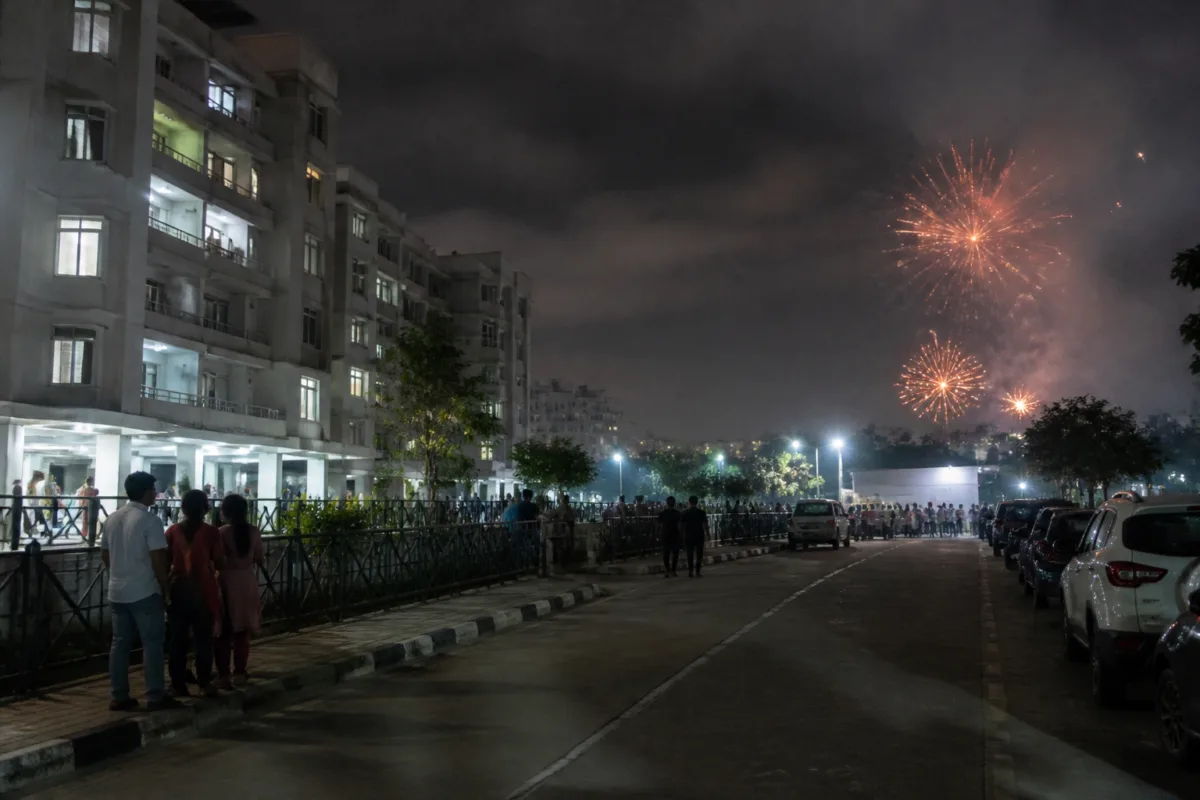
Bhubaneswar noise pollution rose sharply during Diwali celebrations, with residential areas and the silent zone near Capital Hospital recording sound levels well above legally prescribed night-time limits, according to data collected by the Odisha State Pollution Control Board (OSPCB).
Noise in residential areas reached 74 decibels (dB), exceeding the prescribed night-time limit of 45 dB by 29 dB. At the silent zone near Capital Hospital, readings touched 57 dB against the permissible limit of 40 dB, a violation of 17 dB.
Commercial areas also recorded elevated levels, with noise reaching 77.8 dB against the prescribed limit of 55 dB. Industrial areas recorded levels close to the permitted ceiling of 80 dB and remained within the prescribed range, according to the OSPCB data reported by The Times of India.
The readings were recorded during Diwali celebrations on Sunday night. They were significantly higher than pre-Diwali measurements taken in different parts of the city, which ranged between 50.4 dB and 61 dB. The comparison indicates that the festival-period increase was associated primarily with intensive firecracker use, although the pre-festival readings also show that some areas were already registering noise above their prescribed limits.
The latest measurements are also higher than those recorded during the previous year’s Diwali, when noise levels across the city had exceeded permissible limits by a smaller margin, the report said. The data points to a recurring enforcement challenge in areas where residential activity, hospitals and other sensitive uses are located close to public celebrations.
Senior environmental scientist Niranjan Mallick attributed the increase to the use of more sound-intensive firecrackers. “This time more sound-causing firecrackers have been used, leading to increased decibel levels in residential and silent zones,” he said.
The breach is particularly significant around Capital Hospital, where the silent-zone limit is intended to restrict disturbance around a healthcare facility. Excessive noise in such areas can affect patients and people accompanying them, while residents, children and senior citizens may also be exposed to elevated sound levels during festival periods, the report said.
The OSPCB’s readings also show the difference between a city’s prescribed noise standards and conditions experienced on the ground. Residential zones have a lower night-time limit than commercial and industrial areas because of the need to protect homes and sleeping hours. Silent zones have a still lower limit because they include sensitive locations such as hospitals.
The findings come despite awareness campaigns and regulations intended to control noise pollution during festivals. The OSPCB’s next reported readings and enforcement actions will determine whether the Diwali spike remains a seasonal breach or prompts further measures around firecracker use and sensitive urban locations.

