


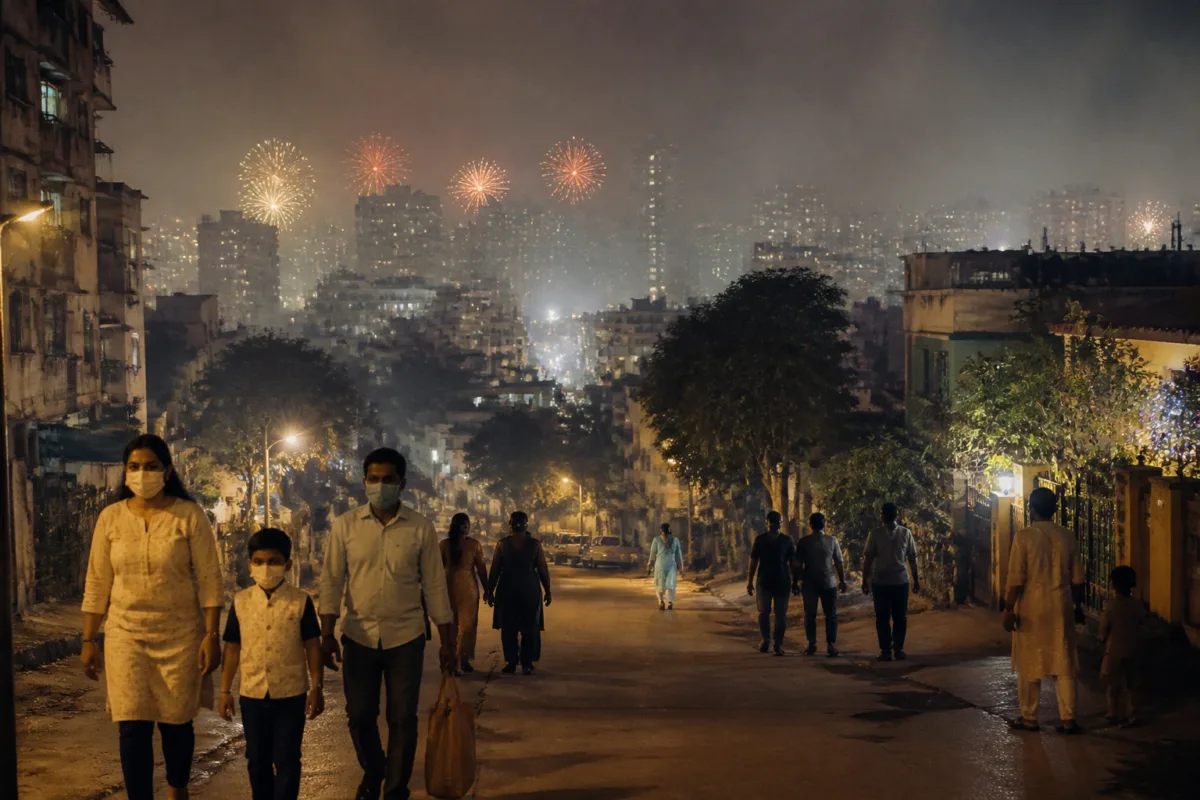
Firecracker pollution during Diwali is not only a short-lived nuisance for Mumbai’s residents. It exposes how quickly a dense city’s air can deteriorate when a concentrated burst of emissions meets a large, vulnerable population and limited room for exposure to disperse. The immediate concern is the spike in particulate pollution, but the larger urban question is whether public-health planning treats festival-related emissions as a predictable risk or merely as a seasonal inconvenience.
The report by Mid-Day quotes Dr Subhash Hira, professor of global health at the University of Washington and a member of World Health Organization expert committees on pandemic preparedness, as saying that the bursting of firecrackers each year results in a rise in the Air Quality Index and can produce harmful pollution levels. He identifies children, older people and those recovering from Covid-19 or living with other respiratory illnesses as particularly vulnerable.
That distinction matters in Mumbai because exposure is shaped by the built environment. People live, work and travel close to one another, while homes, roads, commercial areas and public spaces are often tightly interwoven. Pollution generated on one street can therefore become a neighbourhood-level concern, especially when emissions accumulate during a period of intense and simultaneous activity. The supplied report does not provide a citywide AQI reading, ward-level comparison or monitoring data for a particular Diwali, so the precise scale of Mumbai’s increase cannot be established from the available evidence. It does, however, describe the mechanism by which firecrackers worsen air quality.
Firecrackers release particulate matter, including PM2.5 and PM10, into the atmosphere. These particles can remain suspended and contribute to thick, polluted air. The report also says that firecrackers emit sulphur dioxide, nitrogen oxides and heavy metals, adding chemical pollutants to the particulate burden. The significance of this mixture is that the health effect is not limited to visible smoke or temporary discomfort. Exposure can aggravate existing respiratory conditions and place additional stress on people whose lungs or cardiovascular systems are already compromised.
The report specifically links poor air quality with the worsening of conditions such as asthma and bronchitis. Children face a particular concern because their lungs are still developing, while older people may already have reduced respiratory capacity or chronic illnesses. People recovering from Covid-19 are also described as vulnerable because lingering respiratory problems may make them more susceptible to polluted air. These risks are not evenly distributed across the city: the same episode of pollution can have a more serious effect on residents with different health conditions, ages and levels of exposure.
This makes firecracker pollution an urban governance issue as much as a personal-choice issue. A city’s response depends on several institutions and behaviours operating together: public communication, regulation of sales and use, enforcement in densely populated areas, health advisories, local monitoring and the availability of safer ways to celebrate. If any one of these elements is missing, responsibility can be pushed entirely on to residents, even though individual decisions take place within a wider system of streets, markets, housing density and administrative capacity.
The expert quoted in the report recommends cooperation between communities and local governments to balance cultural practices with public health. The recommendations include educating residents about the health risks, promoting alternative forms of celebration, enforcing regulations on firecracker sales and use, restricting bursting in densely populated areas, and encouraging community events that reduce noise and pollution. These measures point to a layered approach rather than a single solution. Public messaging may influence behaviour, but it cannot replace enforcement. Restrictions may reduce exposure in specific areas, but they require clear rules and credible implementation.
The absence of city-specific numbers in the supplied report is itself important for how this issue should be understood. It confirms the health pathway and identifies vulnerable groups, but it does not establish how much firecracker pollution contributed to Mumbai’s air quality on a particular day, which neighbourhoods recorded the highest readings, or whether enforcement reduced emissions. Those questions require data from monitoring stations, municipal or pollution-control authorities, health departments and enforcement agencies. Without such information, public discussion can become polarised between broad claims of danger and broad claims that the concern is overstated.
A stronger urban response would therefore connect air-quality monitoring with public-health communication. Residents need timely and local information about pollution levels, while authorities need to identify places where dense settlement, schools, hospitals, care facilities or heavy pedestrian movement make exposure especially consequential. The source material does not state that Mumbai has adopted such an integrated system for Diwali, nor does it provide details of enforcement arrangements. The evidence supports the need to examine those institutional links, not to assume that they already exist or work effectively.
Firecracker pollution also reveals a recurring problem in urban policy: seasonal risks are often treated as exceptional even when they are foreseeable. Diwali is a recurring festival, and the report describes the associated pollution spike as an annual concern. That predictability creates an opportunity for preparation. Authorities can plan communication, monitoring and enforcement in advance, while communities can organise celebrations that reduce concentrated exposure. The effectiveness of those steps would need to be assessed through comparable air-quality readings, compliance information and health indicators, none of which are supplied in the report.
The central issue is not whether the city must choose between cultural celebration and public health. It is whether the costs of celebration are recognised and managed in a way that does not transfer disproportionate risk to people who have the least ability to absorb it. Children, older residents and people with respiratory illness may not be able to avoid polluted streets or seal themselves away from their neighbourhoods. In a dense city, individual exposure is also influenced by what happens outside a person’s home, in shared public spaces and around residential buildings.
The available evidence confirms that firecrackers can add particulate and chemical pollutants to urban air and that vulnerable groups face heightened health risks. It does not establish a Mumbai-specific pollution figure, quantify the number of affected residents or assess the performance of local enforcement. Those are the facts that need to be tracked as the city prepares for future festival periods. Until then, the episode remains a clear reminder that air quality is not only an environmental measurement; it is also a question of urban design, administrative coordination and unequal public-health exposure.

