


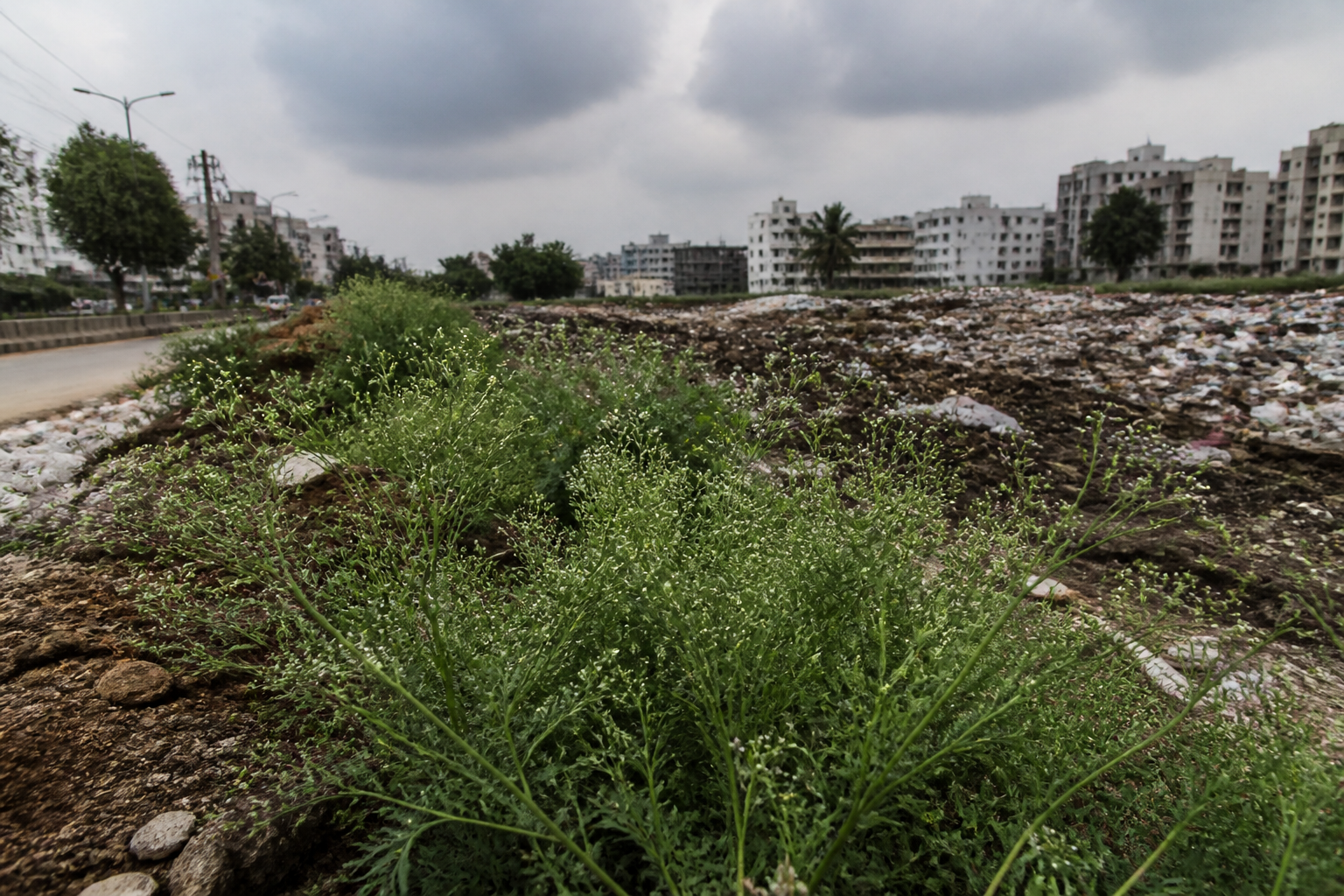
A study of soil and vegetation around seven waste-disposal sites in Bengaluru has found heavy-metal contamination that extends beyond the visible waste footprint. Researchers from CHRIST (Deemed to be University) recorded lead, iron, manganese and chromium in soil and in the leaves, stems and roots of plants growing around the sites, raising questions about how urban waste is contained, monitored and eventually reclaimed.
The findings matter because a dumping site is not an isolated patch of land. When waste is left unmanaged, metals can leach into surrounding soil and become part of the local ecological system. The Bengaluru study indicates that contamination is present not only in the ground but also in vegetation capable of absorbing pollutants and surviving in difficult urban conditions.
The researchers collected samples from Dharmaram, Chikkassandra, Hanumanthe Gowder Main Road, SG Palya, Tavarekere Park, Jose Mess and BTM Lake. They examined soil and different plant parts of Parthenium hysterophorus, commonly known as the carrot plant, which was found at all seven locations.
The study recorded lead concentrations in soil of up to 114.5 parts per million at some sites. The report noted that the maximum permissible limit for lead in soil under regulations of the Central Environment Ministry is 50 parts per million. That comparison places the highest recorded soil reading at more than twice the stated permissible limit.
Lead was also found in plant parts, with concentrations reaching 67 parts per million in roots at some locations. The researchers additionally recorded high levels in stems and leaves. Plant tissues contained manganese levels of up to 141 parts per million in some samples, while iron concentrations approached 7,700 parts per million. Chromium levels in certain plant parts reached 23.27 parts per million.
These figures do not, by themselves, establish the extent of exposure for nearby residents or demonstrate that the plants are entering the food chain. The supplied study report does not provide a population-health assessment, a detailed assessment of groundwater or air contamination, or a site-by-site account of the waste composition. But the findings establish a material environmental management concern: waste sites can remain sources of contamination even when the most obvious waste is no longer the only visible issue.
## What the plant samples reveal
The choice of Parthenium hysterophorus was central to the study. Researchers selected the plant because it is invasive, has a high reproductive rate, can acclimatise to harsh conditions and was present across all seven locations. Its ability to grow where other plants may struggle makes it a useful indicator of the conditions around disturbed or contaminated land.
The presence of metals in roots, stems and leaves shows that contaminants in soil can be taken up by vegetation. The study does not claim that every plant growing near a waste site is equally contaminated, nor does it establish that the carrot plant can safely be used for any other purpose. Its importance lies in showing how pollution can move through an urban ecological system rather than remaining confined to discarded material.
The reported comparisons with food-safety standards make the issue more consequential, although they must be interpreted carefully. The Food Safety and Standards (Contaminants, Toxins and Residues) Regulations, 2011, cited in the report, set a lead limit of 20 parts per million and a chromium limit of 50 parts per million in food. The World Health Organization’s cited maximum permissible limits for lead in edible plants are 2.00 parts per million, while the chromium range is 1.30 to 1.60 parts per million.
The sampled plant is not being presented as a food crop. Therefore, these food-related thresholds cannot be used to claim that people have consumed contaminated produce from the seven sites. They do, however, underline why plants growing near waste areas cannot be treated as harmless simply because they are part of the landscape. Land use, informal cultivation and the handling of vegetation from contaminated sites become important questions wherever waste disposal overlaps with public space or settled areas.
## Heavy metals in Bengaluru soil are also a reclamation problem
The study’s second contribution is its focus on what happens after land has been used for dumping. Dr Jobi Xavier, head of the Department of Life Sciences at CHRIST, said Parthenium could be explored as a low-cost option for phytoremediation, in which plants are used to help remove or contain pollutants in soil.
The proposed use is not a ready-made solution. The researchers acknowledge that studies on using such plants to remediate waste sites are currently lacking. They also identify a practical drawback: once the plant has absorbed heavy metals, it must be processed and handled safely. Simply cutting contaminated vegetation and moving it elsewhere could transfer the problem rather than resolve it.
This is the institutional challenge behind the research. Reclaiming a waste site requires more than covering waste or allowing vegetation to grow over it. Authorities would need to know what contaminants are present, how far they have travelled, how they change over time, and what can safely be done with contaminated soil and plant matter. The study report supplied here does not identify a city-wide reclamation programme or a site-specific implementation plan.
The findings therefore point to a gap between waste disposal and land management. A site may be treated as a disposal location at one stage and as potential land for another use later, but contamination can persist across that transition. Without monitoring and a defined end-use strategy, the apparent closure of a dumping area does not necessarily mean that its environmental liabilities have ended.
## The governance question behind the findings
Urban waste management is often measured through collection, transportation and disposal. The Bengaluru study shifts attention towards the condition of land and vegetation after waste reaches its destination. That requires a longer administrative chain: identifying the waste stream, controlling leaching, testing soil and plants, restricting unsafe uses and establishing responsibility for remediation.
The seven-site sample also shows why contamination cannot be understood only through large, formally recognised dumping grounds. The locations named in the study include roads, neighbourhood areas and a lake-side site, indicating that waste-related contamination can be examined across different urban settings. The report does not establish that each site has the same waste history or contamination pathway, so no single management response can be assumed for all seven.
The study’s evidence supports a more precise monitoring approach. Soil results should be linked to the location, depth and surrounding land use. Plant results should distinguish roots, stems and leaves, as the researchers have done. Further assessment would be needed to determine whether metals are moving into water, dust or food-growing areas. Those questions are not answered by the study, but they follow directly from its findings.
The research also illustrates the limits of low-cost environmental interventions. A plant that grows readily in harsh conditions may help identify or absorb pollutants, but its use creates a new material requiring controlled disposal. That makes phytoremediation a potential component of site reclamation, not a substitute for waste containment, testing or regulatory oversight.
For Bengaluru, the larger issue is whether waste sites are managed as temporary service locations or as long-term urban land liabilities. The reported lead levels, including a maximum of 114.5 parts per million in soil against a cited permissible limit of 50 parts per million, show why that distinction matters. The contamination recorded in vegetation adds an ecological dimension to the question.
The study confirms that heavy metals are present in soil and plant samples collected around the seven named waste-disposal sites and that some recorded levels exceed the regulatory comparison cited for soil. It does not establish the full geographic spread, health impact or future land-use risk. Those uncertainties make follow-up testing, transparent site-level reporting and a documented plan for handling contaminated vegetation central to any next step. The researchers said they are continuing to work on the problem of processing plants after they absorb heavy metals.

