


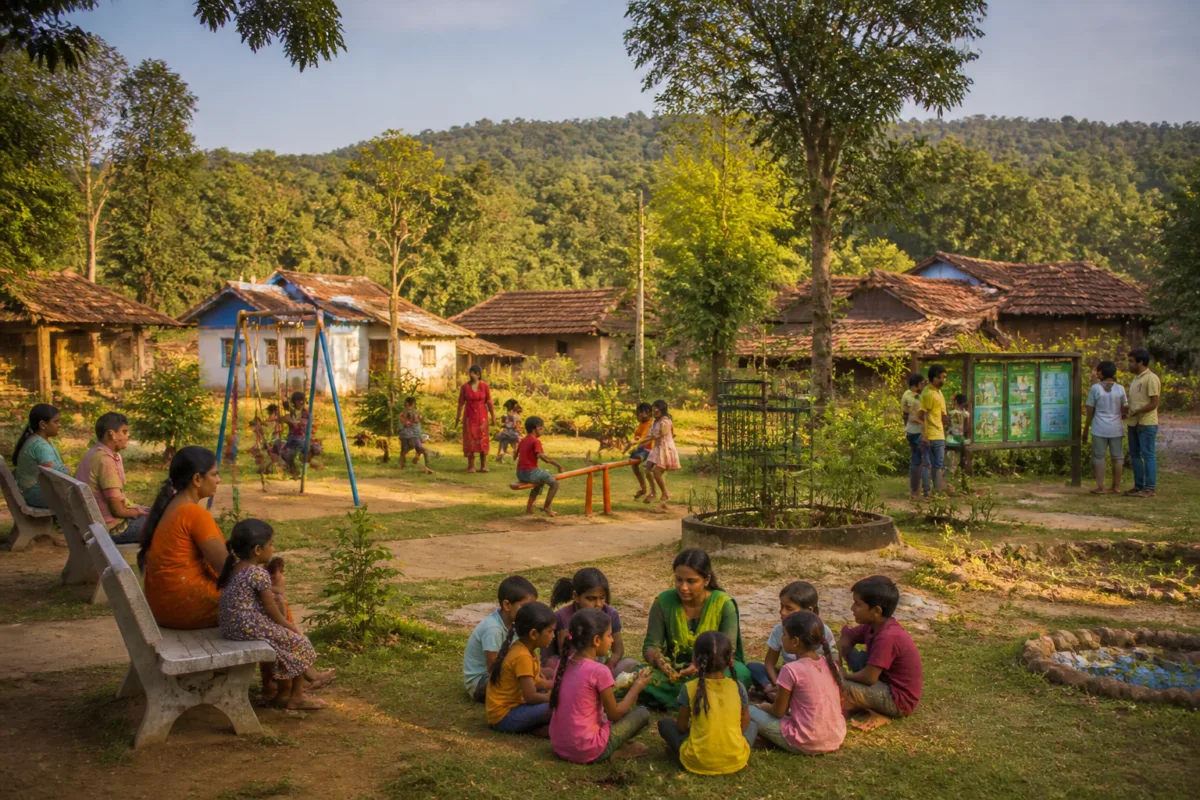
Kanha Tiger Reserve’s plan to build 51 children’s parks in forest-fringe villages by March 2027 is more than a programme to create play areas. It is an attempt to use everyday village infrastructure to strengthen the relationship between communities and the protected forest landscape around them.
Three parks have already been completed and handed over to Eco-Development Committees, or EDCs, in Manori, Kuktisarai and Khursipar villages under the Motinala buffer range of the Buffer Zone Forest Division. Four more parks are under construction. According to the reserve management, each project is taken up on the proposal of the village EDC, making the initiative a locally identified intervention rather than a uniform construction programme announced from outside the villages.
That institutional detail is important. In forest-edge settlements, conservation is not experienced only through rules governing access to forests or wildlife protection. It is also experienced through the availability of public amenities, schools, safe spaces and local services. By linking children’s parks to conservation education and village development, Kanha’s management is treating community infrastructure as part of the wider conservation system.
The reserve has named the parks ‘Kanha Bal Udyan’. Their immediate purpose is to provide children in remote forest-edge hamlets with safe places to play and learn. The management also intends them to function as nature-education spaces, where children can learn about forests, wildlife and biodiversity from an early age. This gives the parks a dual identity: they are recreational spaces within the village and informal sites for building familiarity with the ecological landscape surrounding it.
The available information does not specify the size, design, cost, facilities or land ownership arrangements for each park. It also does not state whether the parks will include formal play equipment, nature interpretation material, lighting, toilets or accessibility features. Those details will matter to the quality and usefulness of the assets, particularly in villages where maintenance capacity and safe access can determine whether a public space remains active after construction.
The initiative is focused on villages affected by human-wildlife interactions. The source report does not provide figures on the number or nature of such incidents, nor does it identify the specific communities included in the 51-village target. But the stated focus establishes the central policy logic: conservation outcomes are being connected to the conditions in which forest-edge residents live, particularly children and families who share a landscape with wildlife.
This is where the proposal moves beyond the conventional idea that conservation is primarily a protected-area management task. The reserve management says the parks will also give women, young people and senior citizens a safe place to spend time within their villages. In that formulation, the park is not designed only for children. It becomes a small piece of shared public infrastructure, with possible uses across age groups.
The role assigned to EDCs is equally significant. The committees have been formed under the Joint Forest Management framework and act as a link between the forest department and villagers. Officials told the Times of India that regular meetings with EDC members have helped identify local needs and convert them into projects. The parks therefore sit inside an existing administrative relationship rather than operating as isolated amenities.
That arrangement also shows how local governance can shape the delivery of small public assets. A village proposal becomes the starting point, while the reserve administration appears to coordinate or support implementation through the buffer-zone forest structure. The available report does not establish the precise funding mechanism, tendering process, construction agency or maintenance agreement. It does, however, identify the EDC as the community institution that receives completed parks.
Handover is a critical point in the life of such infrastructure. Construction creates an asset, but continued use depends on upkeep, responsibility and local ownership. In the three villages where parks have been completed, the handover to EDCs creates a formal community role. The report does not say how maintenance will be financed, who will repair equipment or how the committees will monitor safety. These remain important implementation questions as the reserve moves from three completed parks towards its target of 51.
The reserve’s wider school-related work helps explain the broader approach. Through EDCs, desks and benches have been provided in 20 schools so that children do not have to sit on the floor. Smart classrooms have been developed in four schools, while more than 50 schools have received school bags, shoes, socks, tiffin boxes, water bottles and stationery. These interventions cover both physical learning conditions and basic educational support.
Taken together, the parks and school projects suggest that Kanha’s community-development work is not limited to a single type of benefit. The parks address recreation, social interaction and nature education. The school interventions address classroom furniture, digital learning facilities and supplies used by students. The report presents these activities as part of an effort to link conservation with community development and to raise a generation that is environmentally aware.
The numbers provide the clearest picture of the scale currently described. The target is 51 parks by March 2027. Three have been completed, representing less than one-tenth of the stated target, while four are under construction. The report also records support across 20 schools for desks and benches, four schools with smart classrooms and more than 50 schools receiving educational materials. These figures show a programme combining a defined infrastructure target with a wider set of school-support measures.
They also reveal the importance of monitoring implementation rather than treating the announcement as the final outcome. The target date is March 2027, but the source does not provide interim milestones for the remaining parks. It does not state how many villages have submitted proposals, how projects are prioritised or whether all 51 locations have been identified. Without those details, the present evidence confirms the direction and early progress of the programme, but not the likelihood or conditions of completion.
The choice to work through village committees may help align projects with local needs, at least in principle. It provides an institutional channel through which residents can propose facilities and the forest administration can respond. At the same time, the report does not describe the composition of the EDCs, the extent of participation by women and young people, or the process used to resolve competing village priorities. Those factors would determine how representative the local decision-making process is.
The programme also raises a practical question about the meaning of conservation education. If children’s parks are simply recreational facilities with a conservation label, their contribution may be limited. If they are actively used for learning about local forests, wildlife and biodiversity, they could become recurring points of contact between schools, families and the reserve’s conservation message. The supplied evidence confirms the intended educational role, but not how lessons, activities or monitoring will be organised.
For forest administrations, this distinction matters because community relationships are built through repeated local interaction, not only through occasional awareness campaigns. A park that is safe, usable and maintained can become a visible public benefit associated with village institutions and the reserve. A poorly maintained facility would communicate a different message. The report does not provide an assessment of existing community infrastructure or explain how the new parks will be evaluated after handover.
The Kanha initiative therefore illustrates a wider urban and built-environment question, even though the villages are located on the fringe of a tiger reserve: public infrastructure is also a tool of governance. A park, school bench or classroom can shape how institutions are encountered in daily life. In this case, the reserve is using small-scale social infrastructure to connect conservation administration with the lived needs of communities in the buffer zone.
What the evidence confirms is an early-stage, community-linked programme: 51 children’s parks are planned by March 2027; three have been completed; four are under construction; and EDCs are being used to identify village needs and receive completed projects. What remains unclear is how the parks will be funded, designed, maintained and used for nature education. Those details will determine whether Kanha Bal Udyan becomes a durable part of village life or remains primarily a construction target.

