


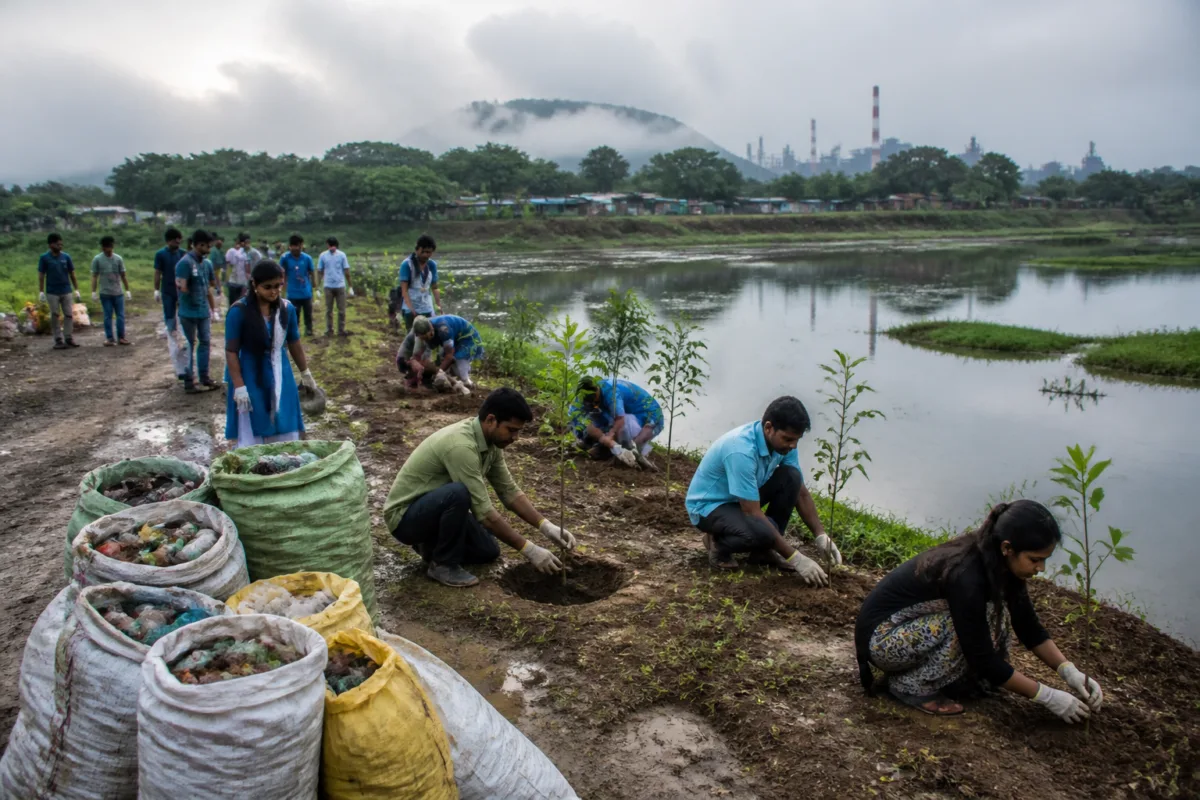
Angul’s biodiversity movement is showing how local conservation can become part of the urban and industrial landscape rather than remain limited to protected forests. Over nine years, Sathee Parivar has grown from a small group of young volunteers into a 145-member network working on wetlands, tree planting, plastic removal and forest-fire awareness across villages and tourism sites in Odisha’s industrial district.
The initiative was started in 2017 by Subrat Kumar Pradhan and Siddharth Pradhan, who were concerned about forest degradation, shrinking water bodies and recurring forest fires. Their work now includes wetlands in Gurang and Benar villages, a 760-tree urban forest in Kumand village near Angul town, and campaigns involving villagers, women’s groups and students.
The significance of the movement lies in the geography in which it operates. Angul has experienced extensive coal mining and industrial development, and the organisers say that this transformation has placed continuing pressure on forests and biodiversity. The conservation response described by Sathee Parivar is therefore not based only on protecting remote ecological areas. It is also focused on rebuilding environmental assets in inhabited and heavily transformed spaces.
That approach matters for districts where industrial activity, settlements, water bodies, agricultural land and forest edges exist close to one another. The source material does not establish the full scale of ecological loss in Angul or quantify the impact of individual industrial projects. It does, however, document a pattern of community action responding to visible pressures: degraded water bodies, forest fires, plastic waste and the loss of everyday contact between residents and local ecosystems.
### From wetland restoration to an urban forest
Sathee Parivar developed small wetlands in Gurang village in 2022 and Benar village in 2023. The group has also created a small urban forest on a cremation ground in Kumand village, where volunteers planted 760 trees. The project demonstrates how land embedded within a settlement can be treated as an ecological resource rather than only as a residual or single-purpose space.
The description of the site as an urban forest is important because it connects biodiversity with the ordinary spaces through which people live and move. In a district undergoing industrialisation, ecological restoration does not occur only through large government reserves or distant conservation zones. It can also take place around villages, public-use sites and water bodies that residents encounter directly.
The source does not provide details about the tree species, survival rates, maintenance arrangements or ownership and management responsibilities for the urban forest. Those gaps are important for assessing the project’s long-term performance. Planting numbers show the scale of the activity, but they do not by themselves establish how many trees have survived or how the site is being managed.
The same distinction applies to wetland creation. The initiatives indicate an attempt to restore or establish small water-based ecological spaces, but the available account does not specify their size, water sources, ecological indicators or institutional maintenance plans. What is clear is that the group treats wetlands as community assets that require both physical work and public participation.
### Plastic pollution becomes a governance problem
One of the group’s most measurable programmes is its plastic-free wetland initiative. Volunteers and local communities have removed more than 10 tonnes of plastic waste over the past three years from ecologically important and frequently visited locations, including Satkosia Gorge, Binikeyee shrine, Derjang Dam and Pampasar stream. The collected waste was sent for recycling, according to Siddharth Pradhan, who is a medicine wholesaler by profession.
The campaign links waste management with biodiversity protection. Plastic discarded at picnic and tourist locations can enter streams, reservoirs and wetlands, where it becomes part of a wider problem involving public behaviour, collection systems and the management of high-footfall sites. Cleaning up waste addresses the immediate presence of plastic, while the group’s stated aim is to change how visitors understand the effects of indiscriminate disposal on aquatic ecosystems and wildlife.
The reported quantity—more than 10 tonnes—also illustrates the scale of the gap that community groups are attempting to fill. The account does not identify the formal agencies responsible for waste collection at each site, nor does it describe whether regular municipal, panchayat or tourism-department systems operate there. Without that institutional information, it is not possible to determine whether volunteer clean-ups are supplementing public services or compensating for their absence.
That question is central to the durability of such initiatives. Volunteer action can mobilise people quickly and create local ownership, but waste prevention and recycling require continuing arrangements for collection, segregation, transport and processing. Sathee Parivar’s work demonstrates community capacity; it does not, by itself, resolve the question of who is accountable for maintaining these sites between campaigns.
### Forest-fire prevention depends on local knowledge
Since 2021, volunteers have also conducted a five-day, 400-km cycling awareness rally every February. The rally covers more than 120 villages near forests in the Athmallik, Angul and Satkosia forest divisions, with messages about the dangers of forest fires and the importance of prevention.
The campaign reflects a wider reality of environmental governance: forest protection depends not only on the agencies formally responsible for forests, but also on people living near forest boundaries. Residents can influence how fires are started, reported and contained, while local knowledge can determine how quickly warnings travel through settlements. The source does not provide data on the number, causes or extent of forest fires in the three divisions, so the effect of the awareness rally cannot be measured from the available evidence.
Sathee Parivar’s stated ambition is to nurture at least one informed and fearless young environmental leader in every village. It also wants to strengthen environmental education in schools and work towards eliminating forest fires through community awareness. This shifts the emphasis from occasional campaigns to a distributed model of environmental leadership, in which each village becomes part of a larger network.
The approach is especially relevant in a district where conservation pressures are spread across a large geography. A five-day rally covering 400 km and more than 120 villages is not a substitute for fire lines, monitoring systems, equipment or official response mechanisms. But it is designed to build awareness across the same settlement network through which environmental risks and warnings are experienced.
### The institutional challenge behind community conservation
The movement’s organisers argue that conservation cannot be sustained by a handful of activists. That observation points to the central institutional challenge in Angul: environmental protection must operate alongside industrial development, local governance and everyday public use of land and water.
The projects described in the source involve several kinds of spaces—villages, wetlands, a cremation ground, tourist locations, dams, streams and forest-adjacent settlements. These spaces are likely to involve different authorities and management arrangements, but the supplied material does not identify the precise institutional roles of municipal bodies, panchayats, forest divisions, tourism agencies or waste-management contractors.
That lack of detail does not diminish the value of the community work. It shows, instead, why conservation outcomes are difficult to sustain when responsibilities are divided. A wetland may require protection from encroachment, waste collection, water-quality monitoring and community stewardship. A forest-fire campaign may need to connect village awareness with official reporting and emergency response. A plastic-free tourism site may need visitor facilities and enforcement in addition to periodic clean-ups.
The evidence available here confirms the scale and range of Sathee Parivar’s mobilisation: 145 volunteers, 760 trees planted in one urban forest, more than 10 tonnes of plastic collected, and an annual awareness rally reaching more than 120 villages. It does not yet establish the ecological outcomes of these activities, their funding model or their formal integration with government programmes.
That distinction is important as community-led environmental action becomes more visible in industrialising districts. The most durable model is unlikely to be one in which volunteers work separately from public institutions. It will depend on whether local conservation efforts can be connected to land management, waste systems, forest protection and environmental education.
Angul’s experience therefore raises a broader urban question: how can districts undergoing rapid industrial change preserve and rebuild ecological infrastructure at the settlement level? Sathee Parivar’s work provides one answer based on local participation. The next measure of its significance will be whether the wetlands, urban forest, clean-up sites and village networks can be maintained over time, and whether the institutions responsible for land, forests, water and waste formally support that continuity.

