


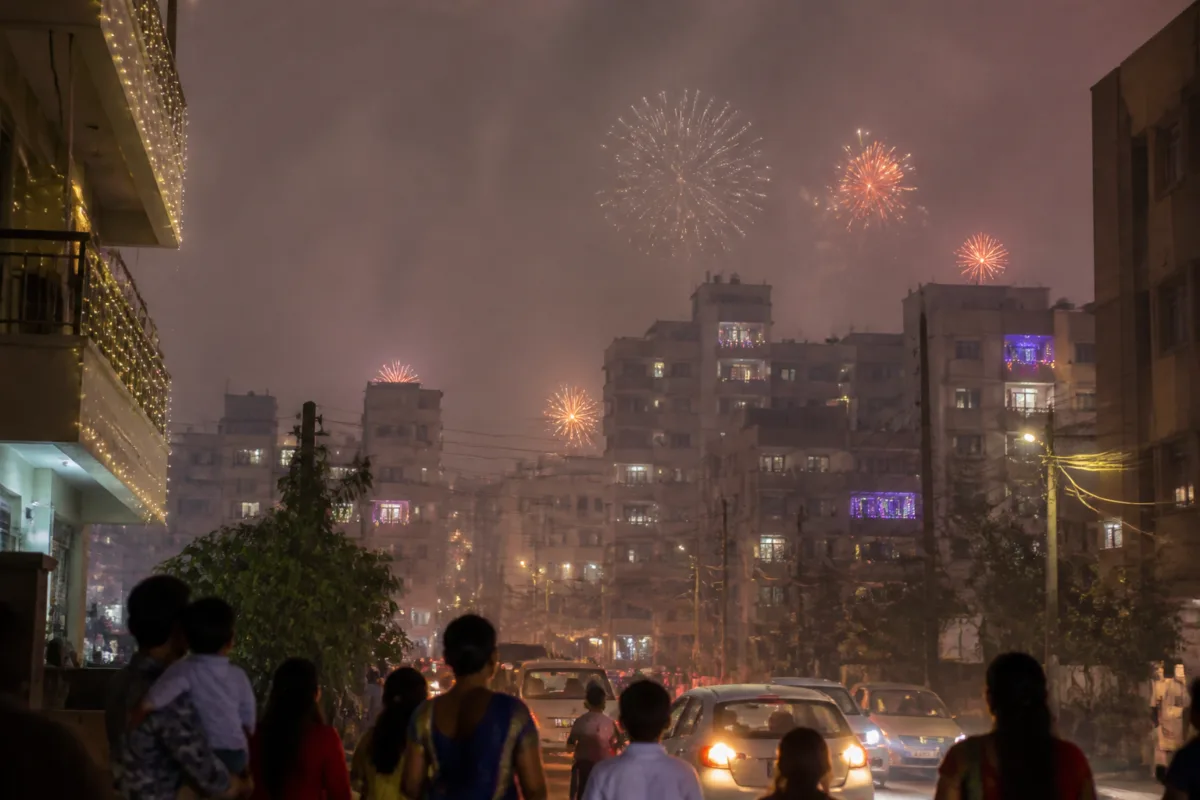
Diwali firecracker rules appeared to be widely violated across Bhubaneswar, Cuttack, Rourkela and Angul on November 8, with fireworks being burst before the permitted hours and urban skies turning visibly hazy, according to a report by Sambad – Bhubaneswar.
The report said firecrackers were being burst from shortly after dusk, despite the Supreme Court guideline cited in the report allowing fireworks between 7 pm and 9 pm. Fireworks were being heard across urban and rural areas, but the sound levels appeared higher in cities, where buildings and dense neighbourhoods amplified the noise.
By around 7.30 pm, the skies over Bhubaneswar, Cuttack, Rourkela and Angul had reportedly taken on a grey appearance. The report linked the haze to the volume of fireworks being used during Diwali and raised concerns about worsening air quality later in the night.
Sambad reported that residents across age groups were continuing to burst crackers outside the permitted window. The account described repeated explosions and intense sound levels in urban areas, indicating that the restrictions were not preventing early-evening firecracker use.
The report did not provide city-wise air-quality readings, measurements of particulate matter or details of enforcement action by local authorities. It also did not identify the number of violations recorded in each city. Its assessment that the air quality index could reach a dangerous level by 11 pm was presented as a concern, rather than as a confirmed measurement.
The episode highlights the operational challenge of enforcing time-bound restrictions across expanding urban areas. A two-hour permitted window requires monitoring across residential neighbourhoods, commercial districts and peripheral settlements, while firecracker use is dispersed rather than concentrated at a single public venue. The supplied report, however, does not specify which agencies were responsible for enforcement or whether any penalties were imposed.
The immediate concern is the combined effect of smoke and noise on people living in dense urban neighbourhoods. The report specifically associates the evening’s conditions with pollution concerns in four Odisha cities, but it does not provide health advisories, hospital data or official assessments of the impact on vulnerable residents.
For now, the next measurable indication will be the air-quality readings recorded later in the night in Bhubaneswar, Cuttack, Rourkela and Angul. Those readings will determine whether the reported haze was accompanied by a significant deterioration in the cities’ air quality.

