


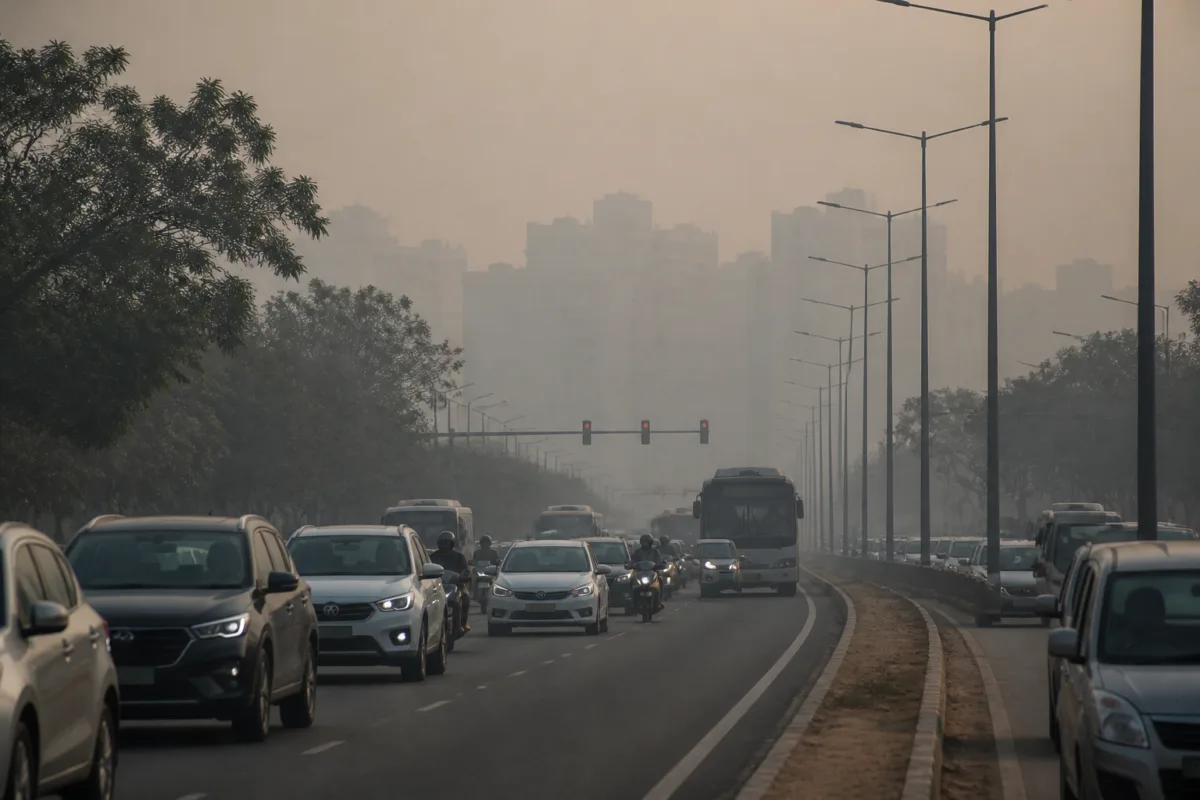
Delhi’s average Air Quality Index (AQI) rose to 376 on Sunday, placing the capital in the ‘very poor’ category, while pollution levels at several monitoring stations crossed into the severe range. The city’s air is expected to deteriorate further after Diwali celebrations, with the AQI potentially entering the severe category from Monday.
Thick smog and reduced visibility were reported across the city as the average AQI increased from 369 on Saturday to 376 on Sunday. The figure is close to the Central Pollution Control Board’s severe threshold of 401.
Of Delhi’s 59 air-quality monitoring stations, 12 recorded AQI levels in the severe category on Sunday, while 22 stations reported very poor air quality. Jahangirpuri recorded the highest AQI at 463, placing it firmly in the severe category.
Under CPCB classification, an AQI between zero and 50 is considered good, 51 to 100 satisfactory, 101 to 200 moderate, 201 to 300 poor, 301 to 400 very poor and 401 to 500 severe. The classification reflects the concentration and health risk associated with pollutants in the air.
According to Delhi’s Air Quality Early Warning System, the city’s air could remain in the severe category for several days from November 9. The assessment comes as pollution from Diwali celebrations is expected to combine with emissions from vehicles, crop-residue burning in neighbouring states and unfavourable weather conditions that can restrict the dispersal of pollutants.
PM2.5 was the principal pollutant recorded in Delhi on Sunday. Data from the city’s Decision Support System showed that transport was expected to be the largest identified contributor to Delhi’s pollution, accounting for 19 per cent. The estimated contribution from stubble burning was 3.5 per cent on Sunday and was expected to decline to 2.99 per cent on Monday.
The contribution figures indicate that Delhi’s pollution episode is being shaped by multiple sources rather than a single activity. Vehicle emissions remain a significant urban source, while seasonal crop-residue burning, firecracker emissions and weather conditions can add to the concentration of particulate matter during the post-monsoon period.
The latest readings also show the uneven spread of pollution within the city. While the citywide average remained below the severe threshold, several locations had already crossed it, with Jahangirpuri recording an AQI of 463. The monitoring-station data therefore presents a more detailed picture than the citywide average alone.
The Air Quality Early Warning System’s assessment for the coming days and the DSS contribution estimates are the next official indicators to watch as Delhi moves through the post-Diwali pollution period. Authorities will also continue to track station-level AQI, PM2.5 concentrations and the effect of weather conditions on pollutant dispersion.

