


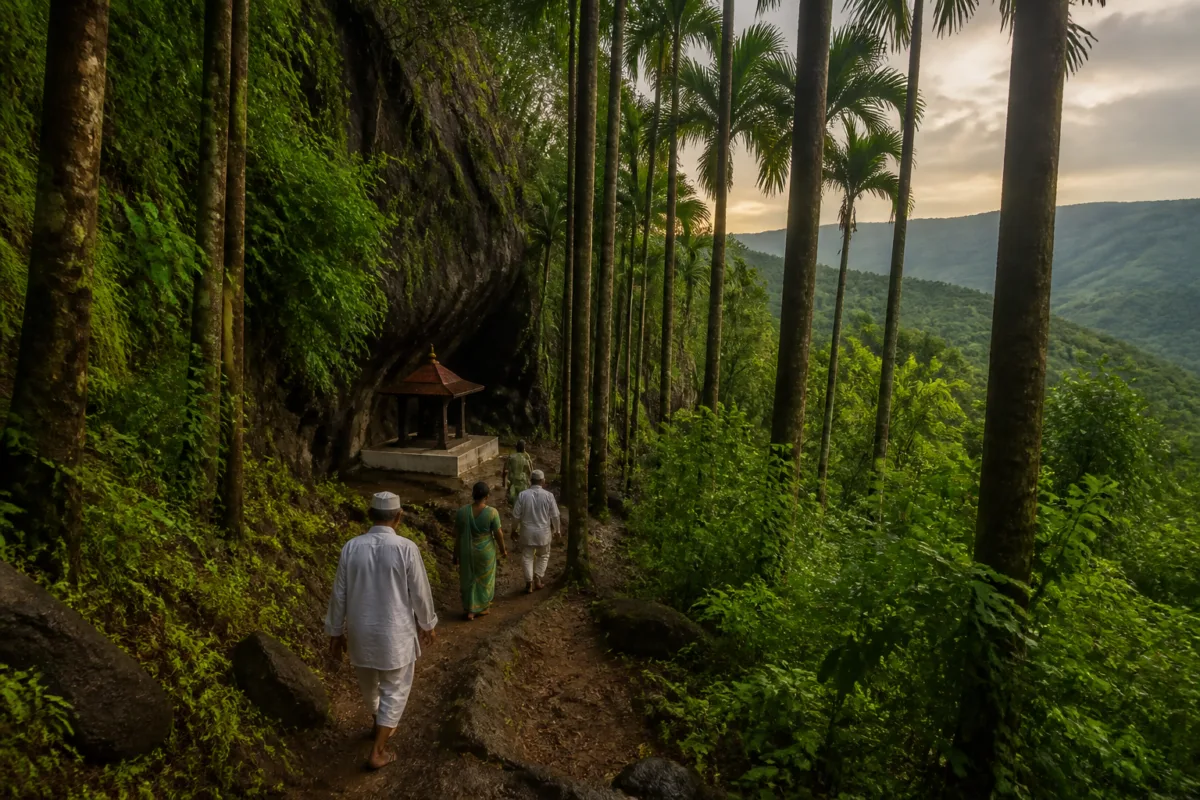
Ajivali’s sacred grove, known locally as a rái or devrai, is more than a patch of forest surrounding a shrine. In the Pune district village, religious practice, community memory and local income appear to have created a set of informal protections around a landscape that residents continue to treat as culturally significant. The arrangement offers a useful way to understand how conservation can operate outside formal protected areas, while also exposing the limits of relying on tradition without documentation and scientific management.
Ajivali lies in the Sahyadri hills, reached from Pune through Kólvan, Hadshi and Javan, with the Pavana reservoir falling behind as the road enters the hill ranges. The village has an older settlement of traditional houses, newer buildings and families who have moved to Pune and Mumbai but return during the annual Wagha Jai pilgrimage. At the centre of the settlement is a stone temple, while the deity’s older sacred site lies about three kilometres away inside a densely wooded grove.
The journey from the village to the grove follows residential lanes before becoming a mud track through increasingly dense vegetation. The source describes the forest as being particularly associated with bhérli palm trees, giving Ajivali’s grove a distinct local identity. Other sacred groves in the region are identified with different species, including hirda trees or bamboo. This variation matters because a sacred grove is not simply a generic forest category: its ecological character is shaped by the species, terrain and community practices that have survived in that particular place.
At the grove, Wagha Jai is worshipped in the form of a roughly shaped stone marked with vermilion near the mouth of a natural rock cleft. A recently built temple stands nearby, but the cleft itself remains central to the local sacred geography. Villagers say that an underground water pool lies deep inside it, based on accounts passed down from earlier generations. The source does not establish the depth or geological character of the cleft, and notes that these features would require scientific study before firm conclusions could be drawn.
That distinction between belief and verified evidence is important. The cultural meaning of the grove is clearly documented through the pilgrimage, the temple and the community’s practices. Claims about the size of the forest, underground water and the historical origins of the deity remain local accounts or interpretations. Some villagers estimate that the grove covers about 2,200 acres, but the report says that this figure has not been confirmed through an actual measurement. For conservation planning, an unmarked boundary is a significant institutional gap, even when local residents know the landscape intimately.
The grove’s protection appears to be rooted partly in a taboo against treating it as ordinary timberland. Trees associated with the deity are not viewed only as sources of wood or income. The belief that the forest is sacred creates a social restraint against cutting or damaging it. The same idea is visible in the pilgrimage ritual in which decorated devotional poles from neighbouring villages are brought to Ajivali and touched to a large sairi tree outside the village temple. The tree is treated as a living sacred presence rather than merely as a physical object in the public space.
Such practices can support ecological protection even when they were not originally framed in the language of biodiversity, watershed security or habitat management. A dense forest can help hold soil on slopes, improve rainwater infiltration and provide shelter for insects, birds and other organisms. The article does not provide a scientific inventory of Ajivali’s biodiversity or establish the grove’s hydrological performance. It does, however, show how cultural restrictions may have preserved a landscape whose ecological functions are now increasingly recognised by modern environmental planning.
Ajivali also demonstrates that conservation and local economic activity do not always have to be opposites. According to information from villagers cited in the report, seasonal income from the palm trees is allocated through an annual auction held around Ganeshotsav. The proceeds are deposited with the gram panchayat and used for village development. Residents estimate that this arrangement generates between Rs 15 lakh and Rs 25 lakh a year, although the amount varies annually and is not independently verified in the supplied material.
This income model creates a direct local incentive to retain the grove. If the trees and the customary system remain healthy, the village receives a recurring financial benefit. The arrangement is different from a conservation model that separates people from forests and offers no visible return to the communities living around them. At the same time, revenue generation can become a pressure if extraction exceeds ecological limits. The source does not specify how the trees are counted, how harvesting is regulated, whether regeneration is monitored or what safeguards are in place during poor rainfall years.
Those unanswered questions point to the governance challenge at the heart of Ajivali’s example. A gram panchayat may receive income from the grove, while religious authorities, village elders, families associated with the shrine and the wider community all influence how the landscape is used. The source describes the village boundary and the grove’s edge as clear to residents but difficult for outsiders to identify. This local knowledge is valuable, but it is also vulnerable to generational change, land pressure and the gradual transformation of customary practices.
The village itself shows signs of that transition. Old Maval houses stand alongside newer construction. Families who have moved to cities return for the pilgrimage, reopening homes that remain shut for much of the year. The annual festival therefore works as both a religious gathering and a mechanism of social reconnection. It brings together urban migrants, older residents and younger people who may otherwise experience the village mainly through family memory.
The palanquin procession reinforces this connection between settlement and landscape. The deity’s palanquin begins at the forest shrine and travels towards the village, stopping at homes and neighbourhoods before reaching the main temple. In cultural terms, the procession brings the forest into the settlement. In social terms, it renews relationships among households. In environmental terms, it keeps the grove present in the community’s collective imagination rather than allowing it to become an invisible parcel of land at the edge of the village.
The pilgrimage also carries practices that require careful handling in the present. The report describes older rituals, including a form of body piercing associated with the festival, while noting that the traditional bagad structure has not been used for the past two or three years after its wooden pole broke. These practices are part of the community’s historical record, but preserving cultural continuity does not remove the need for attention to health and safety. The source does not record any formal safety framework for the festival, so the present administrative arrangements remain unclear.
Ajivali’s experience should not be treated as proof that faith alone guarantees conservation. Sacred status can weaken, boundaries can become contested and economic use can grow beyond the forest’s capacity. Nor can local narratives substitute for ecological assessment. A durable conservation framework would require, at minimum, a documented boundary, a record of tree species and health, clear rules for seasonal extraction, protection of natural water features and transparent use of gram panchayat revenue. The supplied report does not establish whether these systems currently exist.
What it does establish is a compelling local relationship between culture, ecology and village finance. The Wagha Jai grove survives in the account not as an untouched wilderness detached from people, but as a landscape maintained through belief, ritual, memory and carefully limited use. The annual festival gives the grove social visibility; the palm-tree auction gives it an economic connection to village development; and the sacred status of the trees creates a moral boundary around exploitation.
For urban readers, the lesson is relevant beyond Ajivali. Cities such as Pune and Mumbai are connected to hill villages through migration, tourism, water systems, construction demand and seasonal travel. Landscapes that appear remote can be part of the wider ecological and economic systems on which urban regions depend. Ajivali’s sacred grove shows why conservation policy cannot focus only on formally notified forests or large protected areas. Community-held landscapes, local institutions and cultural practices also shape whether ecosystems endure.
The evidence from Ajivali confirms the strength of a community conservation model, but it also shows what remains uncertain. The grove’s exact extent, ecological condition, water features and management safeguards require independent documentation. The next question is whether the village’s inherited protection system can be strengthened with scientific records and accountable local governance without weakening the cultural relationship that made the grove valuable in the first place.

