


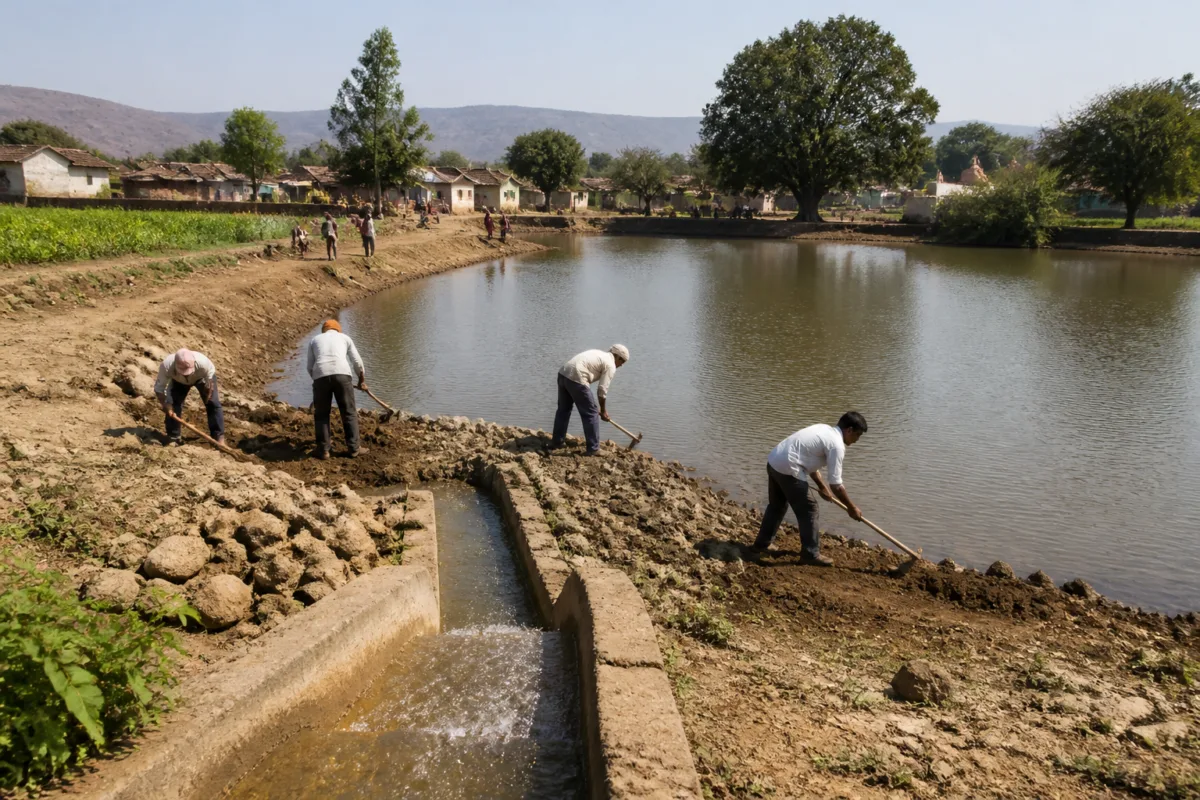
The Maharashtra government is organising division-level programmes across the state to advance its plan for drought-free, water-secure and self-reliant villages under the Mukhyamantri Samruddha Panchayat Raj Abhiyan. The programmes will combine awards for high-performing gram panchayats from the campaign’s first phase with workshops and discussions on implementing the second phase.
The initiative is being conducted by the state Rural Development and Panchayati Raj Department under the guidance of Chief Minister Devendra Fadnavis and with the initiative of Rural Development and Panchayati Raj Minister Jaykumar Gore. Events are planned across six divisions of Maharashtra, according to the announcement reported by Loksatta.
The first phase, covering 2025-26, focused on areas including good governance, public participation, sanitation, environmental conservation and the effective implementation of government schemes. Gram panchayats that performed well in these areas will be recognised through division-level award ceremonies as part of the current programme.
The second phase, covering 2026-27, will place drought mitigation and water security at the centre of village development planning. Its proposed activities include preparing a water account for every village and developing a water-security plan with the approval of the gram sabha. The plans are intended to establish a local assessment of water resources and guide village-level works.
The programme lists the revival of lakes, rivers, streams and wells among its priorities. Rainwater harvesting, improving groundwater levels, farm ponds and other water-conservation works will also receive attention. The department has said these activities will be implemented through the convergence of the Mahatma Gandhi National Rural Employment Guarantee Act and other government schemes.
The division-level workshops will brief officials and elected representatives on the campaign’s objectives, planning process, implementation procedures and development indicators. The associated discussions will examine water conservation, sustainable water management, protection of natural resources and the role of community participation in creating drought-free villages.
The campaign’s design places the gram sabha at the centre of water-security planning while assigning the Rural Development and Panchayati Raj Department responsibility for coordinating implementation. The next operational steps are the division-level workshops, award ceremonies and discussions planned under the campaign across the state’s six divisions.

