


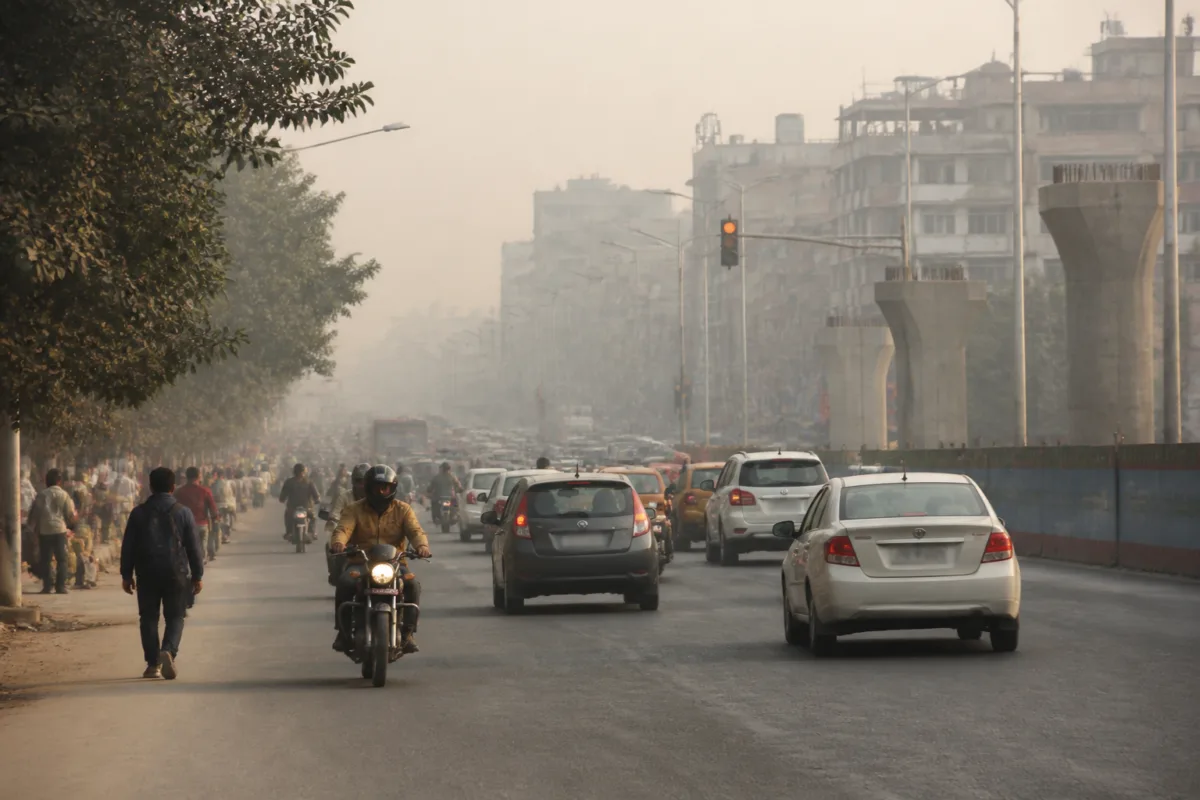
Patna’s air quality deteriorated into the poor category on Monday, with the city’s Air Quality Index (AQI) reaching 220 at 4pm, while Rajbanshi Nagar recorded a very poor AQI of 321, according to the Central Pollution Control Board bulletin and Bihar State Pollution Control Board monitoring data cited by officials.
The reading marked the second time this season that Patna’s citywide AQI had entered the poor zone. The city recorded an AQI of 280 on November 9, after Diwali celebrations. Air quality subsequently improved to 150 on November 14 before worsening to 184 on November 15 and 220 on Monday.
The monitoring data showed significant variation across Patna. Muradpur recorded an AQI of 218, followed by Planetarium at 205 and Samanpura at 204. The DRM Office in Danapur registered 198, while Patna City recorded the lowest reading among the listed stations at 171. The readings placed some parts of the city in the poor or very poor categories even as other monitoring locations remained in the moderate range.
The deterioration was also recorded across other Bihar cities. Araria had the highest AQI among the cities listed in the CPCB bulletin, at 288, followed by Darbhanga at 275, Ara at 266 and Hajipur at 259. Bhagalpur recorded 239, Saharsa 238, Buxar 236, Siwan 234 and Rajgir 224.
Madhubani recorded an AQI of 219, while Purnia and Gopalganj registered 206 and 201 respectively. Sitamarhi recorded 196, Jamui 191, Begusarai 189, Gaya 179, Bettiah 178 and Muzaffarpur 168. Aurangabad’s AQI stood at 155. Biharsharif and Chhapra both recorded 119, while Munger registered 91 and Sasaram 78. Kishanganj recorded 71 and Samastipur had the lowest reading at 66.
The rise in pollution came amid changing seasonal conditions following the conclusion of Chhath Puja. Officials and environmental experts cited multiple factors that can influence air quality, including vehicle emissions, construction dust, local pollution sources, wind speed and atmospheric conditions. Reduced wind movement during winter can slow the dispersal of pollutants and contribute to their accumulation.
Bihar State Pollution Control Board officials said measures were being taken to control pollution in Patna as winter begins. They said civic bodies were regularly sprinkling water and using anti-smog machines. Instructions had also been issued to cover construction materials during transportation, along with other measures.
The latest readings show that pollution levels are not uniform across Patna and that conditions can differ sharply between monitoring stations. The next CPCB and BSPCB readings will indicate whether the deterioration continues or eases as local weather and emission conditions change.

