


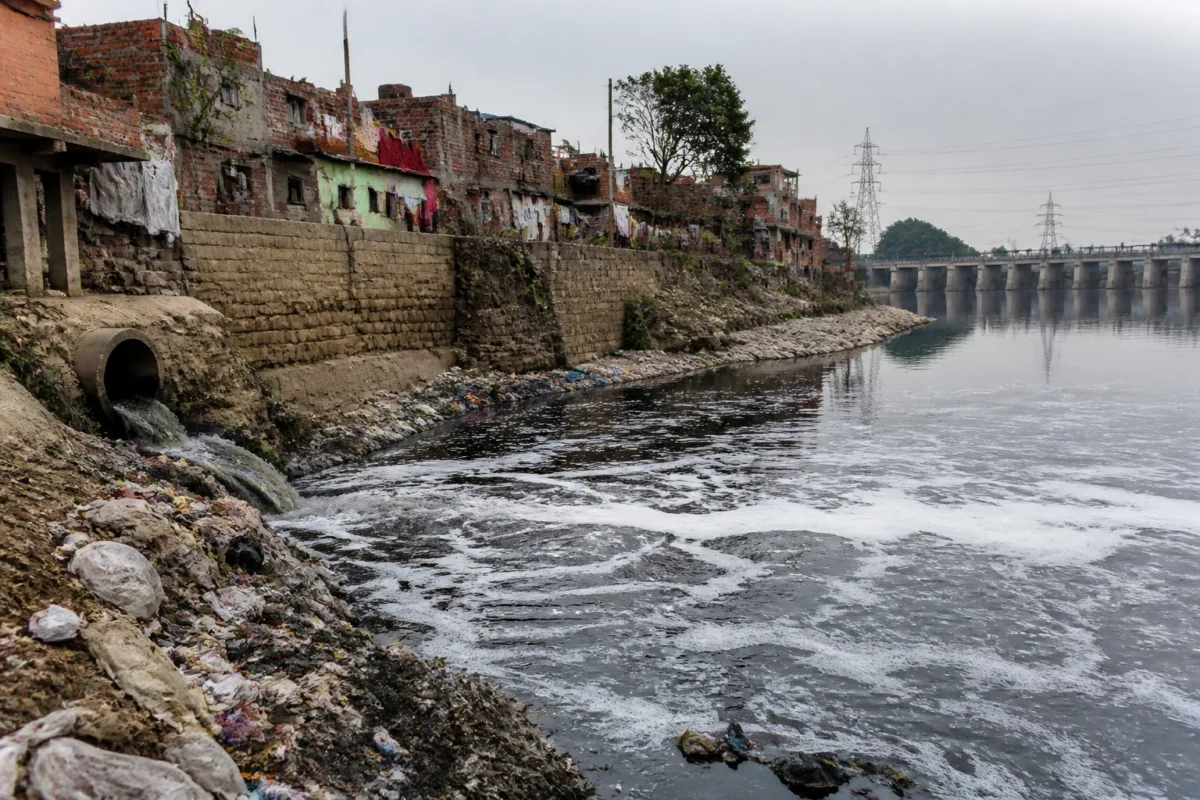
The Supreme Court’s latest directions on Yamuna pollution place a sharper question before India’s urban administrations: why has expenditure on river cleaning failed to prevent pollution from increasing? The court has directed the Central Pollution Control Board (CPCB) to monitor water quality at jurisdictional boundaries and said states, Union territories and districts may face fines if the river’s quality deteriorates while passing through them. The order shifts attention from the construction of more treatment infrastructure to the point where waste enters the river system.
The directions arose during the hearing of a petition related to the cleaning of the Yamuna. According to Live Hindustan’s report, a bench of Justices Manoj Misra and Manmohan observed that pollution in the river had continued to rise despite substantial expenditure on cleaning. The court said that building additional sewage treatment plants (STPs) alone would not be sufficient. Industrial waste and untreated sewage, it said, must be stopped at their source.
This distinction is central to the urban infrastructure problem. An STP can treat sewage that reaches it, but it cannot compensate for missing sewer connections, unauthorised industrial discharges, leaking networks, unmanaged drains or settlements where the physical layout makes conventional sewerage difficult to install. If contaminated flows enter the river before they are intercepted, the existence of treatment capacity elsewhere does not guarantee cleaner water.
The court has therefore asked the CPCB to monitor locations where the Yamuna and its major drains enter or leave different states, Union territories and districts. Such boundary-based monitoring could create a clearer administrative record of where water quality changes. The reported directions also require the CPCB to suggest a formula for calculating compensation, with fines to be deposited in the court registry when water quality is found to have deteriorated within a state, Union territory or district.
The significance of this framework lies in the attempt to connect pollution with responsibility. River pollution often crosses municipal and political boundaries, while the agencies responsible for sewerage, industrial regulation, drainage, waste management and river restoration may operate under separate mandates. A monitoring point at the entry or exit of a jurisdiction can provide evidence for assigning responsibility, but it also requires consistent sampling, shared data and a method that can distinguish pollution entering an area from pollution generated within it.
The court has asked the CPCB to submit detailed reports on pollution events, including fish deaths, white foam on the water surface and eutrophication, which refers to excessive algae growth. The reports are also expected to consider increases in biochemical oxygen demand, chemical oxygen demand and total suspended solids. These indicators are important because they can show not only that water quality has worsened, but also the nature and intensity of the contamination.
The directions require the CPCB to identify the causes of sudden increases in pollution and explain the steps needed to address them. That requirement moves monitoring beyond the publication of test results. It asks the regulator to connect a measurable change in water quality with a source, an institutional response and a documented corrective action. The effectiveness of that system will depend on whether data is collected regularly and whether agencies act on it before a pollution event becomes visible in the river.
The Supreme Court has also directed central and state bodies, ministries, agencies, plant operators and other relevant departments to provide the CPCB with technical cooperation and data without delay. They must connect with the CPCB’s monitoring framework within the timelines set by the court. The direction recognises that river pollution cannot be assessed by a single agency if information on sewage flows, industrial discharge, treatment plant operations and waste infrastructure remains distributed across multiple authorities.
The court has further said that agencies, operators and institutions managing, operating or maintaining infrastructure for contaminated water, solid waste and disposal must provide the CPCB and its experts access to premises, installations and records. The reported direction applies to private entities as well and permits inspections and sample testing without prior notice. This is significant for enforcement because pollution control depends not only on official measurements in the river, but also on access to the systems through which waste is generated, treated and discharged.
The court’s observations also link the Yamuna’s pollution to the growth of unauthorised colonies and informal settlements along drains and the river. It said that sewage would continue to reach the river unless such settlements were removed or their residents rehabilitated. The issue is not presented only as an enforcement problem. The court also noted that these colonies are not built on an organised grid layout, leaving little space for laying conventional sewerage systems and making sewage collection difficult for local administrations.
That observation exposes a recurring weakness in urban planning. Sewerage is often treated as a network to be added after settlement has already taken place. In planned areas, roads, utility corridors and plot layouts can reserve space for pipes, pumping stations and access points. In irregular settlements, dense construction and narrow passages can make the same infrastructure technically difficult and expensive. Where sewer connections are absent, households and local drains become part of a fragmented waste-disposal system, with the river ultimately receiving the accumulated burden.
The reported account refers to 520 drains carrying dirty water into the Yamuna. The number illustrates the scale of the challenge described by the court: pollution is not necessarily a single discharge that can be addressed through one project, but a distributed network of inflows connected to settlements, towns, cities, industries and local administrative systems. Each drain may have a different source, flow pattern and responsible agency. Together, they create a river-wide problem that cannot be solved only at the treatment plant or riverfront.
This is why the court’s emphasis on source control matters for infrastructure planning. Additional STPs may increase nominal treatment capacity, but capacity on paper does not ensure that all sewage reaches the plant. The system also requires household connections, functioning interceptors, pumping arrangements, power supply, maintenance, monitoring and enforcement against illegal discharges. The supplied report does not establish how much capacity is currently functional or how many connections are missing, but the court’s observations indicate that infrastructure creation alone has not produced the intended water-quality outcome.
The directions also reveal the limits of treating river cleaning as a short-term construction programme. A river-cleaning mission involves civic administration, land-use planning, industrial regulation, public health, settlement policy and the operation of treatment assets. Responsibility is distributed across central agencies, state departments, local bodies, private operators and communities. If any link fails, untreated waste can bypass the system even when other components have received substantial investment.
The proposed compensation formula could introduce a measurable financial consequence for deterioration in water quality. Its practical effect will depend on the formula eventually suggested by the CPCB, the indicators used, the frequency of monitoring and the way responsibility is assigned across jurisdictions. The court has not, according to the supplied report, specified the final formula or the amount of any fine. Those details will be important because a system that imposes liability without a reliable baseline may generate disputes, while a system with weak enforcement may not change administrative behaviour.
The larger urban question is whether Indian cities can manage water pollution through accountable operating systems rather than isolated projects. The Yamuna case shows the gap between spending on visible infrastructure and control over the entire sewage chain. Treatment plants, monitoring stations and river-cleaning works are necessary, but they must be connected to land-use decisions, drainage management, settlement regularisation or rehabilitation, industrial compliance and transparent data.
The Supreme Court’s directions do not establish that the pollution problem has been solved. They create a stronger framework for locating deterioration, recording pollution events, obtaining agency data and attaching possible financial consequences to worsening water quality. The next significant developments will be the CPCB’s monitoring arrangements, its proposed compensation formula, the reports on pollution incidents and the compliance of central, state and local bodies with the court’s timelines. Those steps will show whether the order produces a functioning accountability system or remains another layer of instructions around a fragmented urban sewerage network.

