


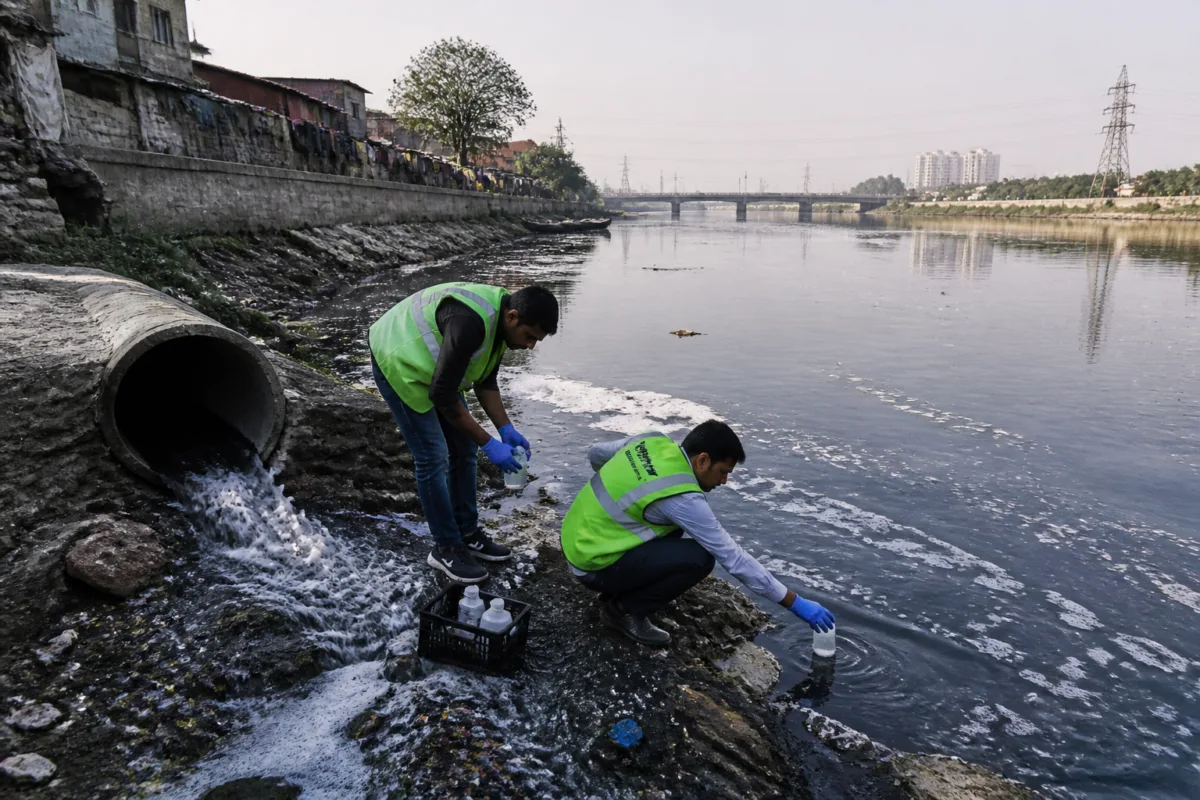
The Supreme Court’s latest directions on Yamuna pollution do more than threaten states, Union territories and districts with fines. They expose a deeper administrative failure: cities and settlements along the river continue to release untreated sewage and industrial waste faster than existing institutions can monitor, intercept and treat it. The court has therefore shifted attention from the construction of more sewage treatment plants to the point where pollution enters the urban system.
The directions came during the hearing of a petition concerning the cleaning of the Yamuna. A bench of Justices Manoj Misra and Manmohan observed that pollution in the river has increased despite substantial expenditure on cleaning efforts. The court said that building additional sewage treatment plants would not be sufficient unless industrial waste and untreated sewage were stopped at their source.
This distinction is central to understanding why the Yamuna remains polluted. Treatment capacity is visible and measurable: a plant can be sanctioned, constructed and commissioned. Source control is more difficult. It requires sewage networks to reach every settlement, industrial units to comply with discharge standards, local bodies to maintain drains, operators to share data and enforcement agencies to identify pollution when it occurs rather than after it has travelled downstream.
The court has directed the Central Pollution Control Board to monitor water quality at locations where the Yamuna and its major drains enter or leave different states, Union territories and districts. If water quality deteriorates while passing through, or leaving, a state, Union territory or district, the concerned administrative unit may be held responsible and fined. The fine is to be deposited with the court registry, while the CPCB has been asked to suggest a formula for calculating compensation.
This proposed accountability mechanism addresses one of the oldest problems in river governance: pollution moves across administrative boundaries, but responsibility remains divided. A drain may be controlled by one agency, a sewage treatment plant by another, an industrial unit by a third and the receiving river by a fourth. Without monitoring at entry and exit points, it becomes difficult to establish where water quality worsened and which authority failed to act.
The court’s directions place the CPCB at the centre of this monitoring framework. The board has also been asked to submit detailed reports on pollution incidents, including fish deaths, white foam on the water surface, eutrophication and increases in biochemical oxygen demand, chemical oxygen demand or total suspended solids. These reports must identify the reasons for the incident and describe the steps needed to address it.
The importance of these indicators is that they can reveal different forms of stress on a river. Fish deaths and white foam are highly visible events, while biochemical oxygen demand, chemical oxygen demand and total suspended solids provide technical evidence about the condition of the water. A monitoring system that combines visible incidents with water-quality measurements can help distinguish routine deterioration from sudden pollution events and connect both to possible sources.
The directions also require central and state bodies, ministries, agencies, plant operators and other relevant departments to provide technical assistance and unrestricted data to the CPCB. They must connect with the monitoring framework within the timelines fixed by the court. Institutions managing, operating or maintaining infrastructure for contaminated water, solid waste and disposal must provide the CPCB and its experts access to their premises, installations and records. The court said inspections and sampling could take place without prior notice, and that the requirement would also apply to private entities.
This is a significant change from a system in which pollution control can depend heavily on the information supplied by the operator being monitored. Access to records, premises and samples is necessary to determine whether a treatment facility is functioning, whether sewage is being diverted around it, whether industrial waste is entering a drain and whether reported performance matches conditions in the receiving water body. The effectiveness of the direction will depend on how consistently agencies cooperate and how quickly monitoring results lead to enforcement.
The court has also linked river pollution to the physical form of settlements along the drains and riverbanks. It observed that sewage would continue to pollute the river until illegal colonies and slums along drains and the river are removed or their residents rehabilitated. The observation identifies a difficult urban planning problem: settlements that develop outside formal layouts are often not connected to planned sewerage networks, while relocation or rehabilitation involves land, housing, service delivery and administrative coordination.
The supplied report refers to 520 drains carrying dirty water into the Yamuna. The court said these drains reflect deficiencies in the civic administration of towns, cities and villages along the river. In unplanned colonies, collecting sewage is especially difficult because the settlements do not follow a regular grid layout and little space remains for laying sewerage systems.
That detail changes the policy question. The challenge is not only whether Delhi and other urban authorities have enough treatment plants. It is also whether sewage can be collected before it reaches the drains, whether unauthorised and poorly planned settlements can be connected without displacing vulnerable residents, and whether local administrations possess the technical and financial capacity to maintain networks once they are built.
The court’s emphasis on source control therefore exposes the limits of an infrastructure-first response. A treatment plant can only treat water that reaches it through a functioning network and operates within its designed capacity. Waste released upstream, sewage bypassing the network or drains without interception can continue to pollute the river even while treatment infrastructure exists elsewhere. The court’s remarks indicate that expenditure alone cannot be treated as evidence of environmental improvement.
The institutional structure described in the directions is broad. The CPCB is responsible for monitoring and reporting, while central and state bodies, local administrations, ministries, agencies, treatment-plant operators and private entities must provide access, information and technical cooperation. The court itself retains a role in determining accountability through fines and in receiving compensation. This structure recognises that the Yamuna is not governed by a single municipal department, but it also creates a demanding coordination task.
The proposed fines could make administrative boundaries more consequential. Monitoring at points where the river and major drains cross jurisdictions can create a record of changing water quality. However, the supplied material does not establish the precise standards, timelines, monitoring frequency or compensation formula that will be used. Those details will determine how responsibility is assigned and how enforcement operates in practice.
The same limitation applies to the question of rehabilitation. The court has connected pollution control with the removal or rehabilitation of residents of illegal colonies and slums near drains and the river, but the report does not provide a rehabilitation plan, funding arrangement or implementation schedule. Any administrative response will have to deal with the fact that sewerage, land use, housing and environmental enforcement are interlinked rather than separate departments.
The 520-drain figure is the clearest measure in the supplied report of the scale of the urban system feeding the river. It indicates that the Yamuna’s pollution problem is distributed across many localised discharge points rather than concentrated at a single facility. That distribution makes enforcement, maintenance and data collection more complex, particularly where drains pass through multiple jurisdictions or settlements lack formal infrastructure.
The larger urban question is whether river restoration can succeed without restoring the civic systems around the river. The Supreme Court’s directions treat water quality as an outcome of sewage collection, industrial compliance, drain management, settlement planning, treatment-plant operation and inter-agency data sharing. This is a broader framework than a programme focused only on cleaning the river channel.
What the court has established, according to the supplied report, is a stronger monitoring and accountability approach centred on the CPCB, cross-border water-quality checks, access to facilities and records, reporting of pollution incidents and possible financial liability for administrative units. What remains to be established is how the standards, compensation formula, monitoring timelines and rehabilitation measures will work. The next important developments will be the CPCB’s proposed formula and its reports on pollution incidents and water-quality changes at jurisdictional boundaries.

