


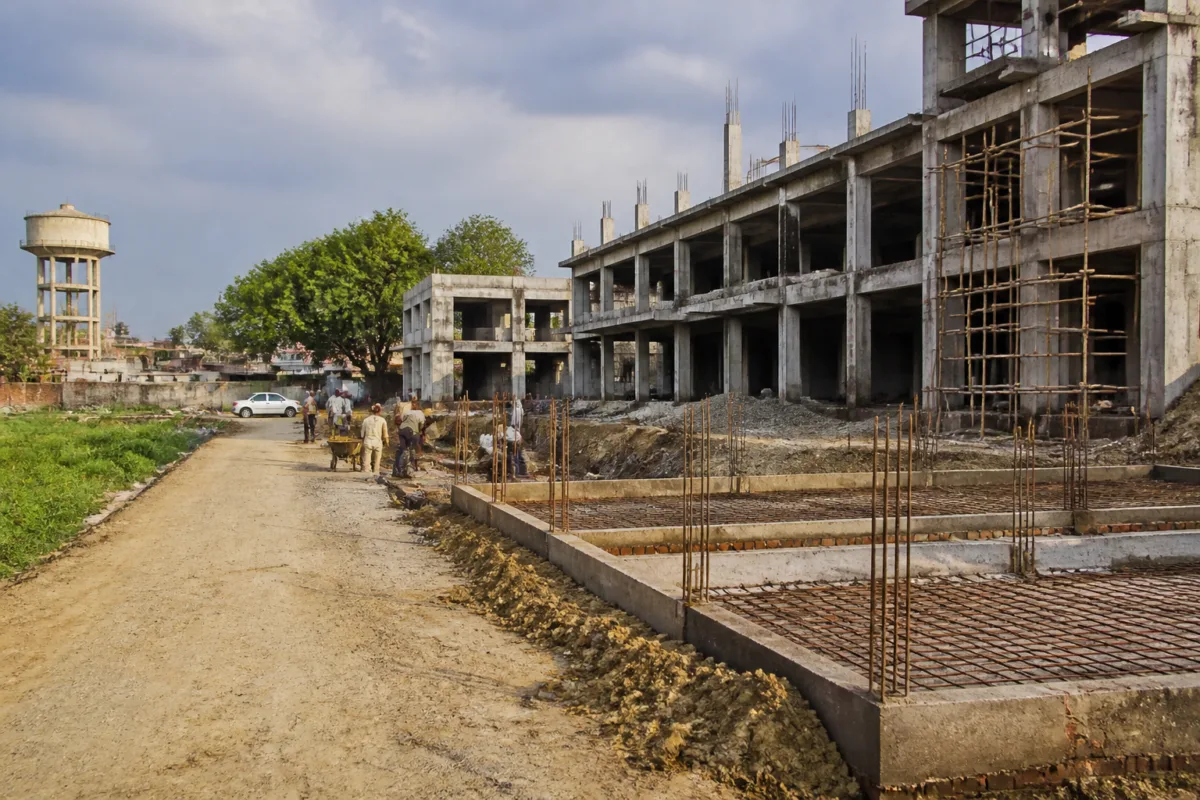
Bihar’s plan to build permanent campuses for 211 new degree colleges is more than a construction programme. It is a test of whether the state can convert an expansion in enrolment opportunity into functioning public infrastructure, with classrooms, libraries, laboratories and hostels available close to students’ homes.
The colleges began teaching on July 15, according to the chief minister’s office, but reports later that month found some operating from temporary premises with limited facilities. The state is now seeking to accelerate permanent campuses under the Saat Nishchay-3 programme, while requesting Rs 5,275 crore from the Centre for their infrastructure. The proposed allocation works out to Rs 25 crore per college.
That sequence matters. Opening a college and building a college are different administrative tasks. The first creates an academic presence. The second requires land, design approvals, procurement, construction, utilities, laboratories, libraries, hostel accommodation and an operating arrangement capable of maintaining the facilities after completion. Bihar’s current effort shows the pressure that can arise when access is expanded faster than the physical system supporting it.
At a review meeting on October 22, Chief Minister Samrat Choudhary examined campus designs, floor plans and land availability. He directed officials to prioritise sites near block headquarters and speed up land identification and other preparations. The location instruction places the colleges within the administrative geography of the blocks they are intended to serve, rather than treating land as an isolated construction input.
The proposed campus design includes classrooms, lecture theatres, libraries, computer laboratories, separate chemistry and zoology laboratories, and separate hostels for men and women. The chief minister also asked planners to retain the option of constructing buildings with five floors above ground level to accommodate future needs.
This design decision is significant because it acknowledges that the 211 campuses are not being planned only for their opening-day capacity. The instruction to preserve the possibility of vertical expansion suggests that the state is attempting to keep future growth within the original site and building framework. Whether that flexibility translates into usable capacity will depend on the eventual designs, structural provisions, funding and later decisions on expansion. The supplied information does not establish how many students each college is expected to serve or when each campus will be completed.
The Rs 5,275 crore request also places the programme within a wider question of funding responsibility. Bihar has sought central assistance, while the state is separately releasing grants for university buildings and campus development. The infrastructure of higher education therefore depends on more than a single department or construction agency. It involves state budgetary decisions, central scheme approvals, land administration, universities and the institutions responsible for executing works.
The state has sanctioned and released Rs 40 crore each in 2026-27 for buildings and campus development at Purnea University and for Patliputra University’s proposed campus in Bakhtiyarpur. These allocations indicate that the 211-college programme is unfolding alongside other higher-education construction commitments. The figures also show why sequencing will matter: individual campuses, university projects and centrally supported buildings may compete for administrative attention and construction capacity even when their funding sources differ.
The experience of Patna University provides another indication of the gap between a completed building and an operational facility. Bihar’s educational infrastructure corporation built an academic block for the faculty of arts and an administrative block at a cost of Rs 147 crore. Both buildings were inaugurated in March, but were still awaiting formal handover when the new academic session began.
A formal handover is not a ceremonial detail in public infrastructure. It marks the point at which responsibility for the completed asset can move into its intended institutional and operational system. Until that process is completed, a building may exist physically without being fully available for teaching, administration or student services. The Patna University example does not prove that the 211 new colleges will face the same delay, but it highlights an implementation stage that must be tracked separately from construction and inauguration.
The state’s request for central support also sits within an existing higher-education infrastructure framework. The Union education ministry told the Rajya Sabha in February that 101 projects worth Rs 732 crore had been approved in Bihar under the Rashtriya Uchchatar Shiksha Abhiyan and its successor, PM-USHA. The cumulative approvals included hostels, laboratories, and academic and administrative buildings.
Those numbers provide scale but not necessarily completion. The supplied report does not state how many of the 101 projects have been completed, how many are under construction, or how they are distributed across institutions. It also does not establish whether the 211 new colleges will receive funding through the same route, the requested Rs 5,275 crore, state grants, or a combination of sources. The distinction is important because approval, release, construction, handover and regular use are separate milestones.
For students in the blocks served by the new colleges, the practical test is straightforward. A campus must allow them to attend classes in permanent buildings, borrow books from a functioning library and complete practical work in equipped laboratories close to home. A college that has begun teaching but lacks these facilities may provide an institutional address without yet providing the full educational environment promised by the expansion.
This is where the programme connects higher education with the built environment. The location of a campus affects daily travel, the time and cost of attendance, and the ability of students to use facilities beyond classroom hours. The planned hostels indicate that residential infrastructure is part of the access model, particularly where daily travel may be difficult, although the report does not provide details on hostel capacity, eligibility or operating arrangements.
The preference for sites near block headquarters may simplify access to administrative centres and existing local networks, but the available information does not show whether each selected site is connected to public transport, roads, water supply, electricity or other essential services. Those details will determine whether a permanent campus functions as an accessible public institution or remains a physically complete but weakly connected facility.
Bihar’s programme therefore raises a central question about the measurement of public education expansion. Counting the number of colleges opened captures the speed of institutional rollout. Counting completed and handed-over campuses, equipped laboratories, stocked libraries, usable hostels and operational administrative systems provides a more demanding measure of delivery. The report supplies the first number—211 colleges—but shows that the physical and administrative work behind the number is still underway.
The next milestones are the identification and preparation of land, finalisation of designs, mobilisation of funds, construction of the permanent campuses and their eventual handover for use. Until those stages are completed, Bihar’s new degree colleges will remain an expansion promise moving through an unfinished infrastructure pipeline.

