


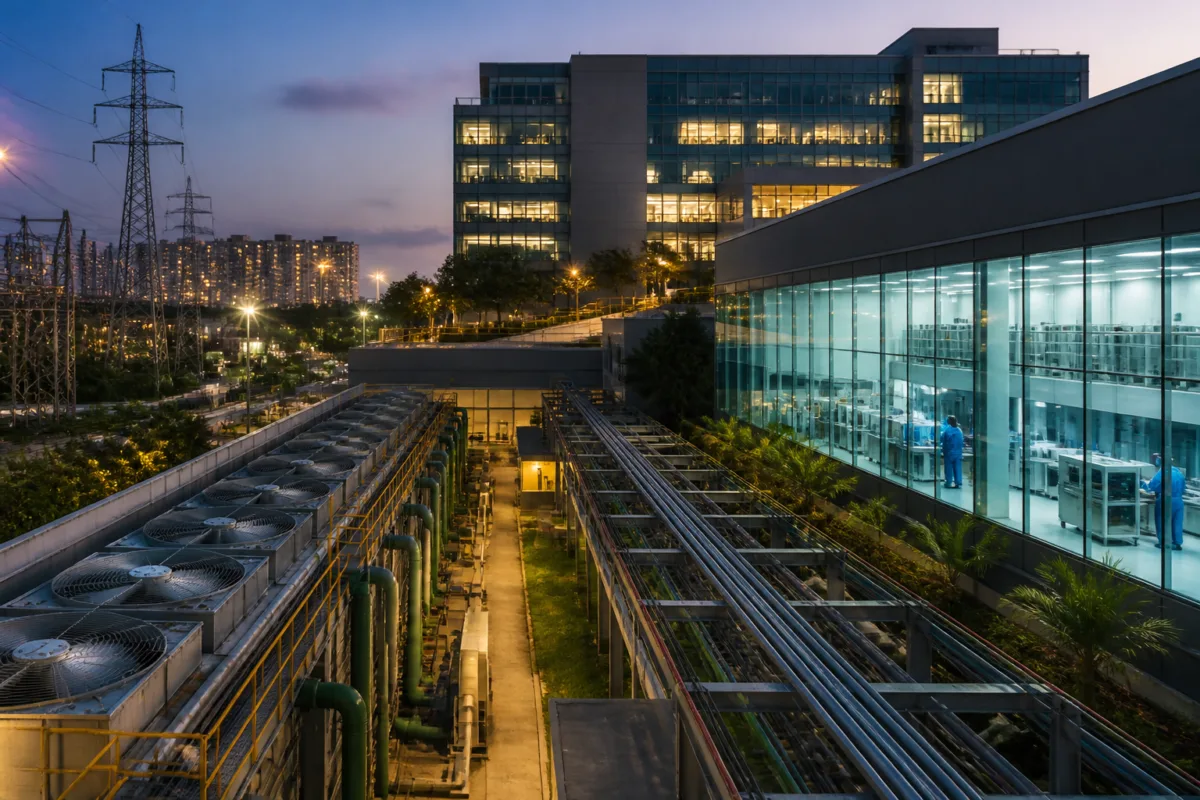
Intel India’s transformation from a research and development outpost into what its president calls a vertically focused semiconductor engineering centre reflects a larger shift in India’s technology infrastructure. The company’s work now spans processor architecture, chip design, graphics, firmware, software, custom silicon and artificial intelligence applications, linking India’s engineering workforce to the physical systems that will support the country’s next phase of digital growth.
Gokul V. Subramaniam, Intel India president and vice-president of the Client Computing Group at Intel Corporation, told Hindustan Times that Intel has invested nearly $11 billion in India over its 37-year presence. He described the change in the country’s role as significant, saying the India operation now works across the semiconductor stack rather than being limited to research and development.
That distinction matters because the semiconductor industry is not only about manufacturing plants. It also depends on architecture, processor design, software optimisation, intellectual property, packaging, firmware and the ability to adapt chips to specific computing requirements. Intel’s account places its Indian teams across these layers, including work on instruction set architectures, central processing units, graphics processors, ecosystem IPs and software.
The company has highlighted contributions from India to Clearwater Forest, Panther Lake and Wildcat Lake, spanning enterprise and consumer silicon. The three products are built on Intel’s 18A process node, which is central to the company’s turnaround strategy. The source report does not specify the scale or timing of new Intel investments in India, but the expanded engineering mandate indicates that the country is being positioned as a location for product and architectural execution rather than only labour-intensive support functions.
This is also consistent with a broader change in the computing market. Demand is moving beyond standard, off-the-shelf processors towards chips designed for particular workloads. Intel added custom silicon and application-specific integrated circuits as a newer business category about a year and a half ago, according to Subramaniam. The segment is aimed at hyperscale cloud providers and artificial intelligence infrastructure operators whose requirements may not be met by general-purpose processors.
For India, the significance of this shift is tied to the rapid expansion of data-centre capacity. The report says India is expected to reach nearly 8 gigawatts of data-centre capacity by 2030, compared with 1.6GW in August this year. It also cites official figures placing data-centre investments at nearly $70 billion, with another $90 billion in announced projects. These figures describe a substantial build-out of electricity-intensive digital infrastructure, although the supplied material does not establish how much of that capacity will use Intel technology.
Data centres are often discussed as buildings filled with servers, but their operation depends on an entire urban and regional system. They require reliable electricity, cooling, fibre connectivity, land, water management and high-capacity network links. The processors inside them influence energy use, performance, latency and the kinds of applications that can be run at scale. As India adds capacity, the design of computing hardware becomes connected to questions normally associated with infrastructure planning and industrial policy.
Intel’s India strategy also extends to sovereign artificial intelligence. Subramaniam said the company is working with the Ministry of Electronics and Information Technology on the IndiaAI mission and the India Semiconductor Mission. The company has partnerships with Bhashini, CoRover.ai and Tech Mahindra, with a focus on multilingual and locally relevant AI applications.
The sovereign AI framing is important because it places computing capacity within national capability-building rather than treating AI as a cloud service sourced entirely from outside India. In the examples cited by Intel, some AI models are designed to run directly on AI-enabled personal computers. This approach can reduce dependence on continuous cloud access for certain applications, although the source does not provide comparative figures on cost, energy use, performance or adoption.
One example is Intel’s collaboration with Tech Mahindra on Project Indus education-focused large language models. The models support Hindi and regional Indian dialects and are intended for Intel-powered AI PCs used by students. Earlier this year, Intel India worked with MeitY’s Digital India Bhashini Division to make Vidyalekha’s real-time translation and transcription tool available on Intel-based AI PCs.
The tool is designed to use sovereign multilingual models on the device rather than relying solely on the cloud. It supports 22 Indian languages and is aimed at higher education. The stated benefit is particularly relevant in areas where connectivity is limited, because some translation and transcription functions can take place locally. The underlying system uses multiple types of models, including speech recognition, text-to-speech, machine translation and large language models.
This architecture illustrates why semiconductor engineering cannot be separated from application design. The practical challenge is not simply to build a more powerful processor or train a language model. It is to combine multiple models and optimise them for a specific use case, while managing latency, device capability and the realities of Indian language use. Subramaniam pointed to code-switching between English and Indic languages as an additional challenge for conversational AI systems.
The institutional structure behind this work is distributed across government and industry. MeitY’s IndiaAI and India Semiconductor Mission provide the policy context cited in the report. Bhashini contributes a language-technology platform and partnerships. Intel supplies hardware and engineering expertise, while companies such as Tech Mahindra and CoRover.ai work on applications and models. Universities and academic institutions are also part of Intel’s stated focus, although the report does not provide details of specific academic programmes or funding commitments.
This arrangement shows that India’s AI infrastructure is being built through several connected layers. Public institutions define missions and language priorities. Technology companies develop chips, software and models. Enterprises translate those capabilities into education, business and government applications. The effectiveness of the system will depend on whether these layers work together, rather than on any single product announcement.
Intel’s emphasis on embedding optimisation at the chip level is particularly relevant to edge computing. AI applications in education, small businesses, robotics, physical systems and local enterprise environments may require fast responses without sending every task to a distant data centre. The source report links Intel’s generational products to personal computers, edge devices, robotics, physical AI and data centres, but it does not establish the current scale of deployment in India.
The data-centre figures cited in the report provide the clearest measure of the infrastructure opportunity. Moving from 1.6GW of capacity in August to a projected nearly 8GW by 2030 would represent a major expansion in computing infrastructure. Alongside the cited $70 billion in investments and $90 billion in announced projects, the numbers suggest that India’s digital economy is creating demand for more specialised hardware. They do not, however, by themselves indicate how quickly projects will be completed, where capacity will be located or how electricity and water requirements will be managed.
That limitation is central to understanding the next stage of the sector. Semiconductor engineering, AI applications and data centres are often presented as separate technology stories, but they increasingly form one infrastructure chain. Decisions about chip architecture affect computing performance; computing demand affects data-centre construction; data centres affect power and connectivity systems; and public-sector AI missions influence the applications that the infrastructure must support.
Intel’s account therefore presents India as more than a market for imported devices or a source of engineering talent. It describes an attempt to connect Indian teams to product architecture, custom silicon, sovereign AI and the infrastructure requirements of large-scale computing. The evidence supplied confirms the breadth of the company’s stated mandate and the scale of the data-centre opportunity, while leaving investment timelines, project delivery and measurable deployment outcomes to be established through future disclosures.

