


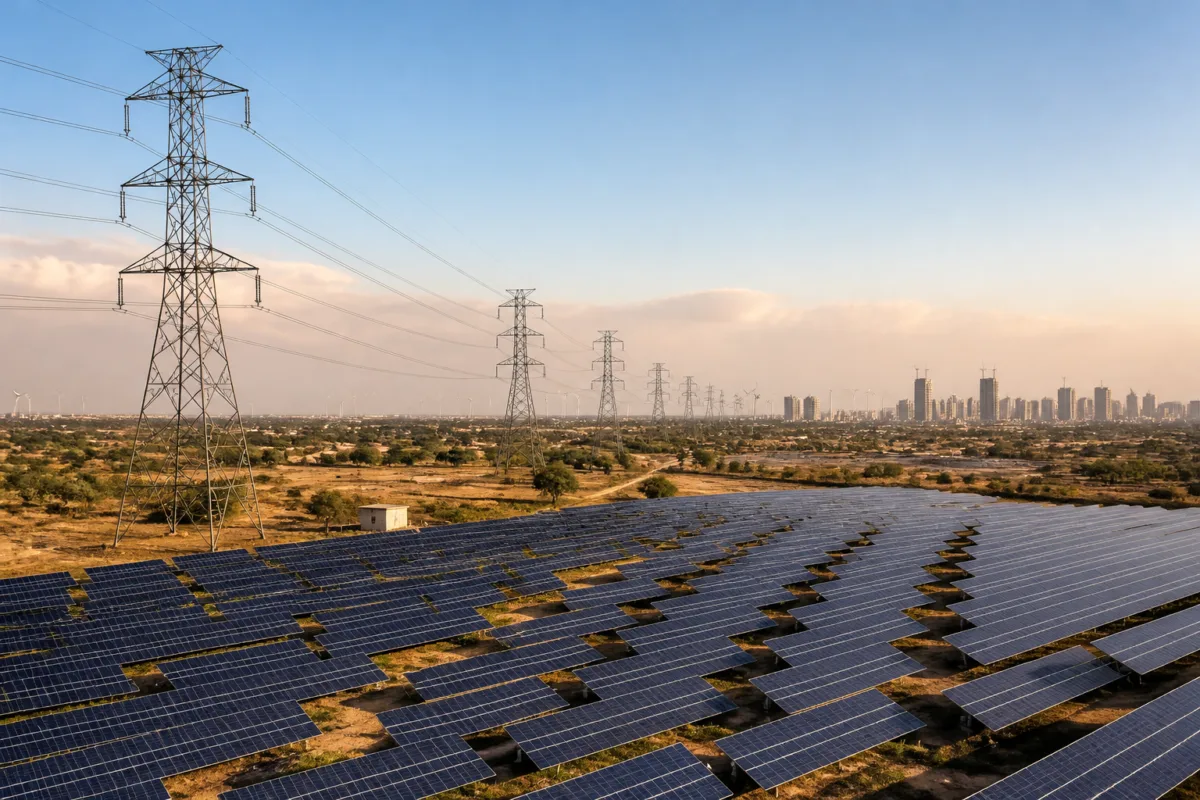
India’s plan to reach 500 GW of renewable energy capacity by 2030 now has a clearly stated financial requirement: USD 220 billion over the next four years. The figure, outlined by Ministry of New and Renewable Energy Secretary Santosh Kumar Sarangi, shows that the target is not only a question of adding solar and wind farms. It requires a parallel build-out of transmission networks, energy storage, manufacturing capacity and green hydrogen infrastructure.
That distinction is important because renewable capacity is useful only when electricity can be produced, moved, balanced and consumed. The investment estimate therefore offers a view of the physical system India must assemble before 2030. It also places financial institutions—including private equity firms, pension funds, mutual funds and other financial investors—at the centre of the next phase of the energy transition.
The Bharat Renewable Energy Summit & Expo 2026, scheduled from November 2 to 5 at Bharat Mandapam in New Delhi, is expected to be used as a platform to mobilise this capital. Prime Minister Narendra Modi is expected to inaugurate the event. Sarangi said the summit would help identify a roadmap for mobilising the required resources over the next four to four-and-a-half years.
### The investment requirement is spread across the entire energy chain
The USD 220 billion estimate is divided across several parts of the renewable-energy system. Solar power is expected to receive the largest share, at around USD 70 billion. Wind energy is projected to attract USD 25-30 billion, while hydropower is expected to receive USD 12-15 billion. Bioenergy is estimated to require USD 3-5 billion.
The allocation also makes clear that generation assets are only one part of the build-out. Transmission infrastructure is expected to require USD 40-45 billion, making it the second-largest investment category after solar. Energy storage is projected to receive USD 20 billion, while green hydrogen is expected to attract USD 20-25 billion. Manufacturing could receive USD 15-20 billion.
This distribution reveals the institutional challenge embedded in the 500 GW target. A solar or wind project can be commissioned by a developer, but its output must connect to a grid with sufficient transmission capacity. Variable renewable generation also requires systems that can manage fluctuations in supply. Storage, transmission and manufacturing are therefore not supporting elements at the margins; they are part of the capacity target’s delivery architecture.
The stated investment requirement also spans sectors with different timelines, revenue models and risk profiles. Solar and wind projects generate electricity through operating assets. Transmission is a network investment dependent on coordinated planning and grid connectivity. Manufacturing requires industrial capacity and demand visibility. Green hydrogen depends on renewable electricity as well as equipment, logistics and identified end uses. Treating the entire requirement as a single pool of capital would obscure these differences.
### Why transmission and storage are central to the target
The allocation of USD 40-45 billion for transmission is a significant signal about the physical bottlenecks that can emerge when renewable generation expands faster than the grid. Renewable projects are not always located close to the centres where electricity demand is concentrated. Moving power from generation zones to consumers requires new lines, substations and associated infrastructure.
Transmission investment also has an administrative dimension. It must be aligned with generation projects, land availability, approvals, procurement and the operating requirements of the electricity system. If these components move at different speeds, completed generation capacity may not immediately translate into usable electricity supply. The summit’s proposed roadmap will therefore need to address coordination across project developers, grid institutions, manufacturers and financiers, although the supplied announcement does not set out the specific mechanisms that will be adopted.
Storage represents another layer of system planning. The projected USD 20 billion allocation indicates that the renewable-energy target is being considered alongside the challenge of managing variable generation. Storage can help balance supply and demand, but the announcement does not specify the technologies, procurement structures or operating models that will account for this amount. Those details will determine how the investment translates into functioning infrastructure.
For cities, the implications are indirect but substantial. Urban economies depend on reliable electricity for homes, offices, transport systems, water supply, sewage treatment, hospitals, data infrastructure and industry. A renewable-energy transition that adds generation without adequate transmission and balancing capacity would leave the wider urban system dependent on an incomplete network. The investment breakdown places this network question alongside the headline capacity target.
### The financing challenge is larger than a single public programme
Sarangi said financial investors, private equity firms, pension funds and mutual funds are expected to play a key role in mobilising the required capital. This indicates that the next phase is intended to draw on a broad financing ecosystem rather than rely solely on government expenditure.
The approach matters because the projected requirement covers multiple asset classes. Long-term institutional investors may be relevant to infrastructure with predictable revenue streams, while private equity may participate in companies, platforms or manufacturing capacity. Mutual funds and other financial investors could enter through market-linked instruments or investment vehicles, subject to the structures eventually announced.
However, the source material does not provide details on guarantees, subsidies, tariff arrangements, risk-sharing mechanisms or the specific policy instruments that would make the projects investable. Nor does it identify how the USD 220 billion will be divided between public and private capital. These are not minor details. They determine who bears construction risk, revenue risk, technology risk and delays in connecting projects to the grid.
The only comparable investment figure provided in the announcement is that India’s renewable-energy sector attracted nearly USD 64 billion between the previous RE-Invest summit in 2024 and the current edition. Even without projecting a future annual rate, the contrast shows the scale of the mobilisation task: the requirement identified for the period to 2030 is substantially larger than the investment recorded since the 2024 summit.
That comparison should not be read as a direct forecast of funding performance. The two figures cover different periods and may include different categories of investment. But together they establish the central issue facing the upcoming summit: attracting capital at a much greater scale while ensuring that it reaches the infrastructure components needed for the target to function.
### The policy landscape is becoming an infrastructure landscape
India’s renewable-energy policy discussion has often been framed around capacity additions and investment commitments. The 500 GW target adds a wider implementation question. Its achievement requires alignment between energy policy, industrial manufacturing, electricity transmission, storage, hydrogen development and finance.
The Ministry of New and Renewable Energy is leading the stated mobilisation effort, but the categories in the investment breakdown extend beyond the responsibility of one ministry or one type of institution. Transmission requires coordination with grid and power-sector agencies. Manufacturing links renewable deployment with industrial policy and supply chains. Green hydrogen requires connections between electricity generation, production facilities and potential users. Storage requires market rules and operational integration with the grid.
The Bharat Renewable Energy Summit & Expo 2026 will run alongside the ninth session of the International Solar Alliance Assembly and the fourth International Conference on Green Hydrogen. The concurrent events create a platform where investment discussions can be connected with international cooperation and sector-specific technology discussions. The event is expected to bring together participants from more than 75 countries, with over 400 exhibitors and more than 100 curated sessions.
Those numbers describe the scale of participation planned for the summit, not the amount of capital already committed. The event’s significance will ultimately depend on whether it produces financing pathways, institutional commitments or project-level outcomes that move beyond broad declarations. The announcement identifies the need for a roadmap but does not yet publish its terms.
### What the numbers establish—and what they do not
The available figures establish five clear points. India is targeting 500 GW of renewable-energy capacity by 2030. The government estimates that USD 220 billion will be required over the next four years. Solar has the largest projected allocation at around USD 70 billion. Transmission follows at USD 40-45 billion, while wind, green hydrogen, storage, manufacturing, hydropower and bioenergy make up the remaining identified categories.
The figures also show that the target is being planned as a portfolio rather than as a single technology programme. Solar remains the largest component, but the investment requirement includes the networks and industrial capabilities needed to support it. The presence of green hydrogen and manufacturing in the calculation indicates that the government is linking renewable capacity with broader clean-energy and industrial objectives.
What remains unclear is equally important. The announcement does not state how much capacity must be added in each generation technology to reach 500 GW. It does not provide a year-by-year investment schedule, project pipeline, regional distribution, financing instrument or implementation milestone. It also does not establish how the previous USD 64 billion figure was calculated or how it compares category by category with the USD 220 billion requirement.
These gaps do not undermine the central announcement, but they define the next stage of scrutiny. A financing roadmap will need to translate a headline requirement into investable projects, responsible institutions, delivery timelines and measurable outcomes. Until those details are published, the USD 220 billion figure remains an official estimate of need rather than a committed funding package.
### The larger urban question
The renewable-energy target is ultimately a built-environment issue as much as an energy-sector objective. Electricity networks, storage facilities, manufacturing plants, hydrogen infrastructure and generation projects occupy land, require approvals and interact with existing settlements and economic corridors. Their delivery will shape the reliability, cost and resilience of the systems on which India’s cities depend.
The investment breakdown also changes how progress should be measured. Counting installed generation capacity alone would not reveal whether transmission is keeping pace, whether storage is available where it is needed or whether manufacturing capacity is reducing project dependencies. A functioning transition requires these components to advance together.
The evidence supplied so far confirms the scale of the financial task and the sectors expected to absorb it. It does not yet show how the capital will be mobilised or how implementation will be governed. The next significant milestone will be the Bharat Renewable Energy Summit & Expo 2026, where the government is expected to seek a roadmap for raising the required resources through 2030.

