


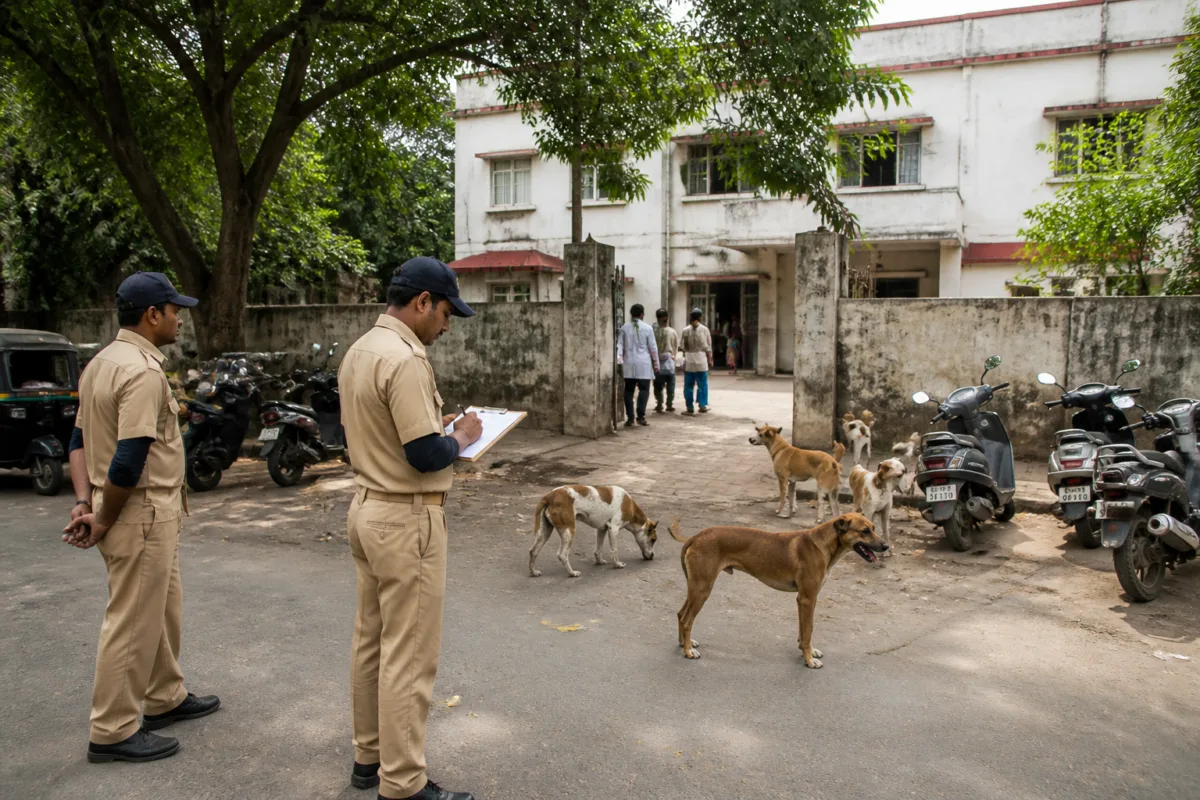
Gujarat’s stray dog control system came under scrutiny in the Gujarat High Court after the court was informed that 13 of the state’s 34 districts do not have Animal Birth Control centres, even as authorities reported inspections across 79,150 public institutions and the appointment of 6,478 nodal officers.
The suo motu proceedings were initiated in line with directions issued by the Supreme Court on the stray dog menace. The Animal Welfare Board, all municipal corporations, municipal commissioners and the National Highways Authority of India, among others, have been made parties to the case.
During the hearing, the court-appointed amicus curiae said that districts without dedicated Animal Birth Control facilities lacked local capacity for sterilisation and related dog-control measures. According to the government’s affidavit cited in court, the state has proposed setting up 29 new Animal Birth Control centres. The proposal includes facilities in districts that currently have none and more than one centre in 12 districts.
The government told the court that it was working on centres designed to remain operational for 30 years. The government advocate also said that animals from districts without such facilities were being transported to centres in nearby districts for sterilisation. Animals from Kheda and Anand, for example, are taken to Vadodara under the current arrangement, according to the submission reported during the hearing.
The state is required to submit reports to the Supreme Court every four months on compliance with its directions, while reports must be placed before the Gujarat High Court every two months. The amicus curiae cautioned that inspections alone would not be sufficient and that institutions needed an operational mechanism to deal with stray dogs on their premises.
The government said it had identified 79,150 institutions where stray dogs could be present. Of these, 7,748 were institutions under urban local bodies and 71,402 belonged to state departments, including schools and other educational facilities, government offices, hospitals and bus depots. A total of 6,478 nodal officers have been appointed to supervise implementation and report local complaints to the authorities.
In Ahmedabad district, 1,150 institutions were identified, including 214 health institutions, 792 educational institutions, 13 transport-related facilities such as bus stands, railway stations and the airport, one court, 43 sports complexes and 87 public spaces. The government reported that stray dogs had been removed from institutions on 105 occasions, while 1,140 institutions had been declared secure. It also reported that 7,130 institutions across the state had no stray dogs during the inspection process.
The hearing also examined the availability of rabies vaccines. The amicus curiae sought details on the quantity of vaccine available in Gujarat, its consumption and the state’s requirement. The government advocate said Ahmedabad had a strong dog-catching system and therefore required fewer vaccine doses. Around 100 units were reported to be sufficient at Ahmedabad’s Asarwa and Sola civil hospitals, while each health centre in the state was stated to have two to three units. Rabies vaccine is included in the essential drug list, the court was told.
The court is expected to take up the status of Animal Birth Control centres in greater detail in a subsequent hearing.

