


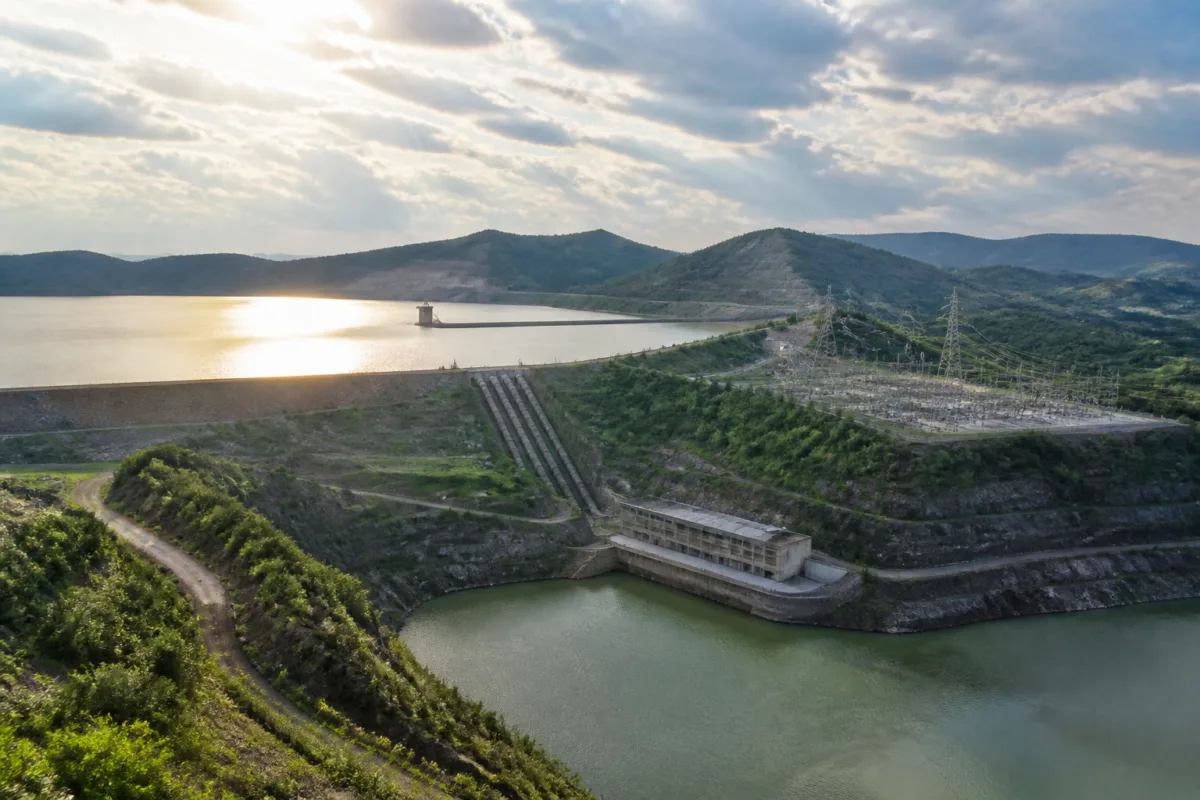
India has identified 345.38 gigawatts of pumped-storage hydropower potential, but only 7.43 GW is currently operational. The gap is becoming more important as solar and wind power expand, creating a national need to store electricity when supply is high and release it when demand rises. The figures, reported with reference to information from the Press Information Bureau and the Central Electricity Authority, point to a central infrastructure challenge: identifying energy-storage potential is considerably easier than converting it into operating projects.
The government has identified 320 pumped-storage projects across the country. Of these, 11 projects with a combined capacity of 15.87 GW are under construction. This means that a relatively small share of the identified potential has moved from assessment to construction, while an even smaller share has reached operation. The difference is not simply a matter of building more generation capacity. Pumped-storage projects require suitable geography, two reservoirs or equivalent water-storage arrangements, tunnels and turbines, transmission connectivity, environmental assessment and clearances.
Pumped storage works like a large rechargeable battery, although its storage medium is water. When electricity is available in excess, pumps move water from a lower reservoir to an upper reservoir. When demand increases, particularly during the evening, the stored water is released through turbines to generate electricity. This arrangement allows the same facility to absorb surplus power at one point in the day and provide dispatchable electricity at another.
That function is increasingly relevant to a power system with a growing share of solar and wind generation. Solar output is concentrated during daylight hours, while electricity demand often increases later in the day. Wind generation can also vary depending on weather conditions. Pumped storage does not eliminate that variability, but it provides a way to shift electricity across time. In practical terms, the issue is not only how much renewable power India can generate, but whether the grid can move and deliver that power when consumers need it.
The reported numbers show the scale of the transition. India has set a target of 500 GW of non-fossil-fuel-based electricity-generation capacity by 2030. As renewable generation expands, storage becomes an increasingly important part of the supporting infrastructure. Without sufficient storage, surplus electricity may not be available when demand rises, while the grid may need other balancing resources to manage fluctuations in generation.
The Central Electricity Authority’s plan identifies an additional 100.81 GW of pumped-storage capacity to be developed by 2035-36. If that target is achieved, the country’s total pumped-storage capacity would reach 105.56 GW. The planned addition is substantially larger than the capacity currently operating, making implementation—not merely resource identification—the decisive stage of the programme.
The gap between identified potential and planned capacity also reveals that not every mapped site will automatically become a viable project. The source material specifically identifies geography, geology, water availability, environmental impacts and transmission connectivity as areas requiring detailed evaluation. Each factor can influence whether a project is technically feasible, financially workable and compatible with the surrounding landscape.
Geography and geology determine whether reservoirs, tunnels and underground structures can be built safely and efficiently. Water availability affects how a project can operate over time, while environmental assessment determines the consequences for land, water systems and surrounding ecosystems. Transmission connectivity is equally important because a storage project has limited value if it cannot absorb surplus power or deliver electricity to the grid when required.
This creates an institutional coordination challenge. Pumped-storage development sits at the intersection of electricity planning, water management, environmental regulation, land and construction approvals, and transmission investment. The project pipeline therefore depends not only on developers and generating utilities, but also on the ability of public authorities to assess sites and process linked permissions without weakening scrutiny.
The government has begun measures intended to support development, including financial assistance for infrastructure, exemptions from transmission charges and faster approval processes. These measures indicate that pumped storage is being treated as a system-level infrastructure requirement rather than only as another generation asset. However, the source does not establish how many projects have received these benefits, how quickly approvals are being processed or whether the measures have resolved the main barriers to construction.
The reported storage requirement provides another measure of the challenge. India’s estimated need for electricity storage capacity is 73.93 GW by 2031-32. Of this, pumped-storage projects are expected to account for 26.69 GW and battery energy-storage systems for 47.24 GW. The figures show that pumped storage is expected to form an important part of the storage mix, but not the entire solution. The energy system will rely on more than one technology and will require planning for how different storage systems operate together.
Regional distribution adds a spatial dimension to the national target. The western region has the highest identified pumped-storage potential at 129.72 GW. Maharashtra accounts for 67.36 GW and Gujarat for 33.36 GW, according to the figures attributed to the Central Electricity Authority. These numbers place western India at the centre of the identified opportunity, but they do not by themselves establish which projects will be built, how electricity will be transmitted or what local environmental and water implications will arise.
The concentration of potential in particular regions may influence future transmission planning and the geography of renewable-energy investment. It also means that the benefits and impacts of the transition will not be distributed evenly. Areas hosting reservoirs, tunnels, powerhouses and transmission infrastructure may experience construction activity and land-use changes, while electricity demand may be located elsewhere. The available report does not provide project-level details, so the local effects cannot yet be assessed individually.
The use of reservoirs outside conventional dam systems is another part of the identified pipeline. The source lists 258 such projects and an aggregate capacity of 288.71 GW in its summary of potential. This reinforces the breadth of the resource assessment, but it also underlines the need to distinguish between theoretical or identified potential and capacity that has secured a site, approvals, financing, a construction schedule and grid access.
For urban India, the storage question is connected to a broader reliability challenge. Cities concentrate households, businesses, public services, transport systems and commercial activity that depend on predictable electricity supply. Evening demand peaks can coincide with the decline in solar generation, making the timing of electricity availability important for urban operations. Pumped storage is not a city-level utility in every case, but its performance can affect the wider grid on which cities depend.
The evidence currently confirms three things. First, India has identified a large pumped-storage resource. Second, operating capacity remains small compared with that potential. Third, the planned expansion is being positioned as support for renewable growth and the 2030 non-fossil capacity target. What remains unclear from the available material is the delivery status of individual projects, their investment requirements, construction timelines, water-use arrangements and environmental outcomes.
The next phase of India’s storage strategy will therefore be measured by how many identified projects move through site assessment, approval, construction and commissioning. The scale of the proposed increase makes those milestones more significant than the size of the initial resource estimate. The Central Electricity Authority’s 2035-36 capacity plan and the government’s stated support measures will be the key institutional reference points as the project pipeline develops.

