


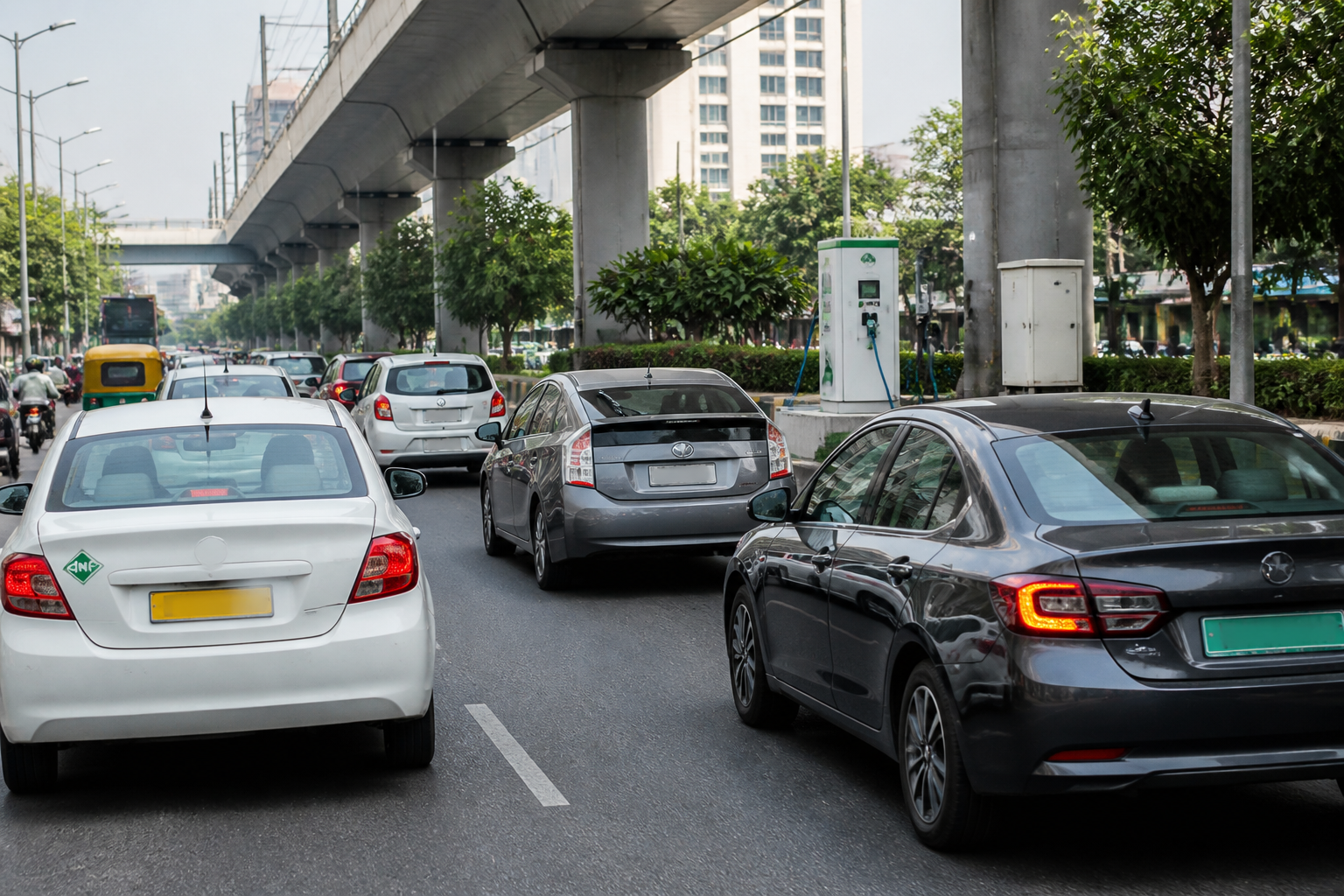
CNG, hybrid and electric vehicles together accounted for 42 per cent of India’s passenger vehicle sales in August 2026, exceeding petrol’s 41 per cent share for the first time, according to an Equirus Securities report cited by The Hindu BusinessLine. The shift marks a change in the composition of the country’s car market, even as overall passenger vehicle retail sales grew 16 per cent year on year after GST rate cuts improved affordability.
The figures do not describe a single transition from petrol to electric vehicles. Instead, they show a broader movement towards alternatives that includes compressed natural gas, hybrids and battery-powered cars. CNG was the largest contributor to this change, reaching a record 25 per cent share in August, while electric vehicles accounted for 7.7 per cent of passenger vehicle sales. Hybrid sales were included in the combined 42 per cent figure, but the supplied report does not provide a separate hybrid share.
That distinction matters. India’s vehicle market is not moving along one uniform path. Consumers appear to be choosing different alternatives according to price, operating conditions, fuel availability and confidence in the technology. The August numbers therefore point to a diversified transition in which CNG, hybrids and EVs are expanding together rather than one technology immediately replacing petrol.
The most immediate evidence of change is the decline in petrol’s market share. Petrol accounted for 46 per cent of passenger vehicle sales in August 2025, falling to 41 per cent a year later. Over the same period, CNG’s share rose from 21 per cent to 25 per cent. The combined position of the cleaner-fuel categories consequently moved ahead of petrol, although the report does not establish whether this shift will persist in subsequent months.
The report attributed part of the movement to buyer hesitation around the E20 transition. E20 refers to petrol blended with up to 20 per cent ethanol. The supplied material does not quantify the number of buyers affected or establish whether concerns were concentrated in particular vehicle segments. It does, however, identify the transition as one factor that may have supported interest in CNG, hybrid and electric vehicles during August.
The demand shift also coincided with stronger overall retail activity. Passenger vehicle retail sales increased 16 per cent year on year in August, with the report linking improved affordability to GST rate cuts. This combination of market expansion and changing fuel preferences complicates the usual account of cleaner mobility: alternatives gained share not only in a stagnant market, but while more vehicles were being sold overall.
Electric vehicles remain a smaller part of the market than CNG, but they recorded the fastest growth among the specific categories for which figures were provided. Electric car sales rose 52 per cent year on year to 30,700 units in August. EV penetration increased from 5.9 per cent in August 2025 to 7.7 per cent in August 2026. The August figure was nevertheless lower than the 8.1 per cent penetration recorded in July 2026, showing that monthly growth can coexist with short-term fluctuations.
The market shares of individual manufacturers also reveal a competitive and uneven EV landscape. Tata Motors accounted for around 43 per cent of electric vehicle sales in August, its highest share since December 2025. That compared with approximately 42 per cent in July 2026 and 41 per cent in August 2025. The report linked the recovery to Tata Motors’ broad electric vehicle portfolio and the recent launch of the Tiago EV.
JSW MG Motor’s share fell to around 15 per cent in August from 28 per cent a year earlier, amid increasing competition, according to the report. Mahindra & Mahindra’s share eased to around 21 per cent from 23 per cent in July. Maruti Suzuki, which recently entered the electric vehicle segment, captured around 5 per cent of the EV market in August. These figures suggest that the electric market is expanding while its competitive structure remains unsettled.
The manufacturer data also shows why a rise in EV penetration cannot be read simply as a broad-based victory for every electric vehicle producer. Tata Motors’ stronger position and Maruti Suzuki’s early share after entering the segment sit alongside declines for other manufacturers. The supplied evidence does not explain the full causes of these changes, but it points to the importance of portfolio breadth, new model launches and intensifying competition.
The regional picture is equally important for understanding how vehicle electrification is developing in Indian cities. Delhi recorded the country’s highest electric car penetration in August at approximately 19 per cent. The report cautioned that the figure was inflated by fleet registrations linked to a VinFast-supplied taxi fleet. Excluding those registrations, Equirus estimated underlying penetration at about 12-14 per cent, still above the national level of 7.7 per cent.
Delhi’s numbers therefore carry two different messages. First, fleet purchases can rapidly change the apparent pace of electric vehicle adoption in a city. Second, even after removing the identified fleet effect, the estimated penetration remains higher than the national average. The supplied material does not identify the reasons for Delhi’s higher underlying rate, so it cannot establish whether the difference reflects policy, charging access, fleet economics, consumer preferences or the composition of local registrations.
For urban infrastructure, the distinction between private vehicles and fleet registrations is significant. A fleet purchase creates concentrated demand that may affect charging provision, vehicle utilisation and registration statistics differently from dispersed household adoption. The report’s Delhi adjustment demonstrates that headline penetration figures need to be read alongside the type of buyer driving registrations. Without that distinction, a city’s electric transition may appear either faster or more representative than it actually is.
The August data also places CNG at the centre of the near-term market transition. With a 25 per cent share, CNG was more prevalent than electric vehicles and formed the largest individual alternative to petrol in the figures supplied. Its growth from 21 per cent a year earlier indicates that consumers are responding to more than the long-term promise of electrification. The evidence does not provide information on CNG station capacity, vehicle running costs, emissions performance or the geographic distribution of CNG demand, so those factors cannot be assessed here.
Hybrids further widen the market’s transition pathway. They are included with CNG and EVs in the 42 per cent combined figure, but no separate sales or penetration number is provided. As a result, the data confirms that hybrids contributed to the collective share of alternatives without showing their independent weight. This is a limitation when assessing which technologies are most responsible for reducing petrol dependence.
The policy landscape visible in the supplied material is therefore indirect rather than fully documented. GST rate cuts are identified as a factor that improved affordability and supported passenger vehicle retail growth. E20-related buyer hesitation is identified as a factor supporting alternatives. The report does not provide details of tax incentives, charging policy, CNG infrastructure programmes, state-level regulations or the responsibilities of urban authorities. Those omissions mean the August figures can describe market movement but cannot establish the complete policy causes behind it.
The data nevertheless raises a wider urban question: how should cities interpret a cleaner vehicle mix when the transition is spread across several technologies? A shift away from petrol may reduce dependence on one fuel type, but the infrastructure implications differ sharply between CNG, hybrid and electric vehicles. CNG requires access to gas-fuelling networks, while EV adoption depends on charging arrangements that serve households, workplaces, fleets and public locations. The supplied report does not measure these systems, but the changing sales mix indicates that demand for them is likely to become more consequential to urban transport planning.
The figures also caution against treating national averages as a complete account of mobility change. Delhi’s reported EV penetration was more than twice the national rate before the fleet adjustment and remained higher after it. At the same time, the national market was led by CNG rather than EVs. This contrast suggests that the character of the transition differs by city and customer group, even though the available evidence is insufficient to rank the causes.
What the August data confirms is a decisive change in the composition of India’s passenger vehicle market. Petrol’s share reached a record low of 41 per cent, while CNG, hybrids and EVs together reached 42 per cent. EV sales and penetration grew from a year earlier, but monthly penetration eased from July, and CNG remained the largest individual alternative identified in the report. What remains uncertain is whether the combined shift will hold, how much of it is driven by E20 concerns or affordability, and how city-level infrastructure will respond. Future monthly sales data, separate hybrid figures and clearer evidence on fleet versus household purchases will be necessary to track whether August represented a temporary crossover or the beginning of a sustained market rebalancing.

