


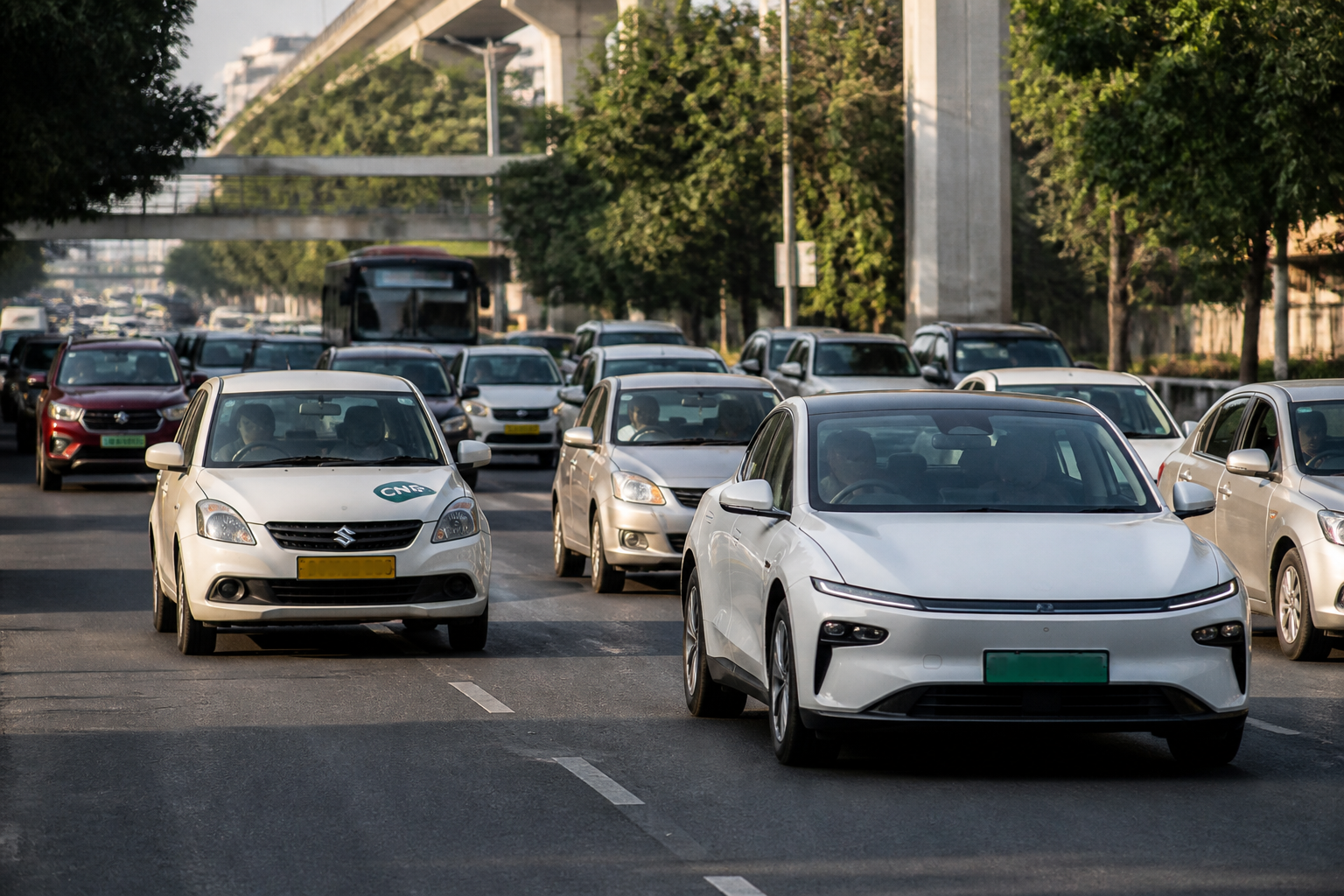
CNG, hybrid and electric vehicles together accounted for 42 per cent of India’s passenger-vehicle sales in August 2026, exceeding petrol’s 41 per cent share for the first time, according to an Equirus Securities report cited by ANI and published by The Times of India. The figures suggest that the country’s car market is entering a more varied transition, but they do not represent a single, uniform move towards electric mobility.
The most immediate change is the decline in petrol’s share. Petrol accounted for 46 per cent of passenger-vehicle sales in August 2025, but fell to a record low of 41 per cent in August 2026. CNG recorded the strongest gain among the alternatives, reaching a record-high 25 per cent, compared with 21 per cent a year earlier. Electric vehicles also expanded rapidly, although from a smaller base, while hybrids contributed to the combined 42 per cent share without a separate figure being provided in the supplied report.
The data comes as overall passenger-vehicle retail sales grew 16 per cent year on year in August. The Equirus report attributed part of that growth to improved affordability following GST rate cuts. This makes the fuel-mix shift important to read alongside broader market expansion: consumers were not only buying more cars, but a larger proportion of those cars used powertrains other than conventional petrol.
The result is a market in which the headline transition away from petrol is being driven by several technologies with different infrastructure, operating and policy requirements. CNG depends on access to refuelling networks. Hybrids continue to use liquid fuel while adding electric assistance. Battery-electric vehicles require charging access and remain more sensitive to the availability of suitable models and supporting infrastructure. The August numbers therefore show diversification of demand rather than the dominance of one replacement technology.
## What the August data reveals
Electric vehicles recorded the fastest year-on-year growth among the specific segments identified in the report. EV sales rose 52 per cent to 30,700 units in August 2026, taking their penetration to 7.7 per cent of the passenger-vehicle market, up from 5.9 per cent a year earlier. However, August’s penetration was below the 8.1 per cent recorded in July 2026. The monthly decline does not erase the annual increase, but it shows that adoption is not moving in a perfectly straight line.
That distinction matters when interpreting market transitions. A higher year-on-year share indicates that EVs are gaining ground compared with the same month last year. A lower monthly share indicates that sales can still fluctuate within a rapidly changing market. The report does not establish whether the July-to-August movement was caused by pricing, model availability, fleet purchases, registration timing or other factors. What it does establish is that EVs have expanded substantially over the year while remaining a minority of total passenger-vehicle sales.
The manufacturer data also points to a competitive market rather than a settled hierarchy. Tata Motors’ EV share recovered to around 43 per cent in August, compared with 42 per cent in July and 41 per cent a year earlier. The report attributed the recovery to Tata’s broad EV portfolio and the recent launch of the Tiago EV. JSW MG Motor’s share fell to around 15 per cent in August from 28 per cent a year earlier, while Mahindra & Mahindra’s share slipped to around 21 per cent from 23 per cent in July. Maruti Suzuki, which has recently entered the EV segment, captured around 5 per cent of the electric-car market.
These figures describe changes in the distribution of EV sales, not necessarily changes in total sales for each company. The supplied material does not provide company-wise unit volumes, so a falling market share cannot by itself be read as an absolute decline. It does, however, show that the arrival of additional models and manufacturers is altering the competitive balance within the electric-car segment.
## Delhi shows the importance of looking beneath headline penetration
Delhi emerged as the leading market for electric cars in August, with reported EV penetration of approximately 19 per cent. The Equirus report cautioned that the figure was inflated by fleet registrations. After excluding VinFast-supplied taxi fleet registrations, it estimated underlying EV penetration at around 12 to 14 per cent. Even the adjusted estimate remained significantly above the national level of 7.7 per cent.
The difference between the headline and adjusted figures illustrates why registration data needs to be examined in context. A city can appear to have unusually high electric-car adoption because a concentrated fleet purchase lifts the total. That does not make the registrations irrelevant: fleet sales are part of the market and can increase the visibility of electric vehicles. But fleet-led demand and private-car demand may reflect different purchasing decisions, operating patterns and infrastructure needs.
For urban authorities, the distinction is particularly important. Fleet registrations may concentrate charging demand in depots or designated operating locations, while private users require more distributed access across homes, workplaces and public facilities. The supplied report does not provide charging-infrastructure data, so it cannot establish whether Delhi’s adjusted penetration is being supported by a comparable expansion in charging access. It does show that the city’s EV market performance is materially shaped by the composition of registrations.
## A transition shaped by uncertainty and affordability
The report identified buyer hesitation around the E20 transition as a factor supporting the shift towards CNG, hybrids and EVs. The statement links consumer choice to uncertainty around the use of higher-ethanol fuel blends, but the supplied material does not quantify the number of buyers affected or establish how much of the August shift can be attributed to that concern. It is therefore best understood as the report’s explanation, rather than a measured causal breakdown of the market.
The larger pattern is clearer. Petrol’s share declined by five percentage points over the year, while CNG gained four percentage points and EV penetration rose by 1.8 percentage points. The combined 42 per cent share of CNG, hybrids and EVs indicates that buyers are using multiple pathways to move away from conventional petrol vehicles. The data does not show whether these choices are being made primarily for operating costs, fuel availability, environmental considerations, technology preferences, product pricing or concerns about petrol vehicles. It confirms the market outcome, not a single consumer motive.
The role of affordability is also significant in interpreting the figures. Overall passenger-vehicle retail sales grew 16 per cent year on year after GST rate cuts improved affordability, according to the report. If a larger market enables more buyers to consider newer powertrains, tax and pricing changes can influence not only how many vehicles are sold but also which technologies gain visibility. At the same time, the supplied material does not separate the effect of GST changes across petrol, CNG, hybrid and electric models.
## The urban implications are broader than vehicle sales
A shift in the passenger-vehicle fuel mix affects more than manufacturers. CNG growth has implications for refuelling networks and gas availability. EV growth raises questions about charging provision, fleet operations and electricity demand. Hybrid growth suggests that some consumers are choosing an intermediate technology rather than moving directly from petrol to battery-electric vehicles. These are distinct systems, and their infrastructure requirements cannot be treated as interchangeable.
The August results also complicate any simple account of India’s vehicle transition. EVs are growing quickly, but their national penetration remains 7.7 per cent. CNG is currently a larger alternative-fuel category at 25 per cent, while hybrids form part of the combined 42 per cent without a separately reported share in the supplied material. The immediate market transition is therefore plural, with different technologies competing and coexisting.
What the evidence confirms is that petrol no longer held the majority share of passenger-vehicle sales in August 2026 when CNG, hybrid and electric vehicles were combined. It also confirms strong annual EV growth, a high but fleet-influenced EV penetration in Delhi, and shifting manufacturer shares within the electric-car market. What remains uncertain is how durable the monthly movement will be, how much demand is private rather than fleet-based, and how the market will divide among CNG, hybrids and EVs in subsequent months. Those are the developments that will determine whether August marks a temporary milestone or the beginning of a sustained rebalancing of India’s car market.
